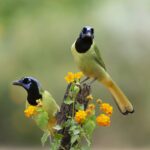
A bird feeder is one of the easiest places to learn bird identification.
Instead of catching a two-second glimpse of a bird disappearing into the trees, you may have several minutes to study it from a window. Birds return to the same perch, feed alongside familiar species, reveal their bills at close range, and often display characteristic behaviors again and again.
That repetition makes a feeder almost like a living bird-identification classroom.
You do not need to memorize every backyard bird before you begin. Start with a few basic clues: size, body shape, bill shape, color pattern, tail, behavior, food choice, and where the bird prefers to feed.
Once you learn the regular visitors, anything unfamiliar becomes much easier to notice.
🐦 Start With Size
Before concentrating on colors, notice the bird’s overall size.
Compare it with familiar feeder birds rather than trying to estimate exact inches.
Is it smaller than a chickadee?
About sparrow-sized?
Closer to a Northern Cardinal?
As large as a Blue Jay?
Dove-sized?
Comparative size is especially useful when several species are feeding at the same time. A House Finch and Northern Cardinal may both have reddish plumage, for example, but the cardinal is larger and more substantial.
Size alone will not identify every bird, but it is an excellent first filter.
👤 Look at the Overall Shape
Next, look at the bird’s proportions.
Is it round and compact or long and slender?
Does it have a large head?
A noticeable crest?
A long tail?
Short legs?
A thick neck?
A bird’s silhouette often remains useful even when lighting makes its colors difficult to judge.
A cardinal’s crest and long tail create a very different outline from the compact shape of a chickadee.
Learning those broad silhouettes makes feeder identification much faster.
👃 Look Closely at the Bill
The bill can tell you a great deal about a feeder visitor.
Finches, sparrows, cardinals, and grosbeaks generally have strong, cone-shaped bills suited to handling seeds.
Woodpeckers have straighter, more chisel-like bills.
Chickadees and nuthatches have smaller pointed bills.
A bird with a heavy triangular bill should therefore send your identification in a different direction from one with a narrow pointed bill.
Notice bill proportions as well.
Is it tiny compared with the head or unusually massive?
A large bill can sometimes be one of the quickest ways to separate otherwise similar birds.
🌻 Notice Which Food the Bird Chooses
Feeders give you an identification clue you rarely get elsewhere: you can see exactly what the bird is eating.
Finches often concentrate on small seeds.
Cardinals readily take sunflower and other larger seeds.
Woodpeckers, nuthatches, and chickadees may visit suet.
Goldfinches are especially associated with nyjer and sunflower.
Hummingbirds visit nectar feeders.
Food preference is not absolute, and birds can surprise you, but it provides useful supporting evidence.
If the appearance, bill shape, and food choice all point toward the same group, your identification becomes much stronger.
🧶 Watch How the Bird Handles Seeds
Two birds may eat the same food in completely different ways.
Finches often remain at a feeder and work seeds through their bills one after another.
A chickadee commonly lands, grabs a single seed, and flies away to handle it somewhere nearby.
Nuthatches may behave similarly, carrying individual seeds away from the feeder.
Blue Jays can collect larger foods and sometimes leave quickly with them.
That feeding rhythm becomes extremely recognizable once you begin watching regularly.
🐤 Learn the Chickadee Feeding Style
Chickadees are among the easiest feeder birds to recognize by behavior.
They often make quick visits.
A chickadee flies in, selects one seed, and leaves almost immediately.
It may carry the seed to a nearby branch, hold it with its feet, and peck it open before returning.
They are small, energetic birds with relatively large heads and short bills.
If a tiny black-capped bird repeatedly darts in and out rather than settling at the feeder, chickadee should be high on your list.
🌻 Learn the Finch Feeding Style
Finches tend to look more comfortable settling in for a meal.
House Finches, American Goldfinches, and related birds may remain perched while feeding on multiple seeds.
Their short, cone-shaped bills are an important clue.
House Finches often occur in groups and may seem relatively sociable around feeders.
American Goldfinches are smaller and can gather in active flocks, particularly around feeders offering nyjer or sunflower.
Watching both the bill and the feeding style helps distinguish them from similarly sized visitors.
❤️ Recognize Northern Cardinals
Northern Cardinals are among the most distinctive feeder birds in much of their range.
Males are famous for their bright red plumage, but female cardinals cause more confusion.
Females are primarily warm brown or tan, with reddish tones in the wings, tail, and crest.
Regardless of sex, look for the prominent crest, long tail, and large orange-red conical bill.
That combination of structure is often enough to recognize a cardinal even when the bird is in shadow.
Cardinals frequently prefer platform-style feeding areas or seeds scattered below feeders, although they also use many conventional feeders.
🔴 Cardinal vs. House Finch
Male Northern Cardinals and male House Finches both contain red, but their patterns and shapes are very different.
A cardinal is larger, has a conspicuous crest, a very heavy bill, and a long tail. An adult male cardinal is extensively red.
A male House Finch is smaller and lacks a crest. Red is generally concentrated around the head and chest rather than covering the entire bird.
Female House Finches are streaky brown birds, while female cardinals are larger, plainer, crested birds with red accents.
Body shape is often more useful than simply asking whether you see red.
🟡 Recognize American Goldfinches
American Goldfinches are familiar visitors to seed feeders.
Breeding males are brilliant yellow with black wings and a black forehead, but their appearance changes outside the breeding season.
Females and winter birds are much duller.
Look for a small finch with a short conical bill, dark wings with pale markings, and an active social manner.
Goldfinches commonly arrive in groups.
Their bouncing, undulating flight can provide another clue when they leave the feeder.
⚫ Recognize Chickadees
Chickadees are small, compact birds with contrasting dark caps and pale cheeks.
Depending on where you live, you may encounter Black-capped Chickadees, Carolina Chickadees, or another regional species.
The basic feeder behavior is often similar: quick visits, individual seeds, and repeated trips between feeder and cover.
Their calls are also extremely useful.
Learning your local chickadee’s voice gives you another way to recognize it before it lands.
🔵 Recognize Blue Jays
Blue Jays are difficult to overlook.
They are much larger than most small feeder songbirds and have a prominent crest, long tail, and substantial bill.
Blue, white, and black plumage provides additional clues.
At feeders, Blue Jays may appear bold and purposeful.
They readily take larger seeds and nuts and may carry food away for later use.
Their size often causes smaller birds to move aside temporarily.
Even in poor light, their proportions and crest make them distinctive.
🕊️ Recognize Mourning Doves
Mourning Doves frequently feed on the ground beneath seed feeders.
They have small heads, plump bodies, and long pointed tails.
Their overall coloration is soft gray-brown rather than boldly patterned.
Instead of clinging to small feeder ports, they commonly walk beneath the feeding area and pick up fallen seed.
Their soft cooing song is another excellent identification clue.
If a dove-like bird flushes from beneath the feeder, watch for the long pointed tail.
🌑 Recognize Dark-Eyed Juncos
Dark-eyed Juncos are particularly common feeder-area birds during the cooler months across much of North America.
They often feed on the ground rather than directly from elevated feeders.
Their appearance varies geographically, but many have dark heads or upperparts contrasting with pale bellies.
One useful feature is the flash of white outer tail feathers when they fly.
Season is an important clue. In many areas, the return of juncos is strongly associated with fall and winter.
🪶 Learn the Sparrows
Small brown birds around feeders are often labeled simply as “sparrows,” but several different species may be present.
Instead of trying to memorize every brown marking, begin with structure.
Look at the crown, face pattern, breast streaking, bill color, tail length, and overall proportions.
Then notice where the bird feeds.
Some sparrows spend considerable time scratching or hopping on the ground beneath the feeder.
Season and geographic location are extremely helpful because the likely sparrow species change throughout the year.
🏠 House Sparrow Identification
House Sparrows are common around buildings and feeders in many settled areas.
Adult males have gray crowns, chestnut on the head, and black around the throat and upper chest.
Females and young birds are much plainer brown.
Their bills are thick and conical.
House Sparrows frequently gather in groups and may spend extended periods around feeding stations.
For beginners, females can easily become generic “little brown birds,” so pay attention to the face pattern, bill, flocking behavior, and setting.
🟤 House Finch Identification
House Finches are another extremely common feeder visitor.
Males usually show reddish coloration around the forehead, face, throat, and upper chest, while females are brown and heavily streaked.
Both sexes have short, conical bills.
Female House Finches can be confused with sparrows because both may appear streaky and brown.
Look carefully at the face. Many sparrows have more distinct head stripes or other facial patterns, whereas female House Finches tend to have a plainer face combined with extensive streaking.
🪵 Recognize Downy Woodpeckers
Downy Woodpeckers commonly visit suet feeders.
They are small black-and-white woodpeckers with a short bill.
Males have a small red patch on the back of the head, while females lack it.
They can cling vertically to suet cages and other feeder structures using their specialized feet and stiff tail feathers.
Their compact size is important because they closely resemble Hairy Woodpeckers.
🪵 Downy vs. Hairy Woodpecker
Downy and Hairy Woodpeckers can appear remarkably similar.
Bill proportion is one of the best clues.
The Downy’s bill looks relatively short compared with the head.
The Hairy’s is much longer and more substantial.
Hairy Woodpeckers are also larger overall, but size can be difficult to judge unless another bird or the feeder itself provides a reference.
A familiar feeder can actually help because you know the dimensions of its ports, cage, or perch.
🙃 Recognize White-Breasted Nuthatches
White-breasted Nuthatches are entertaining feeder visitors.
They have blue-gray upperparts, white underparts, dark caps, and relatively long pointed bills.
Behavior can identify them even more quickly.
Nuthatches move along trunks and branches in unusual positions and are famous for traveling headfirst down trees.
At feeders, they often grab food and leave rather than remaining in one place.
If the bird lands almost upside down, pay attention.
🟠 Recognize Tufted Titmice
Tufted Titmice are slightly larger than chickadees and have noticeable crests.
They are generally gray above and pale below, with warm rusty or peach-colored flanks.
Their eyes can look particularly large and dark against the pale face.
Like chickadees, titmice frequently take individual seeds and carry them elsewhere.
A crest plus the quick grab-and-go feeding style can make identification relatively straightforward.
🔴 Recognize Red-Bellied Woodpeckers
Red-bellied Woodpeckers are larger than Downy Woodpeckers and show bold black-and-white barring across the back.
Adults have bright red on the head, with the exact pattern differing between males and females.
Despite the name, the red on the belly can be surprisingly difficult to see.
Do not depend on that field mark.
At a feeder, the barred back, substantial size, climbing posture, and red head markings are generally more useful.
🐦 Look Beneath the Feeder
Do not concentrate only on the feeder itself.
Some of your most interesting visitors may spend more time underneath it.
Doves, juncos, sparrows, towhees, blackbirds, and other birds take advantage of seeds knocked to the ground.
Watching the ground can also reveal feeding behaviors that are harder to see at a hanging feeder.
A towhee vigorously scratching through leaves, for example, immediately looks different from a dove calmly picking individual seeds from the surface.
🍂 Watch for Scratching Birds
Some ground-feeding birds deliberately kick leaves or debris aside.
Towhees are particularly well known for energetic two-footed scratching.
Sparrows may scratch too.
If a bird under your feeder seems to be throwing leaves behind itself while looking for food, that behavior is worth remembering.
Sometimes the movement identifies the group before you obtain a clear view of the plumage.
🧁 Watch the Suet Feeder Separately
A suet feeder attracts a somewhat different collection of birds from an ordinary seed feeder.
Woodpeckers are among the most obvious visitors.
Nuthatches, chickadees, wrens, and other birds may also investigate suet depending on location and season.
Watch how the bird holds itself on the cage.
Woodpeckers typically brace themselves vertically.
Smaller songbirds may cling from different angles.
The feeder type itself provides context for what you are likely to see.
🌻 Watch a Nyjer Feeder Separately
Nyjer feeders are especially associated with small finches.
American Goldfinches are common users across much of North America, and Pine Siskins or other finches may appear depending on region and season.
The tiny ports and small seed favor birds able to cling comfortably and manipulate the food.
If an unfamiliar little bird appears among goldfinches, compare it carefully with the birds around it.
Size, streaking, bill shape, wing markings, and flock behavior can reveal whether you have a different finch mixed into the group.
🌸 Hummingbird Feeders Require Different Clues
Identification at a hummingbird feeder works differently because nearly every visitor has the same basic hovering feeding strategy.
Concentrate on size, bill length, tail shape, gorget or throat pattern, back color, wing sounds, and behavior.
Females and immature hummingbirds can be particularly challenging.
Location becomes extremely important because the likely species vary dramatically across North America.
Do not identify every green hummingbird as the same species without checking range.
👥 Watch How Birds Interact
A feeder also gives you a front-row view of bird social behavior.
Some species feed peacefully together.
Others chase competitors immediately.
A bird may raise its crest, lean forward, spread its wings, open its bill, or lunge at another visitor.
Dominance can even help you notice size differences that were not obvious before.
Behavior should not be treated as an infallible species marker, but repeated social patterns add another layer of evidence.
😠 Aggression Doesn’t Always Mean a Different Species
Two birds that look slightly different may simply be male and female members of the same species.
Likewise, birds of one species may aggressively chase one another.
Do not assume that different behavior automatically means different species.
Instead, compare their structure carefully.
Sex, age, season, and individual temperament all affect how birds behave at feeders.
🐣 Remember Females and Juveniles
Feeder identification becomes much easier once you expect birds to look different from the most colorful illustration in a field guide.
Male and female plumages can differ dramatically.
Juveniles may be streakier, duller, or differently patterned from adults.
Northern Cardinals provide a classic example: the male is brilliant red, while the female is primarily brownish.
Young birds visiting feeders in summer can create additional confusion.
Always compare a mystery bird with female and juvenile plumages as well as adult males.
🍂 Season Can Change Plumage
Birds do not necessarily look the same throughout the year.
American Goldfinch males are dramatically bright during the breeding season but much duller in winter.
Other species experience subtler seasonal changes.
Feather wear can also affect brightness and patterns.
If a feeder bird looks almost—but not quite—like a familiar species, check whether seasonal plumage could explain the difference.
📅 Season Changes Which Birds Visit
The species at your feeder may also change throughout the year.
Some birds remain year-round.
Others appear primarily during winter.
Migrants may stop briefly in spring or fall.
Irruptive species can appear unexpectedly in some winters and be largely absent in others.
Keeping track of seasonal changes is one of the best ways to improve feeder identification.
Eventually you begin expecting particular arrivals.
🗺️ Location Matters
A feeder in Maine, Oklahoma, Arizona, and Oregon will not attract exactly the same bird community.
Even very familiar groups can contain different regional species.
For example, which chickadee, jay, towhee, hummingbird, or sparrow you are likely to see depends partly on geography.
Always compare your identification with the bird’s expected range.
An appearance-based match becomes much less convincing if the species almost never occurs where you live.
🏘️ Habitat Around the Feeder Matters Too
The surrounding yard changes which birds are likely to visit.
A feeder beside mature woodland may attract different species from one in a treeless urban area.
Dense shrubs may encourage sparrows, towhees, and other cover-loving birds.
Large trees provide places for woodpeckers, nuthatches, chickadees, and jays.
Nearby water can change the community again.
The feeder is only one part of the habitat.
When identifying an unfamiliar visitor, consider what surrounds it.
🎵 Listen While You Watch
A feeder offers an excellent opportunity to connect birds with their sounds.
You already know where the bird is.
That makes it much easier to determine which individual is calling.
Listen for chickadee calls, cardinal whistles, jay cries, nuthatch notes, goldfinch flight calls, and woodpecker sounds while you can see the bird making them.
This combination of sight and sound builds recognition much faster than listening to recordings in isolation.
🪽 Watch the Bird Leave
Do not stop observing when a bird flies away.
Takeoff can reveal additional identification clues.
Look for white in the wings or tail.
Notice whether the flight is direct or undulating.
Watch the tail shape.
See whether the bird flies straight into dense cover, climbs toward the treetops, or drops immediately to the ground.
Sometimes the field mark you needed appears only after the bird leaves the feeder.
📸 Take Photos Even If They Aren’t Perfect
Feeder birds are excellent photography subjects because they repeatedly return to predictable locations.
A photograph allows you to examine field marks later.
Look at the bill, crown, eye line, wingbars, breast pattern, tail, and feet.
Do not delete a picture simply because it is not beautiful.
A blurry identification photo may still contain exactly the information you need.
Photographing several angles is especially useful.
🎥 Video Can Capture Behavior
A short video can sometimes be more useful than a photograph.
It preserves how the bird moves and feeds.
You may notice that the mystery bird repeatedly grabs one seed and leaves, clings upside down, scratches beneath the feeder, or chases every other visitor away.
Those behavioral clues can be lost in a still image.
Video also captures calls that you may not have consciously noticed while watching.
📱 Treat Automated Bird IDs as Suggestions
Smart bird feeders and identification apps can be fun and helpful.
They can also be wrong.
Poor lighting, unusual angles, obstructed views, female or juvenile plumage, and closely related species can all confuse automated recognition.
Treat the suggested identification as a place to begin.
Then compare the bird’s size, shape, bill, markings, behavior, location, and season with reliable references.
The goal is to learn why the identification makes sense rather than simply accepting a label.
📝 Keep a Feeder Bird List
A simple list of regular feeder visitors can make unfamiliar birds much easier to recognize.
You might eventually know that your usual visitors include cardinals, chickadees, House Finches, Downy Woodpeckers, Mourning Doves, and Blue Jays.
Then one morning a bird appears that is smaller than the cardinal, larger than the chickadee, streakier than the finch, and behaving differently from all of them.
Because you know the normal cast of characters, the newcomer immediately stands out.
You do not need elaborate records. A simple dated list is enough.
🔍 Describe the Bird Before Naming It
When an unfamiliar visitor appears, describe what you see before jumping to a conclusion.
Try something like:
Sparrow-sized, brown and streaky, thick conical bill, feeding on the platform with several similar birds.
Or:
Small black-and-white bird, short pointed bill, clinging vertically to the suet cage.
Or:
Medium-sized tan bird, noticeable crest, huge orange bill, red in wings and tail.
Descriptions like these contain actual evidence.
A vague impression such as “some kind of finch” is much harder to evaluate.
🧩 Use Several Clues Together
The most dependable identification rarely rests on one field mark.
Imagine a bird that is red.
That is not enough.
But suppose the bird is robin-sized, has a tall crest, large orange conical bill, long tail, and is eating sunflower seeds.
Now the possibilities are dramatically narrower.
Try to collect three or four independent clues.
Size + shape + bill + behavior is often more reliable than color alone.
🪟 Learn From the Same Birds Repeatedly
One of the greatest advantages of feeder birding is repetition.
A bird that was confusing on Monday may return Tuesday.
And Wednesday.
And every morning for the next month.
You can observe it in sunlight, shadow, rain, different postures, and different interactions with other birds.
Over time, you stop needing to consciously check every field mark.
You simply recognize the bird.
That familiarity is the foundation for becoming better at identifying birds everywhere else.
🌱 Start With the Common Birds
You do not need to identify every unusual visitor immediately.
Begin with five or ten species that appear regularly.
Learn their size, silhouette, bills, favorite feeding positions, calls, and behavior.
Once those become familiar, add another species.
A feeder full of anonymous birds gradually turns into a community of individuals you recognize.
And when something genuinely unusual appears, you will know immediately that it does not belong to the usual group.
⭐ A Bird Feeder Is an Identification Classroom
A feeder brings some of the best bird-identification clues together in one place.
You can compare species side by side.
You can see bill shapes close up.
You can watch different feeding techniques.
You can learn male, female, juvenile, breeding, and winter plumages.
You can hear calls while watching the bird that produces them.
And you can observe the same species repeatedly until recognition becomes automatic.
Start with size and shape. Look at the bill and tail. Notice where the bird feeds and what food it chooses. Watch how it behaves around other birds. Consider season and location, and listen to its voice.
You do not need to identify every visitor instantly.
The feeder will probably give you another chance tomorrow.
🔗 Related Articles
- Bird Identification: How to Identify the Birds You See
- Backyard Birding: How to Attract, Feed & Enjoy Birds at Home
- Bird Feeder Cameras: How They Work, Features & Setup Guide
- Yellow and Black Birds: Identification Guide With Photos
- Birds With Red Chests: Identification Guide
📚 Sources & Further Reading
- Cornell Lab Bird Academy — Feeder Birds: Identification and Behavior
- National Audubon Society — Bird Feeding and Care
- National Audubon Society — How to Identify Birds
- National Audubon Society — Get to Know These 20 Common Birds
- National Audubon Society — How to Identify Birds: 8 Clues From Kenn Kaufman