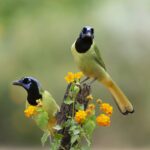
Sometimes the easiest way to identify a bird is to stop looking at its colors and watch what it is doing.
A small bird may be hopping beneath leaves, hanging upside down from a branch, darting into the air after insects, hammering at tree bark, probing mud, diving beneath the water, or hovering beside a flower. Those feeding behaviors can reveal the bird’s identity even when distance, poor lighting, or confusing plumage makes traditional field marks difficult to see.
Different birds have evolved different ways of finding food, and many species repeat those behaviors so consistently that experienced birders recognize them almost immediately.
Learning a handful of common foraging styles can therefore make bird identification much easier.
👀 Start by Watching Before You Identify
When you see an unfamiliar bird, resist the urge to immediately open a field guide or identification app.
Watch it for a few moments first.
Where is it feeding?
On the ground? On a tree trunk? In the upper canopy? On the surface of the water? Underwater?
Then notice how it obtains its food.
Does it peck, scratch, probe, hover, dive, chase, glean, or sit still and wait?
A few seconds of observation can sometimes narrow your mystery bird more effectively than studying tiny feather markings.
🌱 Ground Feeding
Many birds spend much of their feeding time on the ground.
Sparrows, towhees, thrushes, blackbirds, doves, juncos, and other birds frequently search lawns, fields, forest floors, and leaf litter.
But they do not all feed in the same way.
Some walk steadily.
Others hop.
Some pick food directly from the surface, while others move leaves and debris to uncover hidden insects or seeds.
The location and movement of the bird together provide useful clues.
🍂 Scratching Through Leaf Litter
Towhees are famous for their energetic scratching behavior.
A feeding towhee may jump slightly forward and then rapidly kick both feet backward, throwing leaves aside to expose insects and seeds underneath.
Some sparrows and other ground-feeding birds scratch through litter as well.
If you hear dry leaves flying around beneath dense shrubs, look carefully.
The movement may reveal the bird before you ever see its plumage.
🪱 Thrushes Searching the Ground
Many thrushes forage primarily on or near the ground.
An American Robin often moves across a lawn in short bursts, stopping and tilting its head before grabbing an earthworm or other prey.
Wood Thrushes and related species search through forest-floor vegetation for insects and other small foods.
Their upright bodies and deliberate ground movements can help separate them from similarly sized birds that spend most of their time in trees.
🌻 Seed-Cracking Birds
Finches, sparrows, cardinals, grosbeaks, and several other birds regularly feed on seeds.
Instead of swallowing every seed whole, many use their strong bills to manipulate, crack, or remove the outer hull.
Watch a finch carefully at a feeder.
It may remain in one spot while repeatedly working seeds through its bill.
This contrasts with species such as chickadees, which often grab a single seed and immediately carry it elsewhere.
Feeding style at a backyard feeder can therefore be a useful identification clue.
🐦 Grab-and-Go Feeder Birds
Black-capped Chickadees and related species often behave very differently from finches at a feeder.
A chickadee may arrive quickly, select one seed, and immediately fly to a nearby branch.
There it can hold or manipulate the seed while eating it.
Then it returns for another.
Once you recognize that rapid grab-and-go pattern, you may begin noticing chickadees by behavior before you see their head markings clearly.
🌰 Birds That Cache Food
Some birds do not immediately eat everything they collect.
They store food for later.
Blue Jays, chickadees, nuthatches, Clark’s Nutcrackers, Acorn Woodpeckers, and other species can cache seeds, nuts, or other foods.
A bird may grab an acorn, fly away, wedge it into bark or bury it, and then return for another.
Watching a bird repeatedly transport food without eating it can therefore become an identification clue as well as a fascinating glimpse into its behavior.
🌳 Gleaning From Leaves
Gleaning means taking insects or other small prey directly from the surface of leaves, twigs, bark, or other vegetation.
Warblers, vireos, chickadees, kinglets, and many other small birds use variations of this technique.
A gleaning bird may methodically inspect leaves and branches, picking tiny insects from the vegetation as it moves.
Because these birds can be difficult to see among foliage, feeding behavior may sometimes be easier to follow than their plumage.
🍃 Warblers in the Foliage
Many warblers move actively through leaves while searching for insects.
They may hop rapidly between twigs, inspect the undersides of leaves, stretch toward prey, or briefly flutter into difficult positions.
Different species prefer different portions of a tree.
Some forage relatively low.
Others remain high in the canopy.
Even when several warbler species look frustratingly similar, where and how they feed can help narrow the possibilities.
🌿 Vireos Feeding More Deliberately
Vireos also glean insects from foliage, but their movements often appear more deliberate than the frantic activity of many warblers.
A vireo may move slowly through a tree, carefully inspecting leaves before shifting to another perch.
That slower pace can become a useful behavioral distinction.
Instead of trying to identify every small greenish bird from color alone, notice how quickly it moves and how it searches the foliage.
🪽 Hover Gleaning
Some birds briefly hover in front of a leaf, branch, or other surface while picking prey from it.
This behavior is known as hover gleaning.
Kinglets, some flycatchers, hummingbirds, and other birds may use versions of this technique.
A small bird repeatedly hovering beside leaves may therefore belong to a different group from one that stays perched while feeding.
Pay attention to whether the bird actually catches prey in midair or merely uses flight to reach food attached to vegetation.
🪰 Sallying From a Perch
Flycatchers provide one of the most recognizable feeding styles.
A flycatcher may sit quietly on an exposed branch, fence, post, or wire.
Suddenly it launches into the air, catches an insect, and returns to the same perch or one nearby.
This behavior is called sallying or flycatching.
Once you learn it, an otherwise plain gray or brown bird can become much easier to identify.
The perch-and-return pattern is often more revealing than plumage.
🐦 Other Birds Can Flycatch Too
Flycatchers are not the only birds that catch insects in midair.
Some woodpeckers, warblers, vireos, bluebirds, and other species may also fly out after insects.
Lewis’s Woodpecker is a particularly interesting example because it frequently catches insects in the air rather than feeding only by pecking wood.
Therefore, a single feeding action does not automatically prove a bird belongs to a particular family.
Look for repeated behavior and combine it with shape, bill, habitat, and voice.
🌬️ Continuous Aerial Feeding
Swallows and swifts take aerial feeding even further.
Rather than repeatedly returning to a perch, they may remain in flight for extended periods while chasing flying insects.
They swoop, turn, climb, and dive almost continuously.
A flock of streamlined birds weaving back and forth above a field, pond, or wetland is therefore behaving very differently from flycatchers sitting individually on exposed perches.
That difference alone can quickly narrow the identification.
🌸 Hummingbirds Feeding at Flowers
Few feeding behaviors are as recognizable as a hummingbird hovering beside a flower.
The bird remains almost stationary while inserting its long bill into blossoms to reach nectar.
It may visit several flowers in rapid succession before darting away.
Hummingbirds also eat insects and may catch them in flight or pick them from vegetation, so nectar feeding is not their only behavior.
Still, sustained hovering at tubular flowers is one of the strongest behavioral clues in North American bird identification.
🪵 Bark-Climbing Birds
A bird moving vertically along a tree trunk belongs to a relatively small group.
Woodpeckers are the most familiar examples.
They use strong feet and stiff tail feathers to brace themselves against bark while searching for insects.
Their movement along trunks and large branches can make them recognizable even when the bird is partly hidden.
If you see a black-and-white bird clinging vertically to a tree, behavior may narrow the identification before you examine its markings.
🔨 Woodpeckers Excavating for Food
Woodpeckers may tap, chip, pry, probe, or excavate bark and wood while looking for insects.
Some species dig deeply.
Others spend more time picking food from the surface.
Downy Woodpeckers can search trunks, small branches, twigs, shrubs, and even weed stems for insects.
Watching where on the tree a woodpecker feeds can therefore provide additional clues.
Different woodpecker species frequently use somewhat different parts of the same habitat.
🙃 Nuthatches Moving Headfirst
Nuthatches also search tree trunks and branches for insects, but their movements are distinctive.
They frequently move downward headfirst.
A small bird confidently walking down a tree trunk in this way should immediately suggest a nuthatch.
Woodpeckers generally climb upward or maneuver differently along the bark.
Behavior can therefore separate two groups that may occupy exactly the same tree.
🌳 Brown Creepers Working Upward
Brown Creepers offer yet another bark-foraging style.
They typically begin low on a tree trunk and spiral upward while probing bark for insects.
After reaching a higher point, they often fly down to the base of another tree and start the process again.
The combination of tiny size, bark-colored plumage, curved bill, and upward creeping behavior is highly distinctive.
Watching the direction of movement can therefore become an identification clue.
🏖️ Surface-Picking Shorebirds
Many shorebirds feed by picking visible prey directly from the surface of sand, mud, or shallow water.
Plovers are particularly associated with a run-stop-peck feeding strategy.
A bird may run several steps, suddenly stop, locate prey visually, peck, and then move again.
This contrasts with shorebirds that walk more continuously while probing beneath the surface.
Feeding style can help separate birds that otherwise share similar brown, gray, and white plumage.
🏃 Sanderlings Chasing Waves
Sanderlings provide one of the most entertaining feeding behaviors to learn.
On ocean beaches, they often race toward retreating water to pick up small prey exposed by the wave.
When the next wave approaches, they rapidly run back up the beach.
Then they follow the water outward again.
Once you become familiar with this constant back-and-forth movement, Sanderlings can become recognizable from surprisingly far away.
🪶 Probing Shorebirds
Dowitchers, snipes, godwits, sandpipers, and other shorebirds may probe mud or sand with long bills.
Some insert the bill deeply and repeatedly.
Others make shorter probing movements.
Notice both the depth and speed of the action.
A dowitcher feeding rapidly with repeated deep probing can look almost like a sewing machine.
A different shorebird may walk steadily and make occasional shallow probes.
These differences can be extremely useful when several similar species share the same mudflat.
↔️ Sweeping Bills Through Water
Some birds search for prey by sweeping their bills from side to side.
American Avocets are well-known for sweeping their long, upturned bills through shallow water while walking.
Roseate Spoonbills also move their unusually shaped bills through water while feeding.
This kind of repeated side-to-side movement is much more distinctive than simply noting that the bird is a long-legged wader.
🐟 Herons Stalking Prey
Herons and egrets often feed with patience.
A Great Blue Heron may stand almost motionless in shallow water before slowly moving forward.
Then the bird suddenly strikes with its long bill.
That combination of stillness, slow stalking, and explosive attack is extremely characteristic.
Even at a distance, a tall bird creeping through shallow water and waiting for fish is likely to belong to a very different group from a shorebird rapidly probing the mud.
👟 Foot-Stirring and Other Heron Tricks
Not all herons simply stand and wait.
Some actively stir water or vegetation with their feet to disturb prey.
Others spread their wings to change lighting conditions around the water or chase prey more actively.
These variations are useful reminders that species can have several feeding techniques.
Look for the behavior the bird repeats most consistently rather than treating one unusual action as definitive.
🌊 Dabbling Ducks
Dabbling ducks feed primarily at or near the water’s surface.
A familiar behavior is tipping forward so the head and front of the body disappear underwater while the tail points into the air.
Mallards and many related ducks use this technique.
They may also skim food from the surface or reach underwater without completely submerging.
When you see a duck repeatedly tipping tail-up rather than diving entirely beneath the surface, you have a useful clue to its general group.
🤿 Diving Ducks
Diving ducks disappear completely underwater while feeding.
Species such as scaup, mergansers, eiders, and many other diving ducks may remain submerged for significant periods before resurfacing somewhere nearby.
The contrast with dabbling ducks is easy to learn.
Watch the entire bird.
If the tail remains visible while the head is underwater, think dabbling.
If the whole bird vanishes beneath the surface, you are watching a diving strategy.
🌊 Loons and Grebes Diving
Loons and grebes are also accomplished underwater hunters.
They dive from the surface and use their bodies and feet to pursue fish and other aquatic prey.
A bird repeatedly disappearing beneath a lake and resurfacing several yards away may therefore belong to one of several diving groups.
Body shape, bill shape, swimming posture, habitat, and plumage help narrow the options.
Feeding behavior gets you into the right neighborhood.
🖤 Cormorants Underwater
Cormorants dive and pursue prey underwater as well.
They often swim low in the water before submerging.
After feeding, cormorants are famous for perching with their wings extended.
That behavior is not feeding itself, but seeing a diving bird later standing on a rock or branch with its wings spread can reinforce the identification.
Bird behavior is most powerful when you watch the entire sequence rather than a single moment.
🦆 Mergansers Chasing Fish
Mergansers are ducks specialized for catching fish and other aquatic prey.
They have narrow bills and frequently dive beneath the surface.
Their active fishing behavior contrasts with the slower surface feeding of many dabbling ducks.
If a sleek duck repeatedly dives in open water, the feeding style should encourage you to examine the bill and body proportions more closely.
🐦 Kingfishers Plunge for Fish
A Belted Kingfisher often watches the water from an exposed perch.
When it spots prey, it may fly out and plunge toward the surface to catch a fish.
The bird then returns to a perch.
That sequence—watching from above, diving toward water, and returning—is one of the most distinctive feeding patterns around rivers, ponds, and lakes.
You may notice the behavior before you hear the kingfisher’s rattling call or see its markings.
🌊 Plunge-Diving Birds
Pelicans, terns, gannets, and several other birds catch fish by diving from the air.
The exact technique varies dramatically.
A tern may hover briefly before dropping toward the surface.
A Brown Pelican can plunge spectacularly from much greater height.
Watching how high a bird begins its dive, whether it fully enters the water, and how it emerges can help narrow its identity.
✂️ Skimming the Water
Black Skimmers use one of the strangest feeding methods of any North American bird.
They fly low above relatively calm water with the elongated lower portion of the bill cutting through the surface.
When the bill contacts prey, the bird snaps it shut.
A bird feeding this way is so distinctive that behavior may provide the identification almost instantly.
🦅 Raptors Hunting From Perches
Many hawks hunt by watching from an elevated position.
A Red-tailed Hawk may sit on a tree, utility pole, fence post, or other high perch while scanning the ground.
When prey appears, the hawk drops or flies toward it.
This wait-and-strike strategy contrasts with raptors that actively patrol large areas.
A large raptor repeatedly using roadside poles is therefore giving you behavioral information even before it takes flight.
🌾 Harriers Flying Low Over Fields
Northern Harriers use a very different hunting strategy.
They frequently fly low over marshes, fields, and grasslands while searching for prey.
Their wings are often held in a shallow V, and their flight can appear buoyant.
A long-winged raptor cruising only a few feet above an open landscape suggests a different identification from a buteo circling high overhead.
Feeding behavior and flight style overlap here in a very useful way.
🦅 Falcons Pursuing Birds
Falcons may chase flying birds or other prey through the air.
Peregrine Falcons are famous for high-speed aerial hunting.
Merlins can pursue small birds with fast, direct flight.
American Kestrels frequently hunt insects and small vertebrates from perches and may hover above open ground.
Because these species all belong to the same general family yet use somewhat different hunting patterns, behavior can even help narrow identification within a group.
🪂 Hovering Over Open Ground
A bird hovering in place above a field deserves attention.
American Kestrels sometimes hover while hunting.
White-tailed Kites are also well known for hovering.
Northern Harriers can occasionally pause in the air during hunting.
The silhouette, size, habitat, and wing position can then help you determine which hovering predator you are seeing.
🐛 Following Other Animals
Some birds use larger animals to help uncover food.
Cattle Egrets may follow livestock or machinery through fields, grabbing insects disturbed by the movement.
Other birds may follow mammals, farm equipment, or even people when those activities expose food.
When a bird seems unusually interested in the feet of grazing animals or newly disturbed ground, feeding opportunity may explain the association.
🐜 Anting and Unusual Behaviors
Not everything a bird does with an insect is feeding.
Some birds perform “anting,” in which they rub ants through their feathers or allow ants to move through the plumage.
Birds also manipulate prey, wipe bills, carry food to young, or store food.
Before interpreting a behavior as feeding, watch what happens next.
Did the bird actually swallow the item?
Did it hide it?
Did it carry it toward a nest?
Context matters.
🐣 Adults Carrying Food
During the breeding season, birds may repeatedly collect food and fly in the same direction.
This can indicate that they are feeding nestlings or fledglings.
A bird carrying an insect in its bill rather than immediately swallowing it may be returning to young.
Avoid following the bird closely or approaching a nest.
You can still use the behavior as a clue while observing from a respectful distance.
🌲 Feeding Height Matters
Where a bird feeds can be almost as useful as how it feeds.
Some species spend most of their time on the ground.
Others feed in shrubs, along trunks, among outer branches, or at the very top of the canopy.
Two similar-looking songbirds may consistently use different vertical zones within the same forest.
When recording a mystery bird, note not just the tree species but where within the tree the bird was feeding.
🏡 Feeding Behavior at Backyard Feeders
Backyard feeders provide an excellent place to practice behavioral identification.
Watch which birds remain on the feeder and which immediately leave.
Notice which species prefer the ground beneath it.
See who clings to the side of a suet cage, hangs upside down, cracks seeds in place, or carries food into nearby cover.
Because familiar birds return repeatedly, you can watch the same behaviors until they become instantly recognizable.
🌻 Food Choice Can Help Too
The type of food a bird selects can provide another clue.
Finches and cardinals frequently take seeds.
Woodpeckers may be attracted to suet.
Hummingbirds visit nectar feeders.
Fruit-eating birds may gather around berry-producing shrubs and trees.
However, diets are rarely absolute.
A bird that usually eats seeds may also consume insects, while a hummingbird that drinks nectar also needs animal prey.
Use food choice as supporting evidence rather than as the only identification criterion.
🍂 Feeding Behavior Changes With the Seasons
Bird diets and feeding strategies can change during the year.
A species that relies heavily on insects during summer may switch toward seeds, fruit, or stored food in winter.
Migration can also place birds in unfamiliar habitats where they take advantage of temporary food sources.
Do not reject an identification solely because a bird is eating something unexpected.
Instead, ask whether the behavior is known to occur seasonally or opportunistically.
👥 Watch Whether Birds Feed Alone or in Flocks
Social behavior around food is another clue.
Some species commonly forage alone.
Others gather into large feeding flocks.
Winter chickadees, nuthatches, kinglets, and woodpeckers may travel together in mixed-species groups.
Blackbirds can gather in enormous numbers.
Shorebirds may feed shoulder to shoulder across mudflats.
The company a bird keeps can therefore help identify it.
🧩 Mixed-Species Feeding Flocks
Mixed flocks are especially interesting because different species can search the same habitat in different ways.
One bird may inspect bark.
Another searches the undersides of leaves.
Another catches insects in flight.
Because each species uses a slightly different feeding niche, several can move through the same area without doing exactly the same thing.
Watching these differences side by side is one of the best ways to learn bird behavior.
📸 Video Is Especially Helpful
Still photographs preserve plumage and shape, but feeding behavior is movement.
If possible, take a short video of an unfamiliar bird.
A few seconds may record whether it scratches, probes, hovers, dives, returns to a perch, pumps its tail, or moves headfirst down a trunk.
Those behavioral clues can be easier to interpret later than a single photograph.
Even a shaky phone video can be useful.
📝 Describe What the Bird Did
Before trying to identify a mystery bird, write down the behavior in plain language.
For example:
Small bird repeatedly flew from the same fence post to catch insects.
Long-legged bird stood motionless in shallow water and suddenly struck at a fish.
Tiny shorebird ran after every retreating wave.
Black-and-white bird climbed small tree branches and pecked at bark.
Duck tipped forward with its tail sticking straight up.
Descriptions like these often point toward a much smaller set of birds.
🔍 Don’t Use Feeding Behavior Alone
Behavior is powerful, but birds are flexible.
A woodpecker may catch insects in midair.
A hummingbird may hunt insects away from flowers.
A normally tree-feeding bird may descend to the ground.
Weather, season, food availability, migration, and individual opportunity can all lead to unusual behavior.
Use feeding style to narrow the identification, then confirm it with size, silhouette, bill shape, tail, plumage, habitat, range, season, flight, and sound.
Several clues pointing toward the same bird are much stronger than one.
🌱 Practice With Familiar Birds
You can learn feeding behavior without traveling anywhere special.
Watch an American Robin on a lawn.
Study a chickadee at a feeder.
Follow a Downy Woodpecker around a tree.
Watch a hummingbird visit flowers.
Observe ducks at a pond.
Notice what a sparrow does beneath shrubs.
Because you already recognize these common birds, you can concentrate on how they feed.
Those behaviors then become reference points for unfamiliar birds.
⭐ Behavior Makes Birds Easier to Recognize
Eventually, feeding behavior begins to feel almost like another field mark.
A bird is no longer simply “small and brown.”
It is the small brown bird scratching violently beneath leaves.
Another is the small gray bird launching from a fence post and returning after each insect.
Another creeps down a tree headfirst.
Another races after waves.
Another disappears beneath the water.
Those movements give birds personality, but they also give birders information.
The next time you encounter an unfamiliar bird, spend a few moments watching before reaching for the field guide.
Ask where it is feeding, how it finds food, how it moves while searching, and what it does once it finds something.
Sometimes the bird will tell you what it is simply by having breakfast.
🔗 Related Articles
- Bird Identification: How to Identify the Birds You See
- Downy Woodpecker
- Hummingbirds: Species, Identification, Feeding & Backyard Guide
- Identifying Sandpiper Birds: A Practical Guide to Shorebird ID
- Bird Species Guide
📚 Sources & Further Reading
- Cornell Lab of Ornithology — Bird ID Skills: Behavior
- Cornell Lab Bird Academy — Inside Birding: Understanding Behavior
- Cornell Lab Bird Academy — Birds Foraging at the Waterside
- Cornell Lab Bird Academy — Bird Academy’s A-to-Z Glossary of Bird Terms
- National Audubon Society — How to Identify Birds
- National Audubon Society — How to Identify Birds: 8 Clues From Kenn Kaufman