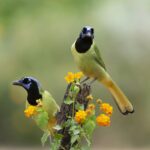
Yellow and black is one of the most eye-catching color combinations in the bird world. A flash of brilliant yellow against dark wings can make a bird stand out instantly at a feeder, in a meadow, or high in the treetops.
But color alone rarely tells the whole story.
A tiny American Goldfinch and a stocky Evening Grosbeak can both appear yellow, black, and white, yet they differ dramatically in size, bill shape, behavior, and habitat. Other birds use black in completely different ways: the Common Yellowthroat wears a bold black mask, the Wilson’s Warbler has a small black cap, and the Yellow-headed Blackbird reverses the pattern with a golden head on an almost entirely black body.
This guide covers some of the most recognizable yellow and black birds of North America, along with the field marks that can help you identify them from a photo or a brief sighting.
🔍 Quick Yellow and Black Bird Identification Chart
| Bird | Best Identification Clue | Size | Where to Look |
|---|---|---|---|
| American Goldfinch | Bright yellow body, black forehead and wings | Small | Backyards, fields, roadsides |
| Lesser Goldfinch | Black cap, yellow belly, bold white wing patch | Small | Western U.S., scrub, gardens |
| Evening Grosbeak | Huge bill, yellow eyebrow, black-and-white wings | Medium | Forests, winter feeders |
| Yellow-headed Blackbird | Entire head and chest bright yellow | Medium-large | Marshes, cattails, farm fields |
| Scott’s Oriole | Black head and chest with lemon-yellow belly | Medium | Southwestern foothills and yucca |
| Hooded Oriole | Yellow-orange body with black throat and wings | Medium | Southwest, palms, open woodland |
| Western Tanager | Yellow body, black wings, red-orange head | Medium | Western coniferous forests |
| Common Yellowthroat | Yellow throat with black facial mask | Small | Marshes and dense thickets |
| Wilson’s Warbler | Yellow body with small black cap | Very small | Wet thickets and woodland edges |
| Magnolia Warbler | Yellow breast with bold black necklace | Very small | Forests, especially during migration |
| Eastern Meadowlark | Yellow breast with black V | Medium | Eastern grasslands and fields |
| Western Meadowlark | Yellow breast with black V | Medium | Western grasslands and prairies |
🐤 1. American Goldfinch

Few North American birds fit the description “yellow bird with black wings” as perfectly as the American Goldfinch (Spinus tristis).
Breeding males become brilliant lemon yellow during spring and summer. They have a black forehead, black wings with white markings, and black tails edged with white. The contrast can be spectacular when a male lands on a seed head or backyard feeder.
Females are much less dramatic. During the breeding season they are generally olive above and yellowish below, while winter goldfinches of both sexes become considerably duller.
American Goldfinches are small birds with short, conical bills and a distinctive bouncing flight pattern. They are especially common around open fields, weedy roadsides, gardens, and backyards.
📸 Photo ID Clues
Look for:
- Bright yellow body on breeding males
- Small black forehead
- Black wings with white markings
- Short, pointed, conical bill
- Small overall size
- Notched tail
- Bouncy, undulating flight
If the yellow-and-black bird in your photo is small and visiting a seed feeder, the American Goldfinch should be high on your list.
🐦 2. Lesser Goldfinch

The Lesser Goldfinch (Spinus psaltria) can easily be confused with the American Goldfinch, particularly in the western United States.
Adult males have bright yellow underparts, a glossy black cap, dark wings, and conspicuous white wing patches. Depending on where they occur, males may have either a dark black back or a greener back.
Females and immature birds are much duller, with olive backs and subdued yellow underparts.
One of the best identification clues is the Lesser Goldfinch’s combination of a black cap and prominent white markings on the wings.
📸 Photo ID Clues
Look for:
- Glossy black cap on adult males
- Bright yellow belly
- White patch in dark wings
- Small, compact finch shape
- Short conical bill
Lesser Goldfinches are especially associated with western and southwestern North America, where they frequent brushy areas, open woodland, gardens, and feeders.
🌲 3. Evening Grosbeak

If your mystery bird looks like an oversized goldfinch with an enormous bill, you may have found an Evening Grosbeak (Hesperiphona vespertina).
Adult males are striking combinations of yellow, black, and white. Their heads are dark, with a bright yellow stripe above the eye. The body is largely yellow, while the wings contain conspicuous black and white patches.
The bill is the giveaway.
Evening Grosbeaks have massive, powerful, pale-colored bills designed for crushing seeds. They are also considerably larger and heavier than goldfinches.
Females and immature males look quite different, appearing mostly gray with black-and-white wings and touches of yellow or greenish yellow.
These northern birds are famous for occasionally appearing far south of their usual range during winter movements. When that happens, flocks may descend on backyard feeders.
📸 Photo ID Clues
Look for:
- Very thick, powerful bill
- Yellow eyebrow
- Dark head
- Yellow body
- Large white wing patches
- Heavy, chunky build
A bird with this color combination plus an unusually massive bill is much more likely to be an Evening Grosbeak than a goldfinch.
Learn more in our guide to the Evening Grosbeak.
🖤 4. Yellow-headed Blackbird

There is little chance of mistaking an adult male Yellow-headed Blackbird (Xanthocephalus xanthocephalus) once you get a good look at one.
Its head and upper chest are brilliant golden yellow while virtually the entire rest of the body is black. Males also show white wing patches, particularly noticeable in flight.
Females look quite different. They are mostly brownish, with considerably duller yellow around the head and chest.
Yellow-headed Blackbirds are birds of marshes and wetlands, particularly across western and prairie regions of North America. During winter and migration they may join large mixed flocks of blackbirds feeding in agricultural fields.
📸 Photo ID Clues
Look for:
- Entire head bright yellow
- Yellow upper breast
- Otherwise black body
- White wing patch on males
- Large, stocky blackbird shape
- Long, pointed bill
If you see a black bird that appears to be wearing a brilliant yellow hood, this is the species to check first.
🌵 5. Scott’s Oriole

The Scott’s Oriole (Icterus parisorum) provides one of the most dramatic black-and-yellow patterns among North American orioles.
Adult males have a velvety black head, back, throat, and upper chest contrasted with a vivid lemon-yellow belly. Yellow also appears on the shoulders and rump, while white markings cross the wings.
Scott’s Orioles are birds of the arid Southwest. They are strongly associated with desert foothills, yucca country, pinyon-juniper woodland, and other dry landscapes.
Females are less contrasting, tending toward yellowish olive with darker wings.
📸 Photo ID Clues
Look for:
- Entire head black
- Black throat and upper chest
- Lemon-yellow belly
- Long tail
- Pointed oriole bill
- White markings on wings
- Southwestern desert or foothill habitat
The location of the black is important. A Scott’s Oriole has much more extensive black on the head and chest than a goldfinch.
🌴 6. Hooded Oriole

Another spectacular southwestern bird is the Hooded Oriole (Icterus cucullatus).
Adult males may range from bright yellow to rich orange depending on geographic region. They have dark wings and tails, along with a black throat that extends around the eye.
Hooded Orioles are long and slender compared with finches. Their slightly curved, pointed bills are also very different from the short seed-cracking bills of goldfinches.
They are often associated with open woodland and palm trees, including ornamental palms planted in parks and residential neighborhoods.
📸 Photo ID Clues
Look for:
- Yellow or orange body
- Black throat
- Black around the eye
- Dark wings and tail
- White wingbar
- Long, slender body
- Slightly curved bill
A yellow bird hanging among palm fronds in the Southwest deserves a careful look for Hooded Oriole.
🔥 7. Western Tanager

The Western Tanager (Piranga ludoviciana) adds a third dramatic color to the yellow-and-black combination.
Breeding males have a bright yellow body, black wings, dark back and tail, and a striking orange-red head. White and yellow wingbars provide additional contrast.
Females are much less colorful and generally appear yellowish green with darker wings.
Western Tanagers breed primarily in coniferous forests across western North America. During migration they may appear in many kinds of wooded habitat, including parks and backyards.
📸 Photo ID Clues
Look for:
- Bright yellow body
- Black wings and back
- Orange-red head on breeding males
- Two noticeable wingbars
- Medium-sized, stocky songbird shape
If your photograph shows a yellow-and-black bird with a fiery red or orange face, the Western Tanager is one of the best possibilities.
🎭 8. Common Yellowthroat

Rather than having black wings, the male Common Yellowthroat (Geothlypis trichas) concentrates its black feathers into one unmistakable feature: a mask.
Adult males have a broad black band across the face, giving them a masked appearance. Their throat and underparts are bright yellow while the upperparts are olive.
Females lack the black mask and are much more subdued.
Common Yellowthroats spend much of their time low in dense vegetation, where they can be frustratingly difficult to see. Marsh edges, wet fields, brushy areas, and tangled vegetation are all good places to find them.
📸 Photo ID Clues
Look for:
- Broad black mask
- Yellow throat
- Yellow underparts
- Olive back
- Small, round-bodied warbler shape
- Dense, low vegetation
A tiny yellow bird with what looks like a black superhero mask is very likely a male Common Yellowthroat.
🟡 9. Wilson’s Warbler

A male Wilson’s Warbler (Cardellina pusilla) looks almost as though someone placed a tiny black cap on an otherwise yellow bird.
The bird is bright yellow below and yellowish olive above. Adult males have a distinct patch of black feathers on the crown.
Females usually lack the bold black cap, although some can show a smaller dark patch.
Wilson’s Warblers are restless little birds that often remain in low vegetation. They occur in wet thickets, willow stands, streamside habitat, woodland edges, and other shrubby areas.
📸 Photo ID Clues
Look for:
- Very small size
- Bright yellow face and underparts
- Small black cap on adult male
- Olive back
- Thin insect-eating bill
- Dark, beadlike eye
Compare the cap carefully with a Lesser Goldfinch. A Wilson’s Warbler has a much thinner bill and lacks the bold black wings and white wing patches of the goldfinch.
🌿 10. Magnolia Warbler

During spring migration, few warblers are more striking than a male Magnolia Warbler (Setophaga magnolia).
Adult males have yellow underparts covered with distinctive black streaks that radiate downward from a dark chest band, creating a necklace-like pattern. The face includes black markings, while the back is largely dark and the wings show a large white patch.
Females and immature birds are considerably more subdued.
Magnolia Warblers breed primarily in northern forests and are seen across much of eastern North America during migration.
📸 Photo ID Clues
Look for:
- Bright yellow underparts
- Bold black streaks across chest and sides
- Black facial markings on males
- Dark back
- White wing patch
- White undertail with a black-tipped tail
The unusual tail pattern can be especially helpful when the chest markings are difficult to see.
🌾 11. Eastern Meadowlark

The Eastern Meadowlark (Sturnella magna) is not entirely black and yellow, but its most visible field marks often create that impression.
The underparts are brilliant yellow, crossed by a bold black V on the chest. The back is intricately patterned with brown and black, helping the bird disappear almost completely when it walks through grass.
Eastern Meadowlarks live primarily in grasslands, pastures, farm fields, and other open habitats.
📸 Photo ID Clues
Look for:
- Large yellow breast
- Bold black V across chest
- Brown-and-black patterned back
- Long, pointed bill
- Short tail
- Robin-sized body
- Grassland setting
🎶 12. Western Meadowlark

The Western Meadowlark (Sturnella neglecta) looks extremely similar to its eastern counterpart.
It also has brilliant yellow underparts, a bold black V across the chest, streaked brown-and-black upperparts, and white outer tail feathers.
The two species overlap in portions of central North America, and plumage alone may not always provide a confident identification. Geography, vocalizations, facial pattern, and subtle plumage details become especially important where both species occur.
📸 Photo ID Clues
Look for:
- Yellow breast
- Black V-shaped chest marking
- Brown patterned back
- Long, slender bill
- Short tail
- Open prairie or grassland habitat
For meadowlarks, song is often more useful than color when separating Eastern from Western birds.
🆚 American Goldfinch vs. Lesser Goldfinch
These are two of the easiest yellow-and-black birds to confuse.
A breeding male American Goldfinch usually has a bright yellow body with a small black forehead, while the Lesser Goldfinch has a larger black cap covering the crown.
Also check the wings.
The Lesser Goldfinch tends to show a conspicuous white wing patch, while the American Goldfinch has black wings crossed by white markings.
Geography helps too. Lesser Goldfinches are primarily western birds, while American Goldfinches are widespread across much of North America.
🆚 Goldfinch vs. Evening Grosbeak
Color can make these birds look surprisingly similar in photographs, but their proportions are dramatically different.
An American Goldfinch is a tiny, lightweight finch.
An Evening Grosbeak is much larger and more heavily built, with an enormous seed-crushing bill.
Think:
Small bird + tiny bill + bright yellow = Goldfinch
Large bird + massive bill + yellow, black and white = Evening Grosbeak
🆚 Scott’s Oriole vs. Hooded Oriole
Both species can appear yellow and black and both occur in the American Southwest.
The adult male Scott’s Oriole has an extensively black head, throat, chest, and back, leaving the lower body strongly yellow.
A Hooded Oriole has a yellow or orange hood and body, with the black concentrated primarily around the throat, face, wings, and tail.
Habitat can also provide a clue. Scott’s Orioles are strongly associated with yuccas and dry foothills, while Hooded Orioles are frequently found around palms and open woodland.
🆚 Wilson’s Warbler vs. Common Yellowthroat
Both are tiny warblers with extensive yellow plumage.
The location of the black solves the mystery.
A male Wilson’s Warbler has a black cap on top of its head.
A male Common Yellowthroat has a black mask across its face.
Both birds often stay low in thick vegetation, so even a brief glimpse of the head can be enough for identification.
📏 Size Matters More Than You Think
Yellow and black plumage immediately attracts attention, but one of the best ways to identify these birds is to temporarily ignore the colors.
Ask yourself how large the bird is.
A Wilson’s Warbler or goldfinch is tiny. An oriole is noticeably longer. A meadowlark is about robin-sized, while a Yellow-headed Blackbird is a substantial, stocky bird.
Also compare the bill.
A goldfinch has a small conical bill for eating seeds. An Evening Grosbeak has a huge crushing bill. A warbler has a narrow insect-catching bill. An oriole has a longer, sharply pointed bill.
These structural clues often identify a bird more reliably than color alone.
🍂 Remember That Plumage Changes
A bird photographed in May may look surprisingly different from the same species photographed in January.
American Goldfinches provide a classic example. Breeding males are intensely yellow and black, while winter birds become much duller and browner.
Age and sex matter as well.
In many species, adult males display the strongest yellow-and-black contrast. Females and immature birds may be olive, brown, gray, or muted yellow.
That means a bird that does not perfectly match a photograph in a field guide is not necessarily a different species.
🗺️ Location Can Narrow the Possibilities
Where you saw the bird can eliminate many possibilities.
A yellow-and-black bird at a thistle feeder in the eastern United States could easily be an American Goldfinch.
A large yellow-headed bird sitting among cattails in a western marsh suggests a Yellow-headed Blackbird.
A black-and-yellow bird among yuccas in Arizona or New Mexico points toward Scott’s Oriole.
A tiny masked bird calling from thick vegetation beside a wetland could be a Common Yellowthroat.
Identification becomes much easier when color, shape, habitat, geographic range, season, and behavior are considered together.
For more help, start with our Bird Identification Guide.
🌻 Which Yellow and Black Birds Visit Feeders?
American Goldfinches are among the most likely yellow-and-black birds to appear regularly at backyard feeders. They readily eat small seeds and are especially well known for visiting feeders stocked with nyjer or sunflower.
Lesser Goldfinches also visit feeders within their range.
Evening Grosbeaks sometimes become spectacular feeder visitors during winter movements. Their large bills allow them to handle sunflower seeds with ease, and flocks can consume impressive quantities when they arrive.
Orioles may also visit yards, although their diet and feeding behavior differ considerably from those of seed-eating finches.
Creating a bird-friendly yard with native plants, water, shelter, and several natural food sources can attract a much wider variety of birds than feeders alone.

📸 How to Identify a Yellow and Black Bird From a Photo
When examining a photograph, work through the bird systematically rather than relying only on its most obvious color.
Check:
- Overall size — tiny, sparrow-sized, robin-sized, or larger?
- Bill — thick and conical, huge and heavy, or thin and pointed?
- Head — black cap, black mask, yellow head, or orange-red head?
- Wings — entirely dark, white wingbars, or large white patches?
- Chest — solid yellow, black bib, black V, or black streaking?
- Tail — short, long, notched, or marked with white?
- Habitat — feeder, marsh, forest, desert, brush, or grassland?
- Location — eastern, western, northern, southwestern?
- Season — breeding plumage and winter plumage can be very different.
These clues are far more useful together than any single feature.
❓ Frequently Asked Questions
What is the most common yellow bird with black wings?
In much of North America, the American Goldfinch is one of the most familiar possibilities. Breeding males are brilliant yellow with black wings and a black forehead.
What bird is yellow with a black head?
Several species fit that description. A Scott’s Oriole has an extensively black head and chest with a yellow belly, while a male Wilson’s Warbler has a small black cap. Lesser Goldfinches also have black on the crown.
Size, bill shape, and location will help distinguish them.
What bird is black with a yellow head?
The Yellow-headed Blackbird is the standout North American example. Adult males have a vivid yellow head and chest contrasting sharply with a black body.
What small yellow bird has a black mask?
The male Common Yellowthroat is famous for its broad black facial mask and bright yellow throat.
What yellow bird has a black cap?
A male Wilson’s Warbler has a distinct black cap on top of an otherwise yellow-and-olive head and body. Male Lesser Goldfinches also have black caps, but their finch-shaped bills and dark wings make them easy to separate with a good view.
What yellow bird has a black V on its chest?
Both Eastern and Western Meadowlarks have bright yellow underparts crossed by a prominent black V.
What yellow and black bird has a red head?
A breeding male Western Tanager is the most likely North American match. It combines a yellow body and black wings with a brilliant orange-red head.
What yellow and black bird has a huge bill?
An Evening Grosbeak is a strong possibility. Adult males combine yellow, black, and white plumage with an exceptionally large, powerful bill.
Are female yellow and black birds less colorful?
Often, yes. In many species—including goldfinches, orioles, grosbeaks, and several warblers—adult males display stronger yellow-and-black contrasts while females tend to be olive, brownish, gray, or more muted yellow.

❤️ Final Thoughts
A yellow-and-black bird may initially seem easy to identify, but North America is home to a surprisingly diverse collection of birds that use these colors.
The trick is to look beyond the colors themselves.
A black forehead may indicate an American Goldfinch. A black cap could point toward a Lesser Goldfinch or Wilson’s Warbler. A black mask suggests a Common Yellowthroat. A massive yellow head belongs to an entirely different bird—the Yellow-headed Blackbird.
Once you combine those markings with size, bill shape, habitat, location, season, and behavior, the mystery usually becomes much easier to solve.
And that is part of the fun of bird identification: sometimes one little patch of black or yellow is all it takes to turn an unfamiliar bird into a species you will recognize for years to come.
🔗 Related Articles
📚 Sources
- Cornell Lab of Ornithology — Four Keys to Bird Identification
- Cornell Lab of Ornithology — American Goldfinch
- Cornell Lab of Ornithology — Lesser Goldfinch
- Cornell Lab of Ornithology — Evening Grosbeak
- Cornell Lab of Ornithology — Yellow-headed Blackbird
- Cornell Lab of Ornithology — Scott’s Oriole
- Cornell Lab of Ornithology — Hooded Oriole
- Cornell Lab of Ornithology — Western Tanager
- Cornell Lab of Ornithology — Common Yellowthroat
- Cornell Lab of Ornithology — Wilson’s Warbler
- Cornell Lab of Ornithology — Magnolia Warbler
- Cornell Lab of Ornithology — Eastern Meadowlark
- Cornell Lab of Ornithology — Western Meadowlark