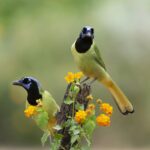
The Evening Grosbeak is one of North America’s most dramatic finches. With an oversized bill, bold white wing patches, and flashes of yellow and black, an adult male can look almost tropical when it lands at a snowy winter bird feeder. Females are more subdued, but their combination of gray, olive, yellow, black, and white makes them distinctive in their own right.
What makes the Evening Grosbeak (Hesperiphona vespertina) especially exciting for birdwatchers is its unpredictability. These birds do not follow the same simple migration schedule every year. Instead, they can remain relatively scarce in an area for several winters and then suddenly appear in large, noisy flocks when food conditions encourage them to wander south.
Once famous for descending on backyard feeders by the dozens, Evening Grosbeaks have experienced serious long-term population declines. Seeing one today can therefore feel like more than an ordinary backyard bird encounter—it is a glimpse of a spectacular northern finch whose future deserves attention.
🔬 Scientific Classification
| Classification | Evening Grosbeak |
|---|---|
| Kingdom | Animalia |
| Phylum | Chordata |
| Class | Aves |
| Order | Passeriformes |
| Family | Fringillidae |
| Genus | Hesperiphona |
| Species | Hesperiphona vespertina |
The Evening Grosbeak belongs to the finch family, Fringillidae, which also includes familiar birds such as goldfinches, siskins, redpolls, crossbills, and several other grosbeaks.
Some older references and government conservation documents list the species as Coccothraustes vespertinus. Current references including the Cornell Lab of Ornithology and BirdLife International use Hesperiphona vespertina, which is the scientific name used throughout this guide.
⚡ Evening Grosbeak Fast Facts
| Fact | Details |
|---|---|
| Scientific name | Hesperiphona vespertina |
| Family | Fringillidae |
| Length | About 6.7–8.3 in (17–21 cm) |
| Wingspan | About 11.8–14.2 in (30–36 cm) |
| Weight | About 1.9–2.8 oz (55–80 g) |
| Range | Canada, United States, and Mexico |
| Primary habitat | Coniferous and mixed forests |
| Diet | Seeds, buds, berries, fruits, and insects |
| Favorite feeder food | Sunflower seeds |
| Clutch size | Usually 3–4 eggs; sometimes 2–5 |
| Incubation | About 11–14 days |
| Conservation status | Vulnerable globally; Special Concern in Canada |
| Distinctive feature | Massive pale bill and bold white wing patches |
| Migration | Irregular and highly irruptive |
👀 How to Identify an Evening Grosbeak
The easiest feature to notice on an Evening Grosbeak is often its bill.
It is enormous for the bird’s size—thick, triangular, and powerful enough to crack large, hard seeds. The chunky body, relatively short tail, pointed wings, and striking wing patches add to its unmistakable appearance.
Evening Grosbeaks are approximately the size of a large finch or small robin. Their proportions can make them look particularly heavy-bodied when sitting at a platform feeder.
The sexes look noticeably different, making male and female identification relatively straightforward once you know what to look for.

💛 Male Evening Grosbeak Identification
Adult males are among the most colorful finches in North America.
Look for a combination of:
- Bright yellow forehead and eyebrow
- Dark brown to nearly black head
- Brilliant yellow neck, shoulders, and underparts
- Black wings
- Large white wing patches
- Black tail
- Very large pale bill
The yellow eyebrow sweeping across the forehead gives the bird an almost fierce expression.
When a male spreads its wings, the broad white patches contrast dramatically with the black flight feathers. Against a snowy landscape or dark evergreen forest, the combination of gold, black, and white is especially striking.
The bill can also change somewhat in appearance seasonally, becoming greenish during spring.
🩶 Female Evening Grosbeak Identification
Female Evening Grosbeaks are much less brightly colored than males, but they are far from plain.
Their plumage is primarily soft gray, brownish-gray, and olive, often with yellowish tones around the neck and sides. The wings are dark with conspicuous white markings, and the tail is dark.
The female also possesses the species’ characteristic oversized triangular bill.
Useful female field marks include:
- Gray to olive-brown body
- Pale gray underparts
- Yellowish wash around the neck
- Black-and-white wings
- Large pale bill
- Chunky finch-like shape
A female at first glance might be mistaken for another large finch, but the combination of the massive bill and dramatic wing pattern is an excellent clue.
🐣 What Does a Juvenile Evening Grosbeak Look Like?
Young Evening Grosbeaks generally resemble females more than adult males.
Their colors are softer and less sharply defined, and young males gradually acquire the stronger yellow, black, and brown pattern associated with adulthood.
Because females and immature males can look similar, determining the exact age and sex of some birds may be difficult during brief observations.
For everyday backyard identification, concentrate first on the overall shape, huge bill, white wing patches, and flocking behavior.
🗺️ Evening Grosbeak Range
Evening Grosbeaks are native to North America.
Their breeding range is strongly associated with the great coniferous and mixed forests of Canada, along with mountainous forests of the western United States. The species also breeds south into high-elevation forests of Mexico.
During winter, however, their distribution becomes much less predictable.
Some Evening Grosbeaks remain relatively close to their breeding range. Others travel considerable distances, sometimes appearing far south of where birdwatchers normally expect to see them.
This irregular movement is one reason the species can seem abundant one year and almost completely absent the next.
❄️ What Is an Evening Grosbeak Irruption?
Evening Grosbeaks are famous for irruptions.
An irruption occurs when unusually large numbers of birds move beyond their typical seasonal range, often because natural food supplies fluctuate.
Northern seed-eating birds depend heavily on crops of cones, tree seeds, berries, and other foods that can vary dramatically from year to year. When those resources are poor or become exhausted, birds may wander hundreds of miles in search of better feeding opportunities.
During a major Evening Grosbeak irruption, birdwatchers well south of the species’ normal breeding areas may suddenly encounter flocks at feeders, parks, woodlands, and roadside trees.
In another winter, the same location might see none.
That unpredictability is part of what makes an Evening Grosbeak sighting so exciting.
🌲 Evening Grosbeak Habitat
During the breeding season, Evening Grosbeaks are primarily forest birds.
They favor coniferous and mixed forests and are frequently associated with trees such as spruce, fir, and pine. In portions of Canada, researchers have also found important associations with mature or older mixedwood forests.
In western North America, they occur in mountainous conifer forests. Farther north and east, they are closely connected with the boreal forest.
Winter habitat can be much more varied.
Evening Grosbeaks may appear in:
- Coniferous forests
- Mixed woodlands
- Deciduous groves
- Forest edges
- Parks
- Suburban neighborhoods
- Areas containing maples and box elders
- Backyards with well-stocked feeders
Their willingness to visit human feeding stations has made them a favorite winter bird for generations.
🌻 What Do Evening Grosbeaks Eat?
The extraordinary bill of an Evening Grosbeak tells you a great deal about its diet.
These birds are powerful seed specialists capable of crushing foods that much smaller finches cannot open.
Their natural diet includes seeds from trees such as:
- Box elder
- Maple
- Ash
- Elm
- Locust
They also consume buds, berries, small fruits, and weed seeds.
During the warmer months, insects become more important.
Evening Grosbeaks are particularly notable for feeding on spruce budworms. Large numbers of grosbeaks can gather where these caterpillars become abundant, making the birds useful predators of an important forest insect.
The seasonal change is fascinating: a bird that spends winter cracking hard seeds can become a determined caterpillar hunter during summer.

🏡 How to Attract Evening Grosbeaks to Your Backyard
There is no guaranteed way to attract an Evening Grosbeak because the birds may simply not occur in your area during a particular winter.
If they are nearby, however, a good feeding setup can greatly improve your chances.
Offer Sunflower Seeds
Sunflower seeds are one of the best foods for Evening Grosbeaks.
Their enormous bills handle the shells with ease, and a flock may consume a remarkable amount of seed once it discovers a reliable feeding station.
Black-oil sunflower seeds are an excellent starting choice.
Use a Platform or Large Hopper Feeder
Evening Grosbeaks are considerably larger and heavier than small feeder finches.
A sturdy platform feeder provides plenty of room for them to land and feed comfortably. Large hopper feeders can also work when the feeding ledge gives these chunky birds enough space.
Small feeders designed primarily for goldfinches may be awkward or unsuitable.
Expect a Crowd
Evening Grosbeaks are highly social outside the breeding season.
Finding one can quickly turn into finding ten, twenty, or even more.
A large flock can empty a feeder surprisingly quickly, so birdwatchers experiencing an irruption may suddenly find themselves buying substantially more sunflower seed than usual.
Keep Feeders Clean
Large congregations of birds can increase opportunities for disease transmission.
Clean feeders regularly, remove wet or spoiled seed, and keep areas beneath feeding stations from becoming heavily contaminated with old food and waste.
A good backyard bird habitat should support birds without unnecessarily concentrating them in unhealthy conditions.
🪟 Make Your Yard Safer for Grosbeaks
One unfortunate consequence of attracting Evening Grosbeaks to yards is their vulnerability to window collisions.
Because they often travel in flocks and visit feeding stations near homes, windows can pose a serious hazard.
Bird-safe window treatments can reduce reflections that birds mistake for open habitat. Effective approaches generally involve placing visible patterns on the outside surface of problematic glass rather than relying only on interior decorations.
Feeder placement can also make a difference.
Evening Grosbeaks are magnificent feeder visitors, but attracting them responsibly means thinking about safety as well as food.
🎵 Evening Grosbeak Calls and Sounds
Despite being classified as a songbird, the Evening Grosbeak is unusual because it does not have the elaborate territorial song associated with many other passerines.
Instead, these birds communicate largely through a variety of calls.
Their vocalizations can sound:
- Sharp
- Ringing
- Chirping
- Burry
- Whistled
The constant calling of a flock can actually be one of the best ways to detect Evening Grosbeaks.
In forest habitat, you may hear the birds before you see them moving through the canopy.
Learning their calls can therefore be extremely useful when searching for the species during winter or migration.
🌳 Evening Grosbeak Behavior
Outside the nesting season, Evening Grosbeaks are strongly social.
They frequently travel and forage in flocks, moving between productive trees or gathering at feeding stations.
Much of their feeding takes place in trees and shrubs, although they also descend to the ground.
Their heavy bills allow them to exploit foods unavailable to many smaller birds. Cornell notes that small finches may even take advantage of seed fragments left behind after grosbeaks crack large seeds.
During summer, Evening Grosbeaks become less conspicuous. Breeding birds often remain high in forest trees, travel in smaller groups, and make less noise than the bustling winter flocks familiar to feeder watchers.
🪺 Nesting and Breeding
Evening Grosbeak nesting behavior can be surprisingly difficult to observe.
Pairs breed primarily in northern and mountain forests, often constructing their nests well above the ground.
The female builds a relatively loose cup nest using materials such as:
- Small twigs
- Rootlets
- Grasses
- Moss
- Pine needles
Nests are generally positioned on a horizontal tree branch or within a fork.
A typical clutch contains three or four eggs, although two to five are possible. The eggs are usually pale blue or blue-green with darker blotches.
The female performs the incubation, which lasts approximately 11 to 14 days. The male may bring food to her during this period.
After hatching, both parents feed the nestlings.
Young birds typically leave the nest roughly two weeks after hatching.
💕 Evening Grosbeak Courtship
Evening Grosbeaks may not sing elaborate songs to impress potential mates, but they do have courtship behaviors.
A male may raise his head and tail, lower and vibrate his wings, and move from side to side in front of a female. Males may also feed females during courtship.
Pairs have additionally been observed bowing toward one another.
These relatively subtle displays are much harder to see than the spectacular winter feeding flocks because breeding occurs largely within forested habitat.
🌎 Why Did Evening Grosbeaks Expand Eastward?
The history of the Evening Grosbeak in eastern North America is unusual.
During the nineteenth century, the bird was considered primarily western and was uncommon east of the Rocky Mountains.
It gradually expanded eastward, however, and by the early twentieth century Evening Grosbeaks had become regular winter visitors in parts of New England.
One possible contributor was the increased planting of box elder and other seed-producing trees around farms, towns, and settlements. Backyard bird feeding may also have provided additional winter food.
For decades, large winter flocks became familiar sights across portions of eastern North America.
Then the numbers began falling.

⚠️ Evening Grosbeak Conservation
The conservation story of the Evening Grosbeak is one of the most concerning among North American landbirds.
Partners in Flight has estimated a population decline of approximately 92% since 1970 across the continental United States and Canada. Canadian assessments have likewise documented substantial long-term declines across much of the species’ range.
BirdLife International currently classifies the Evening Grosbeak as Vulnerable globally.
Canada has listed the species as Special Concern under the federal Species at Risk Act.
The precise reasons for the decline remain incompletely understood, and several factors may be interacting.
Potential threats include:
- Loss or alteration of mature and older forests
- Changes in forest composition
- Window collisions
- Vehicle collisions
- Roadside mortality while birds seek salt and grit
- Changes in food availability
- Other environmental changes affecting boreal and mountain forests
Their nomadic lifestyle makes Evening Grosbeaks particularly difficult to study. Birds may appear in enormous numbers in one area and then vanish, making conventional population monitoring challenging.
Understanding those movements is an important part of current conservation research.
🌲 Why Evening Grosbeaks Matter
Evening Grosbeaks are more than colorful visitors to winter feeders.
They form part of the ecological fabric of North America’s northern forests.
Their diet connects them with seed-producing trees, shrubs, and forest insects. Their appetite for spruce budworms can make them important predators during outbreaks of these damaging caterpillars.
Their dramatic population decline also makes them an important indicator that changes are taking place within the forests and landscapes upon which many other species depend.
Protecting diverse, structurally complex forests can benefit Evening Grosbeaks along with a much wider community of birds and wildlife.
🔎 Evening Grosbeak vs. American Goldfinch
The bright yellow coloration of a male Evening Grosbeak sometimes leads beginners to think of an American Goldfinch.
Up close, however, the birds are dramatically different.
| Feature | Evening Grosbeak | American Goldfinch |
|---|---|---|
| Size | Large, chunky finch | Small finch |
| Bill | Very large and heavy | Small, pointed seed-eating bill |
| Male color | Yellow, brown/black, white | Bright yellow and black in breeding plumage |
| Wing pattern | Large white patches | Black wings with white markings |
| Shape | Thick-bodied | Small and compact |
| Feeder behavior | Often arrives in large wandering flocks | Common and widespread feeder visitor |
The size of the bill alone is often enough to settle the identification.
If the yellow bird at your feeder looks unusually large and appears to be carrying a miniature nutcracker on its face, take another look—you may have found an Evening Grosbeak.
🐦 Evening Grosbeak vs. Other Grosbeaks
The name “grosbeak” can be confusing because not every North American bird called a grosbeak belongs to the same immediate branch of the bird family tree.
Rose-breasted Grosbeaks and Black-headed Grosbeaks, for example, belong to the cardinal family, Cardinalidae.
The Evening Grosbeak is a true finch in the family Fringillidae.
Identification is generally straightforward.
Rose-breasted Grosbeaks show black, white, and red or streaked brown plumage, depending on sex, while Black-headed Grosbeaks feature orange-brown tones. Neither has the distinctive yellow-and-black appearance of an adult male Evening Grosbeak.
The enormous pale bill, broad white wing patches, and tendency to form winter flocks are strong clues.
💡 Fun Facts About Evening Grosbeaks
- Evening Grosbeaks can crush seeds that are too large for many smaller finches.
- They sometimes appear at feeders in enormous winter flocks.
- Their movements can change dramatically from one year to the next.
- They eat significant numbers of insects during summer despite being famous as seed eaters.
- Spruce budworm outbreaks can attract feeding grosbeaks.
- The species expanded dramatically into eastern North America during the nineteenth and early twentieth centuries.
- Evening Grosbeaks lack the elaborate song typical of many other songbirds.
- Their brilliant coloration can make a snowy winter feeding station look surprisingly tropical.
- Females and males are distinctly different in plumage but share the same exceptionally powerful bill.
- A major irruption can bring Evening Grosbeaks to regions where birdwatchers have not seen them for years.
❓ Frequently Asked Questions
Are Evening Grosbeaks rare?
They are still widely distributed across North America, but populations have declined dramatically. In many areas—particularly parts of eastern North America—they are far less common than they once were.
Their irregular winter movements also mean they can appear rare one year and locally abundant during an irruption.
Where can I find Evening Grosbeaks?
During summer, look in northern coniferous forests and mountainous forests of western North America. During winter, watch forests, parks, areas with seed-producing maples and box elders, and backyard feeding stations.
Do Evening Grosbeaks migrate?
Yes, but their movements are unusually variable.
They are described as irruptive migrants. Some birds remain near breeding regions while others may move long distances when food conditions encourage widespread wandering.
What do Evening Grosbeaks eat at feeders?
Sunflower seeds are among their favorite feeder foods.
A large platform or hopper feeder is generally more suitable for their heavy bodies than a tiny finch feeder.
Do Evening Grosbeaks eat insects?
Yes.
Although seeds dominate much of their diet, insects can become important during summer. They are particularly well known for eating spruce budworm caterpillars.
What does a female Evening Grosbeak look like?
Females are primarily gray and olive-brown with yellowish areas around the neck, dark wings, prominent white wing markings, and a large pale bill.
They are considerably less yellow than adult males.
Why are Evening Grosbeaks disappearing?
Scientists do not yet have one simple explanation.
Changes in forest habitat and food supplies, window and vehicle collisions, roadside mortality, and other environmental pressures may contribute to the decline. Researchers continue working to understand which factors are most important.
Are Evening Grosbeaks endangered?
BirdLife International classifies the species as Vulnerable globally. In Canada, the Evening Grosbeak is federally listed as a species of Special Concern.
Why is it called an Evening Grosbeak?
The name dates to the early history of the species and does not mean the bird is primarily active in the evening. “Grosbeak” refers to its exceptionally thick, powerful bill.
🌲 Final Thoughts
Few winter feeder visitors can create the excitement of an Evening Grosbeak flock.
The first clue may be a series of sharp calls from the treetops. Then one chunky yellow-and-black male appears, followed by a softly colored female—and suddenly the feeder is surrounded by birds cracking sunflower seeds with enormous bills.
For many North American birdwatchers, such scenes were once considerably more common.
The decline of the Evening Grosbeak makes every encounter more meaningful. Protecting forests, maintaining safe feeding stations, reducing window collisions, and contributing observations to bird-monitoring programs can all help researchers better understand this remarkable species.
And if a flock unexpectedly appears outside your window one winter morning, enjoy it while it lasts. With the Evening Grosbeak, you never know when the next visit will come.
🔗 Related Articles
- Bird Feeders 101: How to Choose the Perfect Feeder for Your Backyard
- The Best Places to Hang Your Bird Feeder for Maximum Bird Watching
- Clark’s Nutcracker: The Remarkable Seed-Planting Bird of Western Mountains
- Steller’s Jays
- Mountain Bluebird: A Bright Symbol of Open Skies in the West
📚 Sources
- Cornell Lab of Ornithology — Evening Grosbeak
- National Audubon Society — Evening Grosbeak Field Guide
- BirdLife International — Evening Grosbeak Species Factsheet
- Environment and Climate Change Canada — Evening Grosbeak Management Plan
- Partners in Flight — Evening Grosbeak
- Birds Canada — Evening Grosbeak, 2026 Avian Ambassador