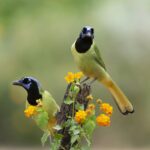
The flash of a deep blue wing between towering evergreens is often the first clue that a Steller’s Jay is nearby. A moment later, a dark-crested bird may land on a branch, cock its head inquisitively, and announce itself with a rough series of rattles, squawks, or scolding calls.
The Steller’s Jay (Cyanocitta stelleri) is one of the most distinctive birds of western forests. Its combination of a charcoal-black or dark blue head, brilliant blue body, prominent crest, and bold personality makes it difficult to overlook. These intelligent members of the crow family thrive in mountain forests, coastal woodlands, parks, campgrounds, and even wooded neighborhoods.
Steller’s Jays are also masters of adaptation. They cache food, investigate unfamiliar objects, imitate other animals, raid unattended picnic tables, and quickly learn where reliable sources of food can be found. Their appearance varies considerably across their enormous range, giving birdwatchers an added challenge when identifying them from one region to another.
🔬 Scientific Classification
| Classification | Steller’s Jay |
|---|---|
| Kingdom | Animalia |
| Phylum | Chordata |
| Class | Aves |
| Order | Passeriformes |
| Family | Corvidae |
| Genus | Cyanocitta |
| Species | Cyanocitta stelleri |
Steller’s Jays belong to the Corvidae family, placing them alongside crows, ravens, magpies, nutcrackers, and other jays. Their closest familiar relative in North America is the Blue Jay (Cyanocitta cristata), the only other living species in the genus Cyanocitta.
⚡ Steller’s Jay Quick Facts
| Fact | Details |
|---|---|
| Scientific name | Cyanocitta stelleri |
| Family | Corvidae |
| Length | 11.8–13.4 in (30–34 cm) |
| Weight | 3.5–4.9 oz (100–140 g) |
| Wingspan | About 17.3 in (44 cm) |
| Diet | Omnivorous |
| Primary habitat | Coniferous, mixed, and pine-oak forests |
| Range | Western North America south into Central America |
| Clutch size | Usually 2–6 eggs |
| Broods | Typically 1 per year |
| Conservation status | Least Concern |
| Distinctive feature | Tall crest with dark head and blue body |
Measurements and nesting figures reported by the Cornell Lab place Steller’s Jays between the size of an American Robin and an American Crow.
👀 How to Identify a Steller’s Jay
Few western birds have the same dramatic combination of colors.
An adult Steller’s Jay is a large, sturdy songbird with a prominent triangular crest, broad rounded wings, a long tail, and a strong, nearly straight bill. The head and upper chest are usually dark charcoal, blackish, or deep blue, while the rest of the body transitions into shades of rich blue. The wings can appear particularly brilliant when illuminated by sunlight.
Unlike the familiar Blue Jay, the Steller’s Jay lacks extensive white underparts. Its overall appearance is much darker.
The sexes look essentially alike in plumage, so identifying a male or female by appearance alone is generally not possible. Juveniles resemble adults but tend to have smaller crests and somewhat duller or grayer plumage.
Key identification features include:
- Tall, pointed crest
- Dark charcoal, black, or dark blue head
- Rich blue body, wings, and tail
- Strong black bill
- Long tail
- Dark legs and feet
- Blue or white forehead markings depending on geographic region
- Loud, harsh calls
- Bold, inquisitive behavior
Their distinctive silhouette can sometimes identify them before their colors are visible. A jay-sized bird with a sharply peaked crest moving among western conifers is an excellent candidate for a Steller’s Jay.

🎨 Why Steller’s Jays Look Different Across Their Range
One of the most fascinating characteristics of this species is its regional variation.
Scientists have described numerous geographic forms of the Steller’s Jay, and Cornell currently discusses 16 subspecies across North and Central America. Birds living along the Pacific Coast tend to be very dark, often showing subtle blue streaks on the forehead or crest.
Interior birds of the Rocky Mountains are often easier to recognize by their conspicuous white forehead streaks and pale markings around the eyes.
Farther south in Mexico and Central America, some populations become noticeably bluer overall, and certain birds have shorter, blue-toned crests.
These differences are substantial enough that a Steller’s Jay seen in coastal Washington may look surprisingly different from one encountered in Arizona, Mexico, or Guatemala. Genetic research has also revealed significant geographic structure within the species, reflecting its long history across the mountainous landscapes of western North and Central America.
🗺️ Range: Where Do Steller’s Jays Live?
Steller’s Jays occupy an enormous north-to-south range.
They occur from southern Alaska through western Canada and the western United States, continuing through Mexico and into Central America as far south as Nicaragua. They are strongly associated with western mountain systems and forested regions, although populations along the Pacific Coast can occur at much lower elevations.
In the United States, they are especially characteristic of the:
- Pacific Northwest
- Cascade Range
- Sierra Nevada
- Rocky Mountains
- Forested mountains of the Southwest
- Coastal forests of California, Oregon, and Washington
Most Steller’s Jays are considered residents rather than classic long-distance migrants. However, birds living at high elevations may move downhill during winter, and larger movements into lower or unusual habitats sometimes occur when mountain food supplies are poor.
🌲 Steller’s Jay Habitat
If you want to find a Steller’s Jay, start with trees—especially evergreens.
The species is strongly associated with coniferous and mixed conifer-deciduous forests. In the southwestern United States and Mexico, it also inhabits pine-oak woodland.
Cornell reports that Steller’s Jays are commonly found at elevations of roughly 3,000 to 10,000 feet, although they occur considerably lower along the Pacific Coast.
Suitable habitats can include forests dominated by:
- Pine
- Fir
- Spruce
- Douglas-fir
- Cedar
- Oak mixed with conifers
They are by no means restricted to untouched wilderness. Steller’s Jays readily use wooded parks, campgrounds, picnic areas, suburban neighborhoods, and backyards when trees and food are available.

🧠 Behavior and Intelligence
Spend a few minutes watching a Steller’s Jay and it quickly becomes apparent that this is not a passive bird.
Steller’s Jays are alert, curious, and constantly evaluating their surroundings. They move through branches with deliberate hops, pause frequently to inspect activity below them, and readily investigate potential sources of food.
Food caching is an important part of their behavior. When nuts and seeds are abundant, the birds carry surplus food away and hide it in scattered locations for later use. Their ability to relocate caches demonstrates the strong spatial memory characteristic of many members of the crow family.
They may also locate and steal food cached by other birds.
Steller’s Jays are highly social outside the breeding period and can travel in groups. They sometimes participate in mixed-species gatherings and frequently join other birds in mobbing predators. A jay that suddenly becomes extremely vocal may be reacting to a hawk, owl, or another potential threat nearby.
🥜 What Do Steller’s Jays Eat?
Steller’s Jays are omnivorous generalists, which is one reason they can thrive in such a wide variety of environments.
Their natural diet includes:
- Acorns
- Pine seeds
- Other nuts and seeds
- Berries
- Wild fruits
- Beetles
- Wasps
- Bees
- Spiders
- Other invertebrates
- Small vertebrates
- Bird eggs
- Nestlings
- Carrion
Plant foods are particularly important during fall and winter, while insects and other animal foods can become more prominent during the warmer months.
Like many corvids, Steller’s Jays sometimes prey on the nests of other birds. They may take both eggs and chicks, a natural behavior that can appear harsh to backyard birdwatchers but is simply part of the species’ opportunistic feeding strategy.
Around people, Steller’s Jays quickly learn to exploit additional food sources. Campgrounds are particularly attractive because the birds may find crumbs, scraps, unattended meals, or garbage.
Their enthusiasm for picnic food does not mean people should deliberately feed them processed human foods, however. Natural foods or appropriate bird-feeder offerings are much better choices.
🥜 Attracting Steller’s Jays to a Backyard
If you live within their range and have mature trees nearby, Steller’s Jays may become regular backyard visitors.
Cornell recommends foods such as peanuts, large seeds and nuts, and suet for attracting them. Their size means they are usually more comfortable at feeders that provide enough room for a large bird to perch or land.
Creating good habitat can be just as important as filling a feeder. Mature conifers and other trees provide shelter, lookout perches, nesting possibilities, and natural foods.
A Steller’s Jay that repeatedly grabs peanuts and flies away may not be eating all of them immediately. It may be transporting food to storage sites scattered throughout its territory.
As with all backyard birds, feeders should be kept clean and spoiled food should be discarded to reduce the risk of disease.
🪺 Nesting and Breeding
Steller’s Jays usually form pairs during the breeding season, and both birds participate in important parts of nest construction.
The pair typically selects a nest site in a tree—often a conifer—and builds a substantial cup-shaped nest on a branch near the trunk. Unlike the delicate nests produced by many songbirds, a Steller’s Jay nest can be surprisingly bulky.
Materials may include:
- Twigs and stems
- Leaves
- Moss
- Mud
- Pine needles
- Rootlets
- Animal hair
- Other soft lining material
The use of mud is particularly interesting. Steller’s Jays and Blue Jays are unusual among New World jays in incorporating mud into their nests.
A typical clutch contains 2–6 eggs, which are bluish-green and marked with darker brown, olive, or purplish spots. Cornell lists an incubation period of about 16 days and a similar nestling period, while Audubon describes the young as taking roughly three weeks before their first flight.
Both parents provide food for the growing nestlings.
🔊 Steller’s Jay Calls and Mimicry
You may hear a Steller’s Jay long before you see one.
Its best-known call is a repeated, harsh “shook-shook-shook” or similarly scolding series of notes. The birds also produce growls, rattles, squeaks, whistles, guttural noises, and quieter courtship vocalizations.
Even more impressive is their talent for mimicry.
Researchers have documented Steller’s Jays copying sounds made by squirrels and several bird species, including Northern Goshawks, Northern Flickers, and White-breasted Nuthatches. They have even reproduced mechanical noises such as sprinklers.
Males—and sometimes females—also produce a much quieter sequence of whistles, gurgles, and popping sounds during courtship.

🆚 Steller’s Jay vs. Blue Jay
Because both birds are large, blue, crested jays, confusion between Steller’s Jays and Blue Jays is understandable.
| Feature | Steller’s Jay | Blue Jay |
|---|---|---|
| Head | Dark charcoal, black, or blue | Mostly blue with white face |
| Underparts | Dark blue | Mostly white or pale |
| Crest | Tall and usually dark | Blue |
| Wings | Blue with dark barring | Blue, black, and conspicuous white |
| Tail | Mostly blue and dark | Blue with prominent white markings |
| Typical range | Western North America | Primarily central and eastern North America |
| Habitat | Strongly associated with western forests | Broad range of forests, woodland edges, towns, and suburbs |
Where their ranges meet, particularly around portions of the Rocky Mountains, the two species have occasionally hybridized.
🌎 Conservation Status
Steller’s Jays remain widespread and are currently classified as Least Concern on the IUCN scale as reported by Audubon. They remain familiar birds across large portions of western forests.
That does not mean their populations should be ignored. Cornell cites North American Breeding Bird Survey data showing an estimated cumulative decline of about 34% between 1966 and 2019, while still describing the species as one of relatively low conservation concern. Because that estimate covers a historical monitoring period ending in 2019, it should not be interpreted as a precise measure of the population trend today.
Maintaining healthy forests, protecting nesting habitat, reducing unnecessary disturbance, and monitoring bird populations through long-term surveys remain valuable for Steller’s Jays and the many other species sharing their ecosystems.
💡 Fascinating Steller’s Jay Facts

Their name is Steller’s, not “Stellar.” The bird was named for naturalist Georg Wilhelm Steller, who encountered it during an expedition to Alaska in 1741. The species was formally described in 1788.
Their appearance changes geographically. Coastal birds tend to be darker, while many interior birds have noticeable white markings on the forehead and around the eyes.
They are excellent mimics. A Steller’s Jay may imitate other birds, mammals, and even mechanical sounds.
They hide food for later. Nuts and seeds may be carried away and placed in scattered caches that the birds can relocate later.
They raise their crests during social encounters. The crest can become especially prominent during aggressive displays and courtship.
They can live for many years. Cornell reports that the oldest recorded Steller’s Jay was at least 16 years and 1 month old.
They are comfortable around people. Forest campgrounds, picnic areas, parks, and wooded backyards frequently provide opportunities to observe them at remarkably close range.
❓ Frequently Asked Questions About Steller’s Jays
Are Steller’s Jays the same as Blue Jays?
No. Steller’s Jay (Cyanocitta stelleri) and Blue Jay (Cyanocitta cristata) are separate species, although they belong to the same genus. Steller’s Jays are generally much darker and are primarily western birds.
Why is it called a Steller’s Jay?
The bird is named after naturalist Georg Wilhelm Steller, who encountered the species during an expedition to Alaska in 1741. That is why the correct spelling is Steller’s, rather than “Stellar’s.”
Where do Steller’s Jays live?
They inhabit western North America and mountainous portions of Middle America, with a range extending from southern Alaska through western Canada, the western United States and Mexico, and south into Central America as far as Nicaragua.
What do Steller’s Jays eat?
They are omnivores. Their diet includes nuts, seeds, acorns, berries, fruits, insects, spiders, eggs, nestlings, and occasionally small vertebrates or carrion. They also readily investigate human food when given the opportunity.
Do Steller’s Jays migrate?
Most are not long-distance migrants. However, some birds move from high elevations to lower elevations during winter, and food shortages can trigger broader seasonal movements.
How can I attract Steller’s Jays?
Within their natural range, wooded yards can attract them with peanuts, larger seeds and nuts, and suet. Mature trees and nearby forest cover make a property considerably more appealing.
Are male and female Steller’s Jays different colors?
No obvious plumage difference separates the sexes. Males and females look very similar.
What does a Steller’s Jay sound like?
Their characteristic call is a loud, rough series often written as “shook-shook-shook.” They also make rattles, growls, whistles, squeaks, and numerous other sounds.
Are Steller’s Jays intelligent?
Yes. Like other members of the crow family, they display sophisticated behaviors including food caching, strong spatial memory, mimicry, social communication, opportunistic foraging, and rapid adaptation to human environments.
Are Steller’s Jays endangered?
No. The species is currently considered Least Concern and remains widespread, although long-term bird surveys have documented declines over parts of the monitoring period.
🌲 A Remarkable Bird of Western Forests
Steller’s Jays combine nearly everything that makes the crow family fascinating: intelligence, curiosity, adaptability, complicated vocalizations, strong memory, and a willingness to investigate almost anything that enters their world.
Their beauty is equally memorable. Against the dark greens of a conifer forest, the combination of brilliant blue feathers and a dramatic charcoal crest creates one of the most striking silhouettes in western North America.
Yet there is much more to these birds than their appearance.
They store food for difficult seasons, communicate loudly with their neighbors, mob potential predators, imitate the sounds around them, raise their young in carefully constructed mud-reinforced nests, and adapt readily to environments shared with people.
The next time a sharp rattling call echoes through a western pine forest, look toward the branches overhead. There may be a Steller’s Jay watching from the shadows—and there is a very good chance it noticed you first.
🔗 Related Articles
- Clark’s Nutcracker: The Remarkable Seed-Planting Bird of Western Mountains
- Mountain Bluebird
- Bird Identification
- Jays
📚 Sources
- Cornell Lab of Ornithology — Steller’s Jay Overview
- Cornell Lab of Ornithology — Steller’s Jay Identification
- Cornell Lab of Ornithology — Steller’s Jay Life History
- Cornell Lab of Ornithology — Steller’s Jay Sounds
- National Audubon Society — Steller’s Jay Field Guide
- National Park Service — Steller’s Jay, Kenai Fjords National Park
- Journal of Heredity — A Highly Contiguous Reference Genome for the Steller’s Jay
- PeerJ / PubMed Central — Deep Ecomorphological and Genetic Divergence in Steller’s Jay