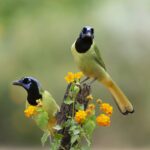
You can often identify a bird without ever seeing it.
A whistle from the treetops, a repeated trill from a hedge, a rich melody from the lawn, or a strange call from deep in the woods can reveal which birds are nearby long before you find them with binoculars.
Learning to identify birds by song can feel overwhelming at first, especially on a spring morning when dozens of birds seem to be vocalizing at once. The trick is not to memorize every sound. Instead, learn how to listen.
Pay attention to the rhythm, pitch, repetition, tone, length, and pattern of a bird’s vocalization. Combine those clues with habitat, location, season, and time of day, and an unfamiliar sound can quickly become much easier to identify.
🎵 Bird Songs vs. Bird Calls
Birds make many different vocalizations, and not every sound you hear is technically a song.
Songs are often longer and more complex. They are commonly associated with territorial defense and courtship, particularly during the breeding season.
Calls tend to be shorter and simpler. Birds use calls for many purposes, including staying in contact with other birds, warning about predators, begging for food, communicating within a flock, or sounding an alarm.
The distinction is not always obvious, and some birds have vocalizations that do not fit neatly into either category.
For identification, you do not necessarily need to decide whether a sound is a song or a call. What matters most is noticing its characteristics.
👂 Start With One Bird at a Time
A dawn chorus can sound like a wall of noise when you are beginning.
Instead of trying to identify everything, choose one sound.
Listen for the bird that repeats the same phrase. Ignore the other sounds temporarily and concentrate on that voice.
Where is it coming from? Is it nearby or far away? Does it repeat at regular intervals? Does each song sound identical, or does the bird change phrases?
Once you begin separating individual voices from the background, birding by ear becomes much less intimidating.
🥁 Listen to the Rhythm
Rhythm is one of the easiest qualities to notice.
Does the bird sing slowly, leaving long pauses between notes? Does it race through the song? Does it alternate between fast and slow sections?
Some birds sound deliberate and measured. Others seem almost impatient.
You do not need musical training to recognize rhythm. Think about how you would tap the sound with your fingers.
A bird’s characteristic tempo can become an important clue even when you cannot remember the exact notes.
🔁 Notice Repetition
Next, listen for repetition.
Does the bird repeat the same note again and again?
Does it repeat each phrase twice before changing?
Does it sing one recognizable sequence over and over?
Northern Mockingbirds are especially useful for learning this principle because they often repeat a phrase several times before switching to another sound. Brown Thrashers also have large repertoires but tend to repeat phrases differently.
Instead of trying to memorize an entire complicated song, recognizing how a bird repeats its phrases may be enough to narrow the possibilities.
🎼 Pay Attention to Pitch
Pitch refers to whether a sound is relatively high or low.
Some birds produce extremely high, thin notes that can be difficult for some people to hear. Others have deep croaks, hoots, or resonant whistles.
Ask whether the song stays at roughly the same pitch or changes.
Does it rise?
Does it fall?
Does it begin high and end low?
Does it bounce unpredictably between pitches?
The overall direction can be more useful than remembering every individual note.
🎶 Listen to the Tone
Tone describes the quality or character of the sound.
A bird may sound clear and whistled, harsh and scratchy, buzzy, nasal, metallic, flutelike, rattling, or trilled.
Northern Cardinals often produce clear, whistled notes. Jays may sound harsh and scolding. Some wrens produce rich, musical phrases, while other birds make insect-like buzzes.
Tone is especially useful when two species sing roughly similar patterns but have very different voices.
Think about the sound as a texture rather than simply a melody.
📏 Notice How Long the Song Lasts
Song length can also help.
Some birds produce a quick phrase lasting only a second or two.
Others continue through long, elaborate performances.
Listen to how long an individual song lasts before the bird pauses.
Then notice the length of the pause before it sings again.
A bird repeating a short phrase every few seconds creates a very different pattern from one producing a long stream of continuous song.
🧩 Break Complicated Songs Into Sections
Long songs become much easier to remember when you divide them into pieces.
Perhaps the bird begins with two whistles, follows them with a fast trill, and finishes with a buzz.
Instead of trying to memorize every sound, remember:
Two whistles → trill → buzz.
Another species might produce:
Slow notes → fast series → final high note.
This kind of simple structure is often enough to recognize the song again later.
🗣️ Turn Bird Songs Into Words
One of the oldest birding tricks is to translate a sound into a memorable phrase.
A Barred Owl is famously associated with a phrase resembling “Who cooks for you? Who cooks for you all?”
Different listeners may hear completely different words in the same song, and that is perfectly fine.
The phrase does not need to be scientifically accurate. It simply needs to help you remember the rhythm and pattern.
Inventing your own mnemonic can sometimes work even better than memorizing somebody else’s.
🐦 Learn the Birds Around Your Home First
Your backyard, neighborhood, or local park is one of the best places to begin.
You will encounter the same species repeatedly, giving you many opportunities to connect a sound with the bird producing it.
If you regularly hear an American Robin before breakfast, learn that song first.
If Northern Cardinals sing outside your window, concentrate on them.
Once several familiar voices become automatic, unfamiliar sounds begin to stand out.
A beginner who confidently recognizes ten common local birds has a much stronger foundation than someone attempting to memorize hundreds of recordings at once.
👀 Find the Bird That Is Singing
Whenever possible, visually locate the bird producing an unfamiliar sound.
This creates a much stronger memory than listening to a recording alone.
Follow the sound gradually. Watch exposed branches, fence posts, treetops, utility wires, shrubs, and other likely singing perches.
When you find the bird, watch its bill.
If the bill opens at the same moment you hear the sound, you have much stronger evidence that you have located the singer.
Take a moment to study both the bird and its voice together.
The next time you hear that song, the visual memory may return immediately.
🌳 Use Habitat to Narrow the Possibilities
Where you hear the song matters.
A bird singing from a marsh belongs to a different set of likely species than one calling from a dry grassland, conifer forest, suburban yard, beach, or mountain meadow.
Habitat can eliminate many otherwise plausible possibilities.
If you hear a mysterious bird in dense reeds beside a wetland, concentrate on species associated with marshes.
A singer high in a western conifer forest suggests another group entirely.
Sound should be combined with habitat rather than interpreted in isolation.
🌎 Consider Your Location
Geographic range is just as important with sound as it is with visual identification.
A recording online may sound exactly like the bird you heard, but first ask whether that species normally occurs where you are.
Some closely related birds occupy different geographic regions.
Others overlap only during migration.
When comparing possible songs, start with birds expected in your area rather than searching every species in North America.
That makes identification much faster and reduces false matches.
🍂 Remember the Season
Bird vocal activity changes throughout the year.
Spring and early summer are particularly rich in song because many birds are establishing territories and attracting mates.
A species that sings constantly in May may be much quieter by late summer.
Migration also changes which birds you may hear.
During spring and fall, unfamiliar calls can suddenly appear overhead or in places where those species do not breed.
Season therefore provides an important reality check when identifying a mystery sound.
🌅 Listen Early in the Morning
Early morning is one of the best times to learn bird songs.
The dawn chorus can begin before sunrise and continue through the first hours of daylight.
At first, this abundance of sound may seem like the worst possible learning environment.
But returning to the same place repeatedly allows you to become familiar with the usual singers.
Start slightly later in the morning if the full dawn chorus feels overwhelming. Fewer birds may be singing simultaneously, making individual voices easier to isolate.
🌙 Don’t Stop Listening at Night
Bird identification by sound continues after dark.
Owls are the most obvious example, but other birds may vocalize at night as well.
During migration, some birds produce short flight calls while traveling overhead after sunset.
Nightjars and other nocturnal species can also be much easier to detect by sound than sight.
If a mysterious nighttime sound repeats regularly, record it or make notes rather than assuming it is not a bird.
🦉 Learn a Few Distinctive Owl Calls
Owls are excellent birds for practicing identification by sound because some species have highly recognizable vocalizations.
The Barred Owl’s rhythmic hooting is one of the best-known examples.
Other owls whistle, trill, bark, screech, or produce surprisingly strange sounds.
Do not assume every eerie sound in the woods is an owl, however. Mammals, frogs, insects, and even other birds can create noises that initially seem owl-like.
Use range, habitat, time of year, and recordings to confirm what you heard.
❤️ Listen for Northern Cardinals
Northern Cardinals are useful birds for beginning ear identification because they commonly sing in suburban areas, parks, woodland edges, and backyards across much of eastern and central North America.
Their songs frequently consist of loud, clear whistles arranged into repeated phrases.
Individual cardinals have varied repertoires, so do not expect every bird to sing exactly the same sequence.
Instead, learn the general clarity, pitch, rhythm, and quality of the cardinal’s voice.
Learning the overall voice rather than a single song prepares you for natural variation.
🍊 Listen for American Robins
American Robins are another excellent reference bird.
Their rich, caroling songs are familiar across much of North America and are especially noticeable during spring mornings and evenings.
The song consists of a series of short musical phrases separated by brief pauses.
Once that pattern becomes familiar, you may start noticing robin songs in the background almost everywhere the species occurs.
Common birds make excellent teachers because you receive constant opportunities to reinforce the sound.
🎭 Be Careful With Mockingbirds
Northern Mockingbirds can make birding by ear especially entertaining—and occasionally confusing.
They are accomplished mimics with large repertoires and can imitate the vocalizations of other birds and various environmental sounds.
A mockingbird may cycle through many different phrases during a single performance.
This is why repetition is useful.
Instead of asking only, “What species does that individual sound resemble?” listen to the complete performance and notice how the singer repeatedly switches among phrases.
The overall pattern can reveal the mimic even when one section sounds convincingly like another bird.
🪶 Jays Can Mimic Too
Mockingbirds are not the only birds capable of imitation.
Jays and other members of the crow family can produce surprisingly varied sounds.
Steller’s Jays, for example, are known for harsh calls, rattles, whistles, and mimicry.
This is a useful reminder that bird sounds should always be interpreted in context.
If a hawk-like call seems to be coming from a jay sitting in a nearby tree, believe your eyes as well as your ears.
🪵 Don’t Forget Nonvocal Sounds
Not every useful bird sound comes from the voice.
Woodpeckers drum on resonant surfaces.
Some birds create sounds with their wings or tail feathers.
Others snap bills, clap wings, or produce mechanical noises during displays.
Woodpecker drumming is particularly important for identification.
The speed, length, rhythm, and spacing of drumming can help distinguish species, and the sound may carry through a forest long before the bird becomes visible.
When birding by ear, listen for everything—not only songs.
🚨 Learn Alarm Calls
Alarm calls can tell you more than the identity of the bird making them.
Songbirds may suddenly begin scolding or giving sharp warning calls when a hawk, owl, snake, cat, or other potential predator appears nearby.
If several normally calm birds suddenly become intensely vocal, look around.
Their behavior may lead you directly to the cause.
Recognizing alarm calls also provides insight into what birds are doing rather than merely which species are present.
🐣 Listen for Contact and Begging Calls
Birds also use sound to stay connected.
Flock members may make quiet contact calls while feeding.
Parents and young communicate around nests and after fledging.
Juvenile birds can make persistent begging sounds that are very different from the adult songs found in field guides.
This is one reason a single species can initially seem to produce an impossible number of sounds.
Learning bird vocalizations means gradually learning a repertoire, not memorizing one sound per species.
🎧 Compare Several Recordings
Do not learn a species from only one recording.
Individual birds vary.
Populations can have regional differences, and a species may use several songs and many calls.
Listen to multiple recordings so you learn what remains consistent.
Perhaps the exact melody changes, but the voice always has the same clear whistle.
Perhaps different songs share the same rhythm.
Perhaps every call has a distinctive nasal quality.
Those recurring traits are often more useful than one memorized recording.
📱 Use Merlin Sound ID as a Learning Tool
Cornell Lab’s Merlin Bird ID includes a Sound ID feature that can listen to nearby bird vocalizations and suggest possible species.
It can be extremely useful for beginners because it helps separate individual singers in a complicated soundscape.
But treat an app identification as a suggestion rather than unquestionable proof.
Look for the bird when possible.
Check whether the species occurs in your location and season.
Compare the recording with known examples and consider habitat and behavior.
The goal is not simply to have an app tell you the answer. Use the suggestion to teach yourself what the bird sounds like so that eventually you recognize it without assistance.
🎙️ Record Mystery Birds
Your phone can be extremely useful when you hear something unfamiliar.
Record the sound while it is happening.
Try to remain still and avoid talking during the recording.
Do not worry if the bird sounds faint. Even an imperfect recording may preserve rhythm, pitch, repetition, and tone well enough to investigate later.
Also make a few notes about where you were, what habitat surrounded you, what time you heard the bird, and whether you saw anything.
Those details can be as valuable as the recording itself.
📈 Learn to Use Spectrograms
A spectrogram turns sound into an image.
Time runs from left to right, while pitch is represented vertically. A bird’s notes appear as visible marks, allowing you to examine details that pass too quickly for your ears to analyze easily.
Spectrograms can show whether a phrase rises or falls, how many notes occur, how quickly they repeat, and whether the sound is clear, buzzy, or complex.
You do not need spectrograms to enjoy birding by ear, but they can be extremely helpful when learning similar songs.
Sometimes seeing the pattern makes hearing it much easier.
🧠 Don’t Try to Memorize the Melody Alone
Humans naturally try to remember bird songs as melodies, but that approach does not always work.
Some birds vary their songs considerably.
Others have enormous repertoires.
Instead, remember several characteristics together.
Think:
Clear whistles, medium pitch, repeated slowly.
Or:
Fast, buzzy trill that rises toward the end.
Or:
Three repeated phrases followed by a pause.
Descriptions like these help you recognize the underlying structure even when the bird does not perform exactly the recording you memorized.
🎵 Compare Similar-Sounding Birds
Once you know several common songs, start deliberately comparing species that confuse you.
Listen to them one after another.
What is different?
Perhaps one sings faster.
Perhaps another has a higher pitch.
One may sound musical while another sounds buzzy.
One might repeat phrases twice while the other repeats them three or more times.
Learning differences between confusing pairs is usually more effective than trying to memorize each species separately.
🔭 Use Sound to Find Hidden Birds
One of the greatest advantages of learning bird songs is that sound tells you where to look.
When you hear a bird, determine whether the sound is coming from your left or right.
Turn your head slightly and listen again.
Notice whether the bird sounds high in the canopy, low in a shrub, on the ground, or far across the landscape.
Move slowly and keep listening.
Eventually you may narrow the location to a particular tree or patch of vegetation.
Birding by ear therefore does not replace visual birding. It helps you find birds your eyes would otherwise miss.
📝 Describe the Sound Before Naming the Bird
When you hear something unfamiliar, resist the urge to guess immediately.
Describe it first.
Is it high or low?
Fast or slow?
Clear or buzzy?
Repeated or variable?
Does it rise or fall?
How long does each phrase last?
Does it come from a treetop, shrub, marsh, or open field?
Once you have collected those clues, compare them with likely species.
This approach is much more reliable than deciding the sound “sort of reminds you” of a bird you heard once.
🐦 Learn Bird Families by Sound
You do not always need to identify a singer to species.
Recognizing the general group is useful progress.
A harsh jay-like call narrows the possibilities.
A thin warbler song suggests another direction.
A deep corvid croak, dove-like coo, owl hoot, woodpecker drum, goose honk, or shorebird whistle places the sound within a much smaller category.
Learning these broader sound families creates a framework for more precise identification later.
🌱 Build Your Bird-Song Library Slowly
Birding by ear is a long-term skill.
Start with three or four birds you hear regularly.
Once those become familiar, add another.
Then another.
Eventually the soundscape changes.
Instead of hearing an indistinct chorus, you begin hearing individual birds: a robin in one tree, a cardinal farther away, a wren near the fence, and a jay calling from the woods.
Then a new sound appears.
Because everything else is familiar, the unfamiliar bird suddenly becomes much easier to notice.
That is one of the most satisfying moments in learning bird songs.
❤️ Listen Before You Look
Bird identification is often described as a visual skill, but some birds reveal themselves more readily through sound.
A bird hidden behind leaves may sing continuously.
An owl may call from darkness.
A marsh bird may remain almost completely concealed.
A migrant may pass overhead without ever entering your field of view.
Learning bird songs expands your awareness far beyond what you can see.
Start with rhythm, repetition, pitch, and tone. Add habitat, range, season, and behavior. Listen to familiar birds repeatedly, compare recordings, and confirm singers visually whenever you can.
Little by little, the background chorus becomes a collection of recognizable voices.
Eventually, you may hear a bird through an open window and know exactly who is outside before you ever look.
🔗 Related Articles
- Bird Identification: How to Identify the Birds You See
- Backyard Birding: How to Attract, Feed & Enjoy Birds at Home
- Steller’s Jays
- Downy Woodpecker
- Bird Species Guide
- Songbirds
📚 Sources & Further Reading
- Cornell Lab of Ornithology — How to Learn Bird Songs and Calls
- Cornell Lab of Ornithology — Rhythm, Repetition, Pitch, and Tone
- Cornell Lab of Ornithology — How to Use Spectrograms to Learn Bird Songs
- National Audubon Society — How to Start Identifying Birds by Their Songs and Calls
- National Audubon Society — A Beginner’s Guide to Common Bird Sounds and What They Mean