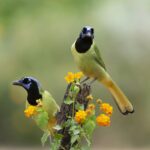
A flash of orange against a backyard tree, fence post, or woodland trail can make an unfamiliar bird surprisingly memorable. But an orange chest alone does not always reveal its identity. American Robins, bluebirds, orioles, grosbeaks, thrushes, and several smaller songbirds can all display shades ranging from pale peach and cinnamon to brilliant pumpkin orange.
The easiest way to narrow down the possibilities is to consider the bird’s size, additional colors, bill shape, behavior, habitat, and geographic location. A blue bird with a rusty-orange breast points toward a bluebird or Lazuli Bunting, while a black-and-orange bird high in the trees may be an oriole. A tiny bird with a striped face and cinnamon-colored underparts climbing down a tree trunk is likely a nuthatch.
This guide covers some of the most useful orange-chested birds to know across North America, including familiar backyard species and more localized western and southwestern birds.
For additional help recognizing unfamiliar species, explore our Bird Identification Guide.
🔍 Quick Identification Guide
| Bird | Chest Color | Best Identification Clue | Typical Region or Habitat |
|---|---|---|---|
| American Robin | Warm orange to orange-red | Gray-brown back, dark head, yellow bill | Lawns, gardens, parks, and woodlands across North America |
| Eastern Bluebird | Rusty orange | Blue upperparts and rusty throat and breast | Eastern North America; open fields and wooded edges |
| Western Bluebird | Rusty orange | Blue throat and head with orange breast | Western North America; open woodlands |
| Baltimore Oriole | Brilliant orange | Black head and back with orange underparts | Eastern and central North America |
| Bullock’s Oriole | Bright orange | Orange face, black eyeline, and white wing patch | Western North America |
| Orchard Oriole | Deep chestnut-orange | Black head and rich reddish-chestnut underparts | Eastern and central North America |
| Hooded Oriole | Yellow-orange to vivid orange | Black throat and mask; frequently near palms | Southwestern United States |
| Altamira Oriole | Brilliant orange | Large orange-and-black oriole with black face markings | Southern Texas and Mexico |
| Black-headed Grosbeak | Cinnamon-orange | Thick bill, black head, and black-and-white wings | Western woodlands and gardens |
| Varied Thrush | Burnt orange | Black breast band and orange eyebrow | Pacific Northwest and western forests |
| Red-breasted Nuthatch | Rusty cinnamon | Black-and-white striped face; climbs tree trunks | Conifer forests and backyard feeders |
| Lazuli Bunting | Pumpkin orange | Bright blue head and back with white belly | Western brushlands and woodland edges |
| Blackburnian Warbler | Fiery orange throat and upper chest | Small size, black-and-white wings, intense orange face | Northern and eastern forests; migration elsewhere |
| Rufous Hummingbird | Rusty orange | Tiny hovering bird with orange body and iridescent throat | Western North America and migration corridors |
| Vermilion Flycatcher | Brilliant orange-red | Dark facial mask and repeated flights from exposed perches | Southwestern United States |
🪱 1. American Robin
The American Robin (Turdus migratorius) is one of the most common explanations for an orange-chested bird in North America. Its warm orange breast contrasts with a gray-brown back, darker head, and yellow bill.
Both males and females have orange underparts, although females usually appear somewhat paler overall. Young robins look different from adults because they have spotted breasts, which can temporarily obscure the familiar orange coloring.
Behavior is often the easiest clue. American Robins regularly run across lawns, pause with an upright posture, and search the soil for earthworms and other invertebrates. They also gather in trees and shrubs to eat berries, particularly outside the breeding season.
Best identification clue: A medium-sized bird with an orange breast, gray-brown back, and yellow bill walking across a lawn.
🔵 2. Eastern Bluebird
The Eastern Bluebird (Sialia sialis) combines vivid blue upperparts with a rusty-orange throat and breast. Its lower belly is white, creating a clear division between the warm orange chest and the paler underside.
Adult males have the brightest blue feathers, while females are more subdued, with grayish upperparts, blue wings and tail, and a softer orange-brown breast. Juveniles often show spotting before their adult plumage develops.
Eastern Bluebirds favor open landscapes with scattered trees, including pastures, fields, orchards, parks, and suburban yards. They frequently perch on fence posts or low branches while watching for insects on the ground.
They also nest in cavities and readily use appropriately designed nest boxes.
Best identification clue: A blue-backed bird with a rusty-orange throat and breast perched in open country.
🌄 3. Western Bluebird
The Western Bluebird (Sialia mexicana) resembles its eastern relative but has several useful differences. Adult males have deep blue heads and throats, rusty-orange breasts, and orange that can extend onto the shoulders or upper back.
The blue throat is particularly helpful. Male Eastern Bluebirds generally have rusty coloration extending onto the throat, while male Western Bluebirds show blue on the throat above their orange breast.
Females are grayish-brown with blue in the wings and tail and a softer orange wash across the chest. Their colors are less intense than those of males, but the combination of muted blue and warm orange remains distinctive.
Western Bluebirds inhabit open woodlands, oak country, forest edges, and lightly wooded landscapes across western North America.
Best identification clue: A blue bird with a blue throat and rusty-orange breast in western North America.
Eastern Bluebird vs. Western Bluebird
| Feature | Eastern Bluebird | Western Bluebird |
|---|---|---|
| Male’s throat | Rusty orange | Blue |
| Breast | Rusty orange | Rusty orange |
| Upper back | Mostly blue | Blue, sometimes with rusty-orange shoulders or upper back |
| Typical range | Eastern North America | Western North America |
| Common habitat | Open fields, pastures, and wooded edges | Open woodlands, oak country, and western forest edges |
A third species, the Mountain Bluebird, usually lacks the rusty-orange chest seen in Eastern and Western Bluebirds. Adult male Mountain Bluebirds are predominantly blue.
🍊 4. Baltimore Oriole

The Baltimore Oriole (Icterus galbula) is among the most recognizable orange-and-black birds in eastern North America. Adult males have a solid black head, black back, brilliant orange underparts, and a white marking on the wing.
Females and immature males are less dramatic but often show yellow-orange breasts, grayish upperparts, and noticeable white wing bars.
Baltimore Orioles spend much of their time in deciduous trees, where they search for insects, fruit, and nectar. They are especially likely around woodland edges, parks, orchards, riverside trees, and leafy residential neighborhoods.
During spring and summer, they may visit backyard feeding stations offering orange halves or other suitable fruit.
Best identification clue: A black-headed bird with bright orange underparts and a white wing marking in eastern or central North America.
🌞 5. Bullock’s Oriole
The Bullock’s Oriole (Icterus bullockii) is a familiar western counterpart to the Baltimore Oriole. Adult males have bright orange underparts, orange faces, black backs, a black throat, and a bold white wing patch.
Unlike the Baltimore Oriole, which generally has an entirely black head, the Bullock’s Oriole has an orange face crossed by a distinct black line through the eye.
Females are more muted, with a yellowish-orange head and tail, grayish back, pale belly, and white wing markings.
These orioles often inhabit riverside woodlands, cottonwood groves, parks, orchards, and neighborhoods with mature trees. They can also visit fruit and nectar feeders.
Best identification clue: An orange-faced oriole with a black eyeline and large white wing patch in western North America.
Baltimore Oriole vs. Bullock’s Oriole
| Feature | Baltimore Oriole | Bullock’s Oriole |
|---|---|---|
| Adult male’s head | Entirely black | Orange face with black eyeline and throat |
| Breast | Bright orange | Bright orange |
| Wing markings | White wing bar | Large white wing patch |
| Typical range | Eastern and central North America | Western North America |
| Overlap | Central Great Plains and adjacent regions | Central Great Plains and adjacent regions |
These species can overlap and hybridize in parts of central North America, so some individuals show a mixture of field marks.
🌰 6. Orchard Oriole
The Orchard Oriole (Icterus spurius) has a darker, richer chest color than the Baltimore Oriole. Adult males are black above and deep reddish-chestnut below, giving them a warm burnt-orange appearance in favorable light.
Their chest is not the bright citrus orange associated with several other orioles, but observers often describe the color as orange-brown, rusty, or chestnut-orange.
Female Orchard Orioles look entirely different. They are primarily greenish-yellow, with white wing bars and no black head. Immature males may resemble females but develop a contrasting black throat.
Orchard Orioles occur in open woodlands, orchards, parks, pastures with scattered trees, and riverside habitats across much of the eastern and central United States.
Best identification clue: A relatively small oriole with a black head and deep chestnut-orange underparts.
🌴 7. Hooded Oriole
The Hooded Oriole (Icterus cucullatus) brings bright yellow-orange or flame-orange color to parts of the southwestern United States. Adult males have colorful heads and bodies contrasted with a black throat, black facial markings, dark wings, and white wing bars.
The amount of orange varies. Some individuals appear more yellow, while others have intensely orange plumage.
Hooded Orioles are especially associated with areas containing palm trees, although they also use other trees and wooded residential landscapes. Their woven nests are sometimes attached beneath palm leaves.
Females are olive-yellow with grayish backs and pale wing markings, making them much less conspicuous than males.
Best identification clue: A slender orange or yellow-orange bird with a black throat and face near palm trees in the Southwest.
🌺 8. Altamira Oriole
The Altamira Oriole (Icterus gularis) is a large, impressive orange-and-black oriole found in southern Texas and Mexico.
Adults have brilliant orange underparts and faces, black backs, black wings, dark tails, and black markings around the bill and chin. A white wing marking and orange shoulder help complete the pattern.
Compared with smaller orioles, Altamira Orioles have a substantial body and a long, pointed bill. They inhabit wooded areas, brushy landscapes, parks, and riverside habitats.
In the United States, the species is most closely associated with the Lower Rio Grande Valley. Geographic location is therefore especially important when considering this identification.
Best identification clue: A large orange-and-black oriole with an orange face and black chin in southern Texas.
🌻 9. Black-Headed Grosbeak
The Black-headed Grosbeak (Pheucticus melanocephalus) is a striking western songbird with a rich cinnamon-orange breast, black head, and boldly patterned black-and-white wings.
Its most useful field mark may be its oversized, thick, triangular bill. Orioles have slender, pointed bills, while grosbeaks have noticeably heavier bills designed for handling seeds and other foods.
Females and immature birds are brown above, with pale facial stripes and varying amounts of warm orange or buff across the breast. Some also show streaking along the sides.
Black-headed Grosbeaks inhabit mixed woodlands, forest edges, mountain valleys, streamside thickets, gardens, and residential neighborhoods. They may visit backyard feeders offering sunflower seeds.
Best identification clue: An orange-chested bird with a black head, white wing markings, and a large, heavy bill.
🌲 10. Varied Thrush
The Varied Thrush (Ixoreus naevius) resembles an American Robin at first glance, but its markings are more dramatic.
Adult males have rich burnt-orange underparts, a dark blue-gray back, a prominent orange eyebrow, and a dark band crossing the upper breast. Their wings also display orange markings.
Females have a similar pattern but are generally browner and less strongly colored.
Varied Thrushes are closely associated with the forests of the Pacific Northwest and other parts of western North America. They often feed on or near the ground, especially in damp forests, wooded gardens, and areas with dense cover.
Their combination of orange eyebrow, breast band, and orange wing markings separates them from American Robins.
Best identification clue: A robin-like bird with an orange breast, orange eyebrow, and dark band across the chest.
American Robin vs. Varied Thrush
| Feature | American Robin | Varied Thrush |
|---|---|---|
| Breast | Warm orange without a dark band | Burnt orange with a dark breast band |
| Eyebrow | Generally lacks a bold orange eyebrow | Distinctive orange eyebrow |
| Wings | Mostly plain gray-brown | Dark wings with orange markings |
| Habitat | Lawns, parks, gardens, and varied landscapes | Particularly associated with western forests |
| Typical range | Widespread across North America | Primarily western North America |
🪵 11. Red-Breasted Nuthatch
Despite its name, the Red-breasted Nuthatch (Sitta canadensis) usually has rusty-cinnamon or orange-brown underparts rather than a truly red chest.
This small, compact bird has a blue-gray back, black cap, dark eye stripe, and a bold white stripe above the eye. Females often have paler underparts than males.
Its behavior is just as distinctive as its plumage. Red-breasted Nuthatches climb along trunks and branches in multiple directions, frequently moving headfirst down tree bark while searching for insects and seeds.
They are especially common in conifer forests but may also visit backyard feeders, particularly where sunflower seeds, suet, or nuts are available.
Best identification clue: A tiny blue-gray bird with a rusty breast and black-and-white striped face climbing down a tree trunk.
💙 12. Lazuli Bunting
The Lazuli Bunting (Passerina amoena) is one of the most striking orange-chested birds of western North America.
Breeding males have bright blue heads and upperparts, a pumpkin-orange breast, a white belly, and a noticeable white shoulder patch. The crisp separation between the orange breast and white belly helps distinguish them from bluebirds.
Lazuli Buntings are smaller and more compact than bluebirds, with a thick, conical bill rather than a slender thrush-like bill.
Females are warm brown with subtle blue on the wings and tail and a pale cinnamon breast.
Look for Lazuli Buntings in brushy hillsides, streamside thickets, shrubby woodland edges, residential gardens, and other western habitats with dense vegetation.
Best identification clue: A small bright-blue bird with a pumpkin-orange breast, white belly, and thick seed-eating bill.
Lazuli Bunting vs. Bluebirds
| Feature | Lazuli Bunting | Eastern or Western Bluebird |
|---|---|---|
| Size | Smaller and more compact | Larger, with a more thrush-like shape |
| Bill | Thick and conical | Relatively slender |
| Breast | Distinct pumpkin-orange band | Rusty orange extending more broadly across the breast |
| Belly | Bright white beneath the orange breast | Usually pale or white below |
| Wing markings | Noticeable pale shoulder or wing marking | Generally lacks a bold white wing patch |
| Habitat | Brushy western slopes and thickets | Open fields or lightly wooded landscapes |
🔥 13. Blackburnian Warbler
The Blackburnian Warbler (Setophaga fusca) is a small songbird famous for the breeding male’s intensely orange throat and face.
The fiery color can extend onto the upper chest, but it is important to describe this bird accurately: the orange is concentrated most strongly around the throat and face rather than covering the entire breast like an American Robin or Baltimore Oriole.
Adult males also have striking black-and-white wing patterns and dark facial markings. Females and immature birds are less intensely colored and may show yellowish or muted orange tones.
Blackburnian Warblers breed primarily in northern and eastern coniferous or mixed forests. During migration, they can appear in a wider variety of wooded habitats.
Because they often forage high in trees, observers may notice the glowing orange throat first.
Best identification clue: A very small black-and-white songbird with a brilliant orange throat and face high in the trees.
🌸 14. Rufous Hummingbird
The Rufous Hummingbird (Selasphorus rufus) is unmistakably smaller than most other birds in this guide, but its warm orange coloration can be especially vivid.
Adult males have extensive rusty-orange feathers across the body, including the back and underparts, along with an iridescent reddish-orange throat. Depending on lighting, the throat can flash intensely or appear unexpectedly dark.
Females are greener above, with rusty tones along the sides and tail. Some show a small patch of orange or red on the throat.
Rufous Hummingbirds visit flowering plants and nectar feeders and are known for defending feeding territories vigorously. Their hovering flight immediately distinguishes them from orioles, bluebirds, and other orange-chested songbirds.
Best identification clue: A tiny hovering bird with extensive rusty-orange plumage and a sparkling reddish-orange throat.
❤️ 15. Vermilion Flycatcher
The Vermilion Flycatcher (Pyrocephalus rubinus) occupies the boundary between red and orange. Adult males are brilliant orange-red or scarlet across the head and underparts, with a dark facial mask and brownish wings, back, and tail.
Although some individuals appear more red than orange, the species is worth considering when an unfamiliar brightly colored bird is seen in the southwestern United States.
Vermilion Flycatchers often sit conspicuously on exposed branches, fences, or other low perches. They repeatedly fly outward to catch insects before returning to a perch.
Females and immature birds are much less colorful, with gray-brown upperparts, lightly streaked breasts, and a softer salmon-colored wash underneath.
Best identification clue: A vivid orange-red bird with a dark facial mask repeatedly launching from an exposed perch.
If the bird you observed looked more red than orange, compare it with the species in our Birds With Red Chests: Identification Guide.
🆚 Orange-Chested Birds Commonly Confused With Other Species
Not every bird with orange feathers actually has an orange chest. Identifying exactly where the color appears can prevent several common mistakes.
American Redstart
Male American Redstarts have bright orange patches on their sides, wings, and tails, but their underparts include a white belly and their chest is not broadly orange. Their small size, black plumage, and habit of fanning their tails make them distinctive.

Spotted Towhee
Spotted Towhees have rusty-orange sides, but their breasts and throats are primarily dark and their bellies are white. The orange is concentrated on the flanks rather than the center of the chest.
Western Tanager
Male Western Tanagers have a dramatic orange-red head, but their body and breast are predominantly yellow. A yellow-chested bird with a red-orange face and black wings is more likely a Western Tanager than a genuinely orange-breasted species.

Scarlet Tanager
Male Scarlet Tanagers are brilliant scarlet rather than orange, with strongly contrasting black wings. They fit more naturally within a guide to red birds than a guide centered on orange chests.

Mountain Bluebird
Adult male Mountain Bluebirds are predominantly blue and generally lack the rusty-orange breast seen in Eastern and Western Bluebirds. A blue bird without orange on its chest may therefore be a Mountain Bluebird, especially in open western landscapes.
👀 How to Identify a Bird With an Orange Chest
An orange breast is useful, but the surrounding details usually provide the decisive clues.
Start by looking at the bird’s head. A completely black head suggests a Baltimore Oriole or Black-headed Grosbeak, while an orange face with a black eye stripe points toward a Bullock’s Oriole. A blue head suggests a bluebird or Lazuli Bunting.
Next, check the bill. Orioles have relatively slender, pointed bills. Grosbeaks and buntings have thicker, conical bills. Nuthatches have narrow, sharp bills, while hummingbirds have long, delicate bills designed for reaching nectar.
Pay attention to size and posture. An American Robin has a comparatively large, rounded body and often stands upright on the ground. A Red-breasted Nuthatch is tiny and compact, while a Blackburnian Warbler is small enough to move easily among fine branches.
Behavior can be equally revealing. Robins search lawns, nuthatches climb tree trunks, flycatchers launch from exposed perches, and hummingbirds hover in front of flowers. Orioles often remain higher in leafy trees, while bluebirds frequently perch in open spaces.
Finally, consider region. An orange-and-black oriole in New England is more likely to be a Baltimore Oriole than an Altamira Oriole, while a blue-and-orange bird in western shrubland could be a Lazuli Bunting.
🏡 Orange-Chested Birds You May See in Your Backyard
Several orange-chested birds will visit residential landscapes when suitable food, water, and shelter are available.
American Robins are especially common where lawns, gardens, berry-producing shrubs, and mature trees provide feeding opportunities. They are less likely to rely on traditional seed feeders but readily use landscapes rich in insects and fruit.
Eastern and Western Bluebirds may appear around open yards, fence lines, and nest boxes. Mealworms, clean water, and appropriate nesting habitat can make a property more attractive to them.
Baltimore Orioles, Bullock’s Orioles, and other orioles sometimes investigate orange halves, fruit, and nectar feeders. Fresh offerings should be replaced regularly, and feeders should be cleaned to reduce spoilage.
Black-headed Grosbeaks may visit sunflower feeders in the West, while Red-breasted Nuthatches often investigate suet, sunflower seeds, and nuts.
The most effective backyard setup usually includes more than food alone. Native plants, clean water, protective cover, and reduced pesticide use can support a broader variety of birds throughout the year.
For additional ideas, visit our Backyard Birding Guide and Bird Feeders 101: How to Choose the Perfect Feeder for Your Backyard.
📍 Orange-Chested Birds by Region
Eastern North America
Common possibilities include American Robins, Eastern Bluebirds, Baltimore Orioles, Orchard Orioles, Red-breasted Nuthatches, and migrating Blackburnian Warblers.
In many eastern neighborhoods, an American Robin is the most likely large orange-chested bird, while a Baltimore Oriole is a strong candidate for a bright orange-and-black bird seen in trees during spring or summer.
Western North America
Likely species include American Robins, Western Bluebirds, Bullock’s Orioles, Black-headed Grosbeaks, Lazuli Buntings, Rufous Hummingbirds, and Red-breasted Nuthatches.
Blue-and-orange birds deserve particular attention in the West because Western Bluebirds and Lazuli Buntings can appear superficially similar.
Pacific Northwest
American Robins, Varied Thrushes, Western Bluebirds, Black-headed Grosbeaks, Rufous Hummingbirds, and Red-breasted Nuthatches are among the possibilities.
A robin-like bird with an orange eyebrow and a dark band across the breast is particularly suggestive of a Varied Thrush.
Southwestern United States
Hooded Orioles, Bullock’s Orioles, Black-headed Grosbeaks, Vermilion Flycatchers, Western Bluebirds, and migrating Rufous Hummingbirds can all appear in suitable habitats.
In southern Texas, Altamira Orioles provide an additional possibility.

❓ Frequently Asked Questions
What is the most common bird with an orange chest?
Across much of North America, the American Robin is one of the most familiar and widespread birds with an orange chest. Its gray-brown back, dark head, yellow bill, and habit of walking across lawns make it relatively easy to identify.
What bird has an orange chest and a blue back?
Eastern Bluebirds, Western Bluebirds, and Lazuli Buntings can all display blue upperparts and orange breasts. Bluebirds have a more slender bill and thrush-like shape, while Lazuli Buntings are smaller and have a thick, conical bill.
What bird has an orange chest and a black head?
A Baltimore Oriole is a common possibility in eastern and central North America. In the West, a Black-headed Grosbeak may also match this description, but it has a much larger, heavier bill and conspicuous white wing markings.
What small bird has an orange chest and a striped face?
A Red-breasted Nuthatch is a strong candidate. It has rusty-cinnamon underparts, a blue-gray back, and a sharply patterned black-and-white face. Its habit of climbing up and down tree trunks provides another helpful clue.
What bird looks like a robin but has a black band across its chest?
The Varied Thrush resembles an American Robin but has a dark breast band, a prominent orange eyebrow, and orange markings on the wings. It occurs primarily in western North America.
What orange-chested bird visits feeders?
Baltimore Orioles, Bullock’s Orioles, Black-headed Grosbeaks, Red-breasted Nuthatches, and Lazuli Buntings may visit appropriately stocked backyard feeding stations. Their preferred foods vary, so fruit, sunflower seeds, suet, and suitable nectar feeders attract different species.
Are female orange-chested birds as colorful as males?
It depends on the species. Female American Robins retain an orange breast, although they may be paler than males. Female bluebirds also show softer rusty-orange coloring, while female orioles are often yellowish or olive rather than bright orange.
Is an American Redstart an orange-chested bird?
Not usually. Male American Redstarts have orange patches on their sides, wings, and tails, but they do not have the broad orange breast characteristic of robins, orioles, or bluebirds.
Is a Western Tanager orange-chested?
A male Western Tanager has an orange-red head but a predominantly yellow breast and body. Although it is a colorful bird with orange feathers, it is not one of the clearest examples of an orange-chested species.
What is the difference between an orange chest and orange sides?
The chest is the central area below the throat, while the sides or flanks run along the outer edges of the body. Birds such as Spotted Towhees and American Redstarts may show orange on their sides without having a fully orange breast.

🔗 Related Articles
- Bird Identification Guide
- Bird Species Guide
- Birds With Red Chests: Identification Guide
- Birds With Red Heads: North American Identification Guide
- Mountain Bluebird
- Backyard Birding: How to Attract, Feed & Enjoy Birds at Home
- Bird Feeders 101: How to Choose the Perfect Feeder for Your Backyard
- The Best Places to Hang Your Bird Feeder for Maximum Bird Watching
📚 Sources
- Cornell Lab of Ornithology: American Robin Identification
- Cornell Lab of Ornithology: Eastern Bluebird Identification
- Cornell Lab of Ornithology: Western Bluebird Identification
- Cornell Lab of Ornithology: Baltimore Oriole Identification
- Cornell Lab of Ornithology: Bullock’s Oriole Identification
- Cornell Lab of Ornithology: Orchard Oriole Identification
- Cornell Lab of Ornithology: Hooded Oriole Identification
- Cornell Lab of Ornithology: Altamira Oriole Identification
- Cornell Lab of Ornithology: Black-headed Grosbeak Identification
- Cornell Lab of Ornithology: Varied Thrush Identification
- Cornell Lab of Ornithology: Red-breasted Nuthatch Identification
- Cornell Lab of Ornithology: Lazuli Bunting Identification
- Cornell Lab of Ornithology: Blackburnian Warbler Identification
- Cornell Lab of Ornithology: Rufous Hummingbird Identification
- Cornell Lab of Ornithology: Vermilion Flycatcher Identification
- Cornell Lab of Ornithology: American Redstart Identification
- Cornell Lab of Ornithology: Spotted Towhee Identification
- Cornell Lab of Ornithology: Western Tanager Identification