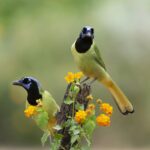
Tropical birds include some of the most colorful, unusual, and specialized birds on Earth. Brilliant macaws sweep over rainforest canopies, hummingbirds hover beside flowers, toucans reach for fruit with enormous bills, and quetzals disappear almost magically into green cloud forests. In other parts of the tropics, hornbills, sunbirds, cassowaries, parrots, kingfishers, and birds-of-paradise occupy equally remarkable ecological niches.
“Tropical bird” is not a scientific classification. Instead, the term generally refers to birds that live primarily in tropical regions—the warm zone surrounding the equator between the Tropic of Cancer and the Tropic of Capricorn. Many tropical species are closely associated with rainforests, but tropical birds also inhabit cloud forests, dry forests, wetlands, mangroves, grasslands, islands, mountains, and even cities.
The tropics support extraordinary bird diversity. Forests are especially important: BirdLife International estimates that forests are used by about 78% of the world’s bird species, with tropical and subtropical forests supporting a particularly large share of that diversity.
From tiny hummingbirds weighing only a few grams to imposing cassowaries standing nearly as tall as a person, tropical birds demonstrate just how many different ways birds have evolved to survive.
🌴 What Are Tropical Birds?
Tropical birds are birds that live in or regularly use habitats within Earth’s tropical regions. These areas generally experience relatively warm temperatures throughout the year, although rainfall, elevation, and seasonality can vary enormously.
A tropical rainforest may receive abundant rainfall throughout the year, while a tropical dry forest can experience a pronounced dry season. Mountainous tropical regions can become surprisingly cool, and high-elevation cloud forests may bear little resemblance to the steamy jungle many people imagine when they hear the word “tropical.”
As a result, there is no single body shape, diet, color, or behavior that defines a tropical bird.
Some tropical birds are brilliantly colored. Others are brown, gray, or nearly invisible against fallen leaves. Some eat fruit, while others specialize in nectar, insects, fish, seeds, small animals, or combinations of foods.
Many species spend their entire lives within the tropics. Others share tropical ecosystems only part of the year. Migratory birds from North America, for example, may breed thousands of miles north of the tropics before spending the winter in Central America, the Caribbean, or northern South America.
🌎 Where Do Tropical Birds Live?
Tropical birds occur around the world, but several regions are particularly famous for their diversity.
Central and South America
The tropical Americas—often called the Neotropics—contain an astonishing variety of birdlife. Tropical Mexico, Central America, the Caribbean, the Amazon Basin, the Atlantic Forest, and the tropical Andes all support distinctive bird communities.
This is the realm of toucans, macaws, hummingbirds, motmots, manakins, tanagers, antbirds, jacamars, trogons, quetzals, and many other groups.
South America is especially rich in bird species, while the mountains of the Tropical Andes contain exceptional numbers of species with relatively small geographic ranges.
Africa
Tropical Africa includes the immense Congo Basin along with forests, wetlands, savannas, and mountains elsewhere across the continent.
African tropical birds include turacos, hornbills, bee-eaters, sunbirds, kingfishers, parrots, pittas, barbets, and numerous forest songbirds.
The African Grey Parrot is one of the best-known forest birds of equatorial Africa and is renowned for its intelligence and vocal learning abilities.
Southeast Asia
The tropical forests of Southeast Asia support hornbills, broadbills, pittas, pheasants, kingfishers, parrots, woodpeckers, and hundreds of other species.
Borneo, Sumatra, the Malay Peninsula, the Philippines, and Indonesia are especially important centers of biodiversity and endemism.
Many birds in this region face severe pressure as lowland forests are cleared or fragmented.
New Guinea and Northern Australia
New Guinea contains one of the world’s most spectacular tropical bird communities. Birds-of-paradise are its most celebrated residents, but the region also supports cassowaries, kingfishers, fruit-doves, parrots, honeyeaters, bowerbirds, and many other distinctive birds.
Tropical habitats continue south into northern Australia and the rainforests of northeastern Queensland.
Tropical Islands
Isolation has produced unusual bird communities on tropical islands throughout the Pacific, Indian Ocean, Atlantic, and Caribbean.
Some island species evolved for millions of years with few predators or competitors. That specialization can make them exceptionally interesting—but also particularly vulnerable when invasive predators, habitat destruction, or disease are introduced.
🌳 Tropical Bird Habitats
Calling a bird “tropical” tells us surprisingly little about the exact environment in which it lives. Tropical habitats range from flooded forests to dry savannas.
Tropical Rainforests
Lowland tropical rainforests are among the most bird-rich environments on Earth. Their layered structure creates numerous ecological niches.
Birds may specialize in the forest floor, understory, middle levels, canopy, or emergent trees towering above the rest of the forest.
Fruit-eating toucans and parrots frequently move through the canopy, while secretive antbirds may forage much closer to the ground.
Cloud Forests
Cloud forests occur on tropical mountains where frequent clouds and mist keep vegetation moist.
These forests support mosses, orchids, bromeliads, ferns, and fruiting trees. They are also home to highly specialized birds.
The spectacular Resplendent Quetzal is closely associated with humid mountain forests of Central America.
Tropical Dry Forests
Not every tropical forest is perpetually wet. Tropical dry forests experience significant seasonal changes in rainfall.
Trees may shed their leaves during the dry season, and bird activity can shift as flowers, fruit, insects, and water become more or less abundant.
Mangroves and Wetlands
Tropical coastlines contain mangroves, estuaries, mudflats, lagoons, and swamps that support herons, kingfishers, rails, shorebirds, parrots, raptors, and other species.
These habitats are also important to many migratory birds traveling between temperate breeding grounds and tropical wintering areas.
Savannas and Open Woodlands
Many tropical birds live far from dense rainforest.
Tropical grasslands and savannas support raptors, seed-eating birds, rollers, bee-eaters, bustards, hornbills, and numerous other species adapted to more open landscapes.
🦜 Major Types of Tropical Birds
Tropical regions contain thousands of bird species belonging to many unrelated families. Several groups are especially closely associated with tropical landscapes.
| Bird Group | Best Known For | Main Tropical Region |
|---|---|---|
| Macaws | Large size and brilliant plumage | Central and South America |
| Toucans | Oversized colorful bills | Central and South America |
| Hummingbirds | Hovering flight and nectar feeding | Americas |
| Quetzals | Iridescent plumage and long tail feathers | Central America and northern South America |
| Tanagers | Exceptional variety of colors | Americas |
| Manakins | Elaborate courtship displays | Central and South America |
| Hornbills | Large bills and unusual nesting behavior | Africa and Asia |
| Sunbirds | Nectar feeding and colorful plumage | Africa and Asia |
| Birds-of-paradise | Extraordinary courtship displays | New Guinea and surrounding region |
| Cassowaries | Large flightless forest birds | New Guinea and northeastern Australia |
| Parrots | Intelligence, powerful bills, and vocal ability | Worldwide tropics |
| Pittas | Colorful but secretive forest-floor habits | Africa, Asia, and Australasia |
These groups represent only a fraction of tropical bird diversity.
🦜 Macaws and Parrots

Few birds symbolize the tropics as strongly as macaws.
Macaws are large New World parrots distinguished by powerful hooked bills, strong feet, long tails, and often spectacular combinations of red, blue, green, and yellow feathers. Species such as the Scarlet Macaw and Blue-and-Yellow Macaw can travel considerable distances between feeding and roosting sites.
Parrots as a whole occur throughout tropical and subtropical regions of the world.
Their bills are excellent tools for cracking nuts, manipulating food, climbing, and investigating objects. Their feet are also highly dexterous, allowing many parrots to grasp food and bring it toward the bill.
Learn more about the Blue-and-Yellow Macaw and the African Grey Parrot.
🌈 Toucans
Toucans live in the tropical Americas and are instantly recognizable by their enormous bills.
Despite their size, toucan bills are relatively lightweight. They help birds reach fruit growing on branches that may be difficult to access with the entire body. Research has also shown that the bill can play an important role in thermoregulation by helping a toucan release excess body heat.
Fruit forms a major part of the diet of many toucans, making these birds important seed dispersers. They may swallow fruit and later deposit seeds elsewhere in the forest, helping plants colonize new areas.
Toucans also consume insects and other animal foods, and some species occasionally prey on eggs or nestlings.
Read more in our Toucan guide.
💚 Quetzals
Quetzals belong to the trogon family and live in forests of the tropical Americas.
The Resplendent Quetzal is the most famous member of the group. Males possess brilliant green plumage, a red breast, and elongated upper tail coverts that can extend dramatically beyond the rest of the body.
Quetzals eat fruit as well as insects and small animals. Wild avocados and related fruits are particularly important to Resplendent Quetzals in portions of their range.
Cloud forests of Central America provide some of the best opportunities to see these remarkable birds.
Explore the Resplendent Quetzal in greater detail.
🌺 Hummingbirds
Hummingbirds occur naturally only in the Americas, with the greatest diversity found in tropical regions.
Their ability to hover allows them to remain almost stationary in front of flowers while feeding. Their wings can also generate force during both portions of the wingbeat, giving hummingbirds exceptional maneuverability.
Different hummingbird species possess dramatically different bill shapes. Some have short, straight bills, while others have extraordinarily long or curved bills adapted to particular flowers.
Although nectar supplies much of their energy, hummingbirds also eat small arthropods, which provide protein and other nutrients.
The relationship between hummingbirds and flowers is one of the most fascinating examples of ecological specialization in tropical ecosystems. In some cases, flower shape and hummingbird bill shape correspond closely, allowing birds to obtain nectar while simultaneously carrying pollen from one flower to another.
See our complete Hummingbirds: Species, Identification, Feeding & Backyard Guide.
🪶 Birds-of-Paradise

Birds-of-paradise are most diverse on New Guinea and nearby islands.
Many species are famous for extraordinary male plumage and elaborate courtship behavior. Males may transform their feathers into fans, disks, capes, or shimmering displays while dancing for females.
In several species, males gather at traditional display locations called leks. Females visit these locations, observe competing males, and choose mates.
These displays are powerful examples of sexual selection—the evolutionary process in which traits that improve mating success can become increasingly exaggerated over generations.
Not every bird-of-paradise looks spectacular, however. Females of many species have relatively subdued brown plumage that provides valuable camouflage while nesting.
🐦 Hornbills
Hornbills fill parts of Africa and Asia with a silhouette that sometimes brings toucans to mind. Despite their superficial resemblance, hornbills and toucans belong to different evolutionary lineages.
Many hornbills have enormous curved bills, sometimes topped with an additional structure called a casque.
Their nesting behavior is particularly unusual. In many species, the female enters a tree cavity and seals much of the entrance with mud, droppings, or other material, leaving only a narrow opening. The male passes food through this opening while the female incubates her eggs and cares for the young during part of the nesting cycle.
Fruit-eating hornbills can also be important seed dispersers in tropical forests.
🐦 Cassowaries
Not all tropical birds fly through the canopy.
Cassowaries are large, flightless birds of New Guinea, nearby islands, and northeastern Australia. Their dark feathers, powerful legs, colorful bare skin, and prominent casque give them an almost prehistoric appearance.
They spend much of their time on the forest floor and eat large quantities of fruit.
Because cassowaries can swallow fruits containing relatively large seeds and move them through the forest, they are important seed dispersers for some tropical plants.
They also demonstrate why tropical birds should never be assumed to be small or brightly colored canopy dwellers.
🎨 Why Are So Many Tropical Birds Colorful?
The vivid plumage of tropical birds has fascinated people for centuries, but bright coloration can serve several biological purposes.
Color may help birds attract mates, recognize members of their own species, signal social status, or communicate during territorial encounters.
Not all tropical coloration is produced in the same way.
Some feather colors come from pigments. Others are structural colors created when microscopic feather structures interact with light. The shimmering greens and blues seen on many tropical birds can change dramatically depending on viewing angle.
Bright plumage does not necessarily make a bird conspicuous to predators. A green parrot sitting among sunlit leaves can be remarkably difficult to see. Light and shadow in a rainforest canopy create a complex visual environment in which seemingly brilliant colors can provide surprisingly effective camouflage.
And many tropical birds are not colorful at all. Antbirds, ovenbirds, nightjars, tinamous, and numerous other forest species rely heavily on shades of brown, gray, olive, or black.
🧬 Amazing Tropical Bird Adaptations
Tropical birds have evolved countless adaptations to exploit different ecological opportunities.
Specialized Bills
Bill shape often provides clues to diet.
Macaws have powerful bills for manipulating nuts, fruits, and seeds. Hummingbirds have slender bills suited to feeding from flowers. Toucans use long bills to reach fruit. Kingfishers possess pointed bills capable of capturing aquatic prey, while raptors use hooked bills to tear food.
Specialized Feet
Parrots have zygodactyl feet, with two toes facing forward and two backward, providing a powerful grip.
Many canopy birds possess feet adapted for perching, while forest-floor birds may have strong legs for walking, scratching through leaf litter, or running.
Life at Different Forest Levels
A tropical forest is not one uniform habitat.
Species can specialize in particular vertical layers. A bird living near the ground experiences different light levels, predators, foods, and vegetation than a species living 100 feet above it.
This division of the forest helps large numbers of species coexist within the same general area.
Fruit and Seed Dispersal
Fruit-eating birds perform an essential ecological service.
After consuming fruit, birds may transport seeds away from the parent plant. Seeds can eventually be dropped or passed through the digestive system in another location.
Toucans, hornbills, quetzals, fruit-doves, cotingas, and many other tropical birds participate in these relationships.
Nectar Feeding and Pollination
Hummingbirds and sunbirds are among the best-known nectar-feeding birds.
As birds move among flowers, pollen can become attached to their feathers or bills and later reach another flower.
These interactions connect bird survival directly with plant reproduction.
Courtship Displays
Competition for mates has produced some of the most elaborate behaviors in the bird world.
Birds-of-paradise manipulate specialized feathers during carefully choreographed performances. Manakins may snap their wings, leap between branches, moonwalk along perches, or cooperate in coordinated displays.
For some tropical birds, courtship is as remarkable as their plumage.
🍌 What Do Tropical Birds Eat?
There is no single tropical bird diet.
Fruit is extremely important in many tropical forests. Figs, berries, palm fruits, and numerous other fruits support parrots, toucans, hornbills, quetzals, fruit-doves, tanagers, and many additional birds.
Other tropical species specialize in nectar.
Insect-eating birds search leaves, bark, branches, dead wood, or the forest floor. Some follow army-ant swarms, not primarily to eat the ants, but to capture insects and other small animals flushed from hiding as the ants advance.
Tropical raptors hunt birds, mammals, reptiles, and other prey. Kingfishers and other aquatic birds catch fish and aquatic animals. Seed-eaters concentrate on grasses, bamboo, palms, and other seed-producing plants.
Many species are opportunistic and switch between foods according to the season.
🪺 How Tropical Birds Nest
Tropical bird nesting strategies are every bit as diverse as their diets.
Toucans, parrots, hornbills, trogons, and many other birds use cavities in trees. Hummingbirds typically construct tiny cup nests. Weaverbirds create intricate hanging nests. Some kingfishers and bee-eaters excavate tunnels into banks or soil.
Birds nesting in tropical regions face predators ranging from snakes and monkeys to other birds and mammals.
Camouflage, hidden nest locations, alarm calls, cooperative defense, and secretive behavior can all improve the chances that eggs and chicks survive.
Tropical environments do not always produce the large seasonal burst of nesting familiar to birdwatchers in northern temperate regions. Breeding periods can instead be influenced by regional wet and dry seasons, flowering cycles, fruit availability, and insect abundance.
🌎 Best Places to See Tropical Birds
For birdwatchers, traveling in the tropics can transform an ordinary morning walk into an unforgettable experience.
Costa Rica
Costa Rica is one of the world’s most accessible destinations for tropical birding.
Lowland rainforest, Caribbean forest, Pacific dry forest, wetlands, and high-elevation cloud forests occur within a relatively small country.
Birders may encounter toucans, motmots, hummingbirds, parrots, tanagers, trogons, and Resplendent Quetzals.
Monteverde and the highlands around Savegre are especially famous for cloud-forest birding.
Panama
Panama’s location between North and South America produces exceptional bird diversity.
The forests surrounding the Panama Canal are legendary among birdwatchers. Pipeline Road is particularly well known for tropical forest species, while western Panama provides access to mountain and cloud-forest communities.
Panama also lies along important migratory routes used by enormous numbers of birds moving between North and South America.
Ecuador
Few destinations pack as many dramatically different bird habitats into such a compact area as Ecuador.
Birders can explore the Amazon Basin, Chocó forests, Andean cloud forests, high-elevation páramo, and Pacific environments.
The Chocó-Andes is especially notable for endemic birds—species found nowhere else.
Peru
Peru combines Amazon rainforest with the enormous elevational range of the Andes.
Traveling from lowland forest into Andean foothills and cloud forests can reveal completely different bird communities over relatively short geographic distances.
Macaws, hummingbirds, tanagers, antbirds, toucans, cotingas, and numerous Andean specialties make the country particularly appealing to serious birders.
Brazil
Brazil contains a huge portion of South America’s tropical bird diversity.
The Amazon is the obvious destination, but it is far from the country’s only important birding region. The Atlantic Forest contains numerous endemic species, while the Pantanal’s more open wetlands and woodlands can make large birds easier to observe.
Trinidad and Tobago
Located just off the coast of South America, Trinidad and Tobago combine Caribbean accessibility with birdlife strongly influenced by the South American mainland.
Hummingbirds, tanagers, toucans, motmots, manakins, and the brilliant Scarlet Ibis are among the attractions.
Uganda
Uganda allows birders to experience both tropical African forests and more open East African environments.
Forest reserves and national parks can reveal turacos, hornbills, barbets, sunbirds, kingfishers, and numerous other species.
Borneo
Borneo is one of Southeast Asia’s great tropical bird destinations.
Its forests contain hornbills, broadbills, pittas, barbets, kingfishers, woodpeckers, and many endemic species.
Remaining areas of mature rainforest are exceptionally important because extensive habitat conversion has occurred throughout parts of the region.
New Guinea
For birders fascinated by evolutionary oddities, New Guinea belongs near the top of the list.
It is the great stronghold of birds-of-paradise and also supports parrots, fruit-doves, kingfishers, bowerbirds, honeyeaters, cassowaries, and numerous endemic species.
Birding can be more logistically challenging than in destinations such as Costa Rica, but the birdlife is extraordinary.
Northeastern Australia
Queensland’s Wet Tropics provide an accessible introduction to Australasian rainforest birds.
The region supports cassowaries, fruit-doves, kingfishers, honeyeaters, parrots, riflebirds, and many other species.
🔭 Tips for Tropical Birdwatching
Tropical forests can contain tremendous numbers of birds without making those birds easy to see.
Dense foliage may hide a bird only a few yards away. Learning calls can therefore be just as valuable as learning plumage.
Early mornings are usually productive, particularly when birds are actively feeding and calling. Watching fruiting trees can also pay off because one productive tree may attract several species.
Look at multiple levels of the forest rather than concentrating only on the canopy. Scan exposed dead branches for perched birds, search flowering shrubs for hummingbirds, and listen carefully for activity in dense understory vegetation.
A local birding guide can be especially useful in unfamiliar tropical habitats. Experienced guides know local calls, seasonal movements, feeding trees, and the subtle behaviors that reveal hidden species.
Most importantly, give birds space. Avoid disturbing nests, crowding rare species, or using excessive playback of recorded calls.

🌱 Why Tropical Birds Matter
Tropical birds do far more than make forests colorful.
Fruit-eating species move seeds across the landscape. Nectar feeders pollinate flowers. Insectivorous birds consume enormous numbers of arthropods. Predatory birds influence populations of prey species, while scavengers help remove animal remains.
Birds are therefore interconnected with the broader ecosystems around them.
When tropical forests lose their birds, ecological relationships developed over thousands or millions of years can also be disrupted.
A tree that depends heavily on large fruit-eating birds for seed dispersal, for example, may struggle to reproduce effectively if those birds disappear.
⚠️ Threats to Tropical Birds
Habitat destruction remains one of the most serious threats facing tropical bird populations.
Forests are cleared or degraded for agriculture, livestock production, logging, roads, mining, settlements, and other development. Fragmentation can leave remaining forest patches too small or isolated for sensitive species.
BirdLife International has documented especially serious forest loss in several tropical regions, including Southeast Asia.
Other threats include hunting, trapping for the wildlife trade, invasive species, pollution, collisions with human structures, and climate change.
Island species can be particularly vulnerable to introduced predators such as rats and cats.
Mountain birds face another problem: species adapted to cool tropical elevations may have limited opportunities to move higher as temperatures change. Eventually, there may simply be no higher habitat available.
🌿 Helping Protect Tropical Birds
People do not need to live in the tropics to help protect tropical birds.
Some migratory birds seen in North American yards and forests spend a large portion of their annual cycle in tropical America. Conservation of forests in Mexico, Central America, and South America can therefore directly affect birds that later appear thousands of miles farther north.
Choosing sustainably produced products, supporting organizations protecting tropical habitat, and selecting bird-friendly shade-grown coffee can all contribute to conservation efforts.
Travelers can also help by choosing responsible birding guides, parks, reserves, and locally operated ecotourism businesses that give communities an economic reason to conserve wildlife habitat.
Responsible tourism cannot solve every conservation problem, but well-managed birding tourism can make intact forests economically valuable to the communities that live beside them.
❓ Tropical Birds FAQ
Are all tropical birds brightly colored?
No. The tropics contain many spectacularly colored birds, but they also contain thousands of species with brown, gray, black, olive, or otherwise subdued plumage. Camouflage can be especially useful to birds living on the forest floor or nesting in dense vegetation.
Are parrots tropical birds?
Many parrots are tropical or subtropical, although the parrot family is not restricted exclusively to hot rainforest habitats. Parrots occur in the Americas, Africa, Asia, Australia, New Guinea, and many Pacific islands.
Are hummingbirds tropical?
Hummingbirds originated in the Americas and reach their greatest diversity in tropical regions, particularly Central and South America. Some species, however, breed far into temperate North America.
What is the most colorful tropical bird?
There is no objective winner. Resplendent Quetzals, Scarlet Macaws, Rainbow Lorikeets, Keel-billed Toucans, Paradise Tanagers, Gouldian Finches, and numerous birds-of-paradise could all compete for the title.
Which tropical region has the most bird species?
The tropical Americas, particularly South America, contain the greatest overall bird species richness. The Amazon Basin and Tropical Andes are among the world’s most important regions for avian diversity.
Do tropical birds migrate?
Some do and some do not. Many tropical species are year-round residents, but others make seasonal or elevational movements. The tropics also provide winter habitat for large numbers of migratory birds that breed in temperate regions.
Can tropical birds live in cities?
Yes. Some tropical species adapt surprisingly well to parks, gardens, farms, and urban environments. Others require intact forest and disappear rapidly when their habitat is disturbed.
What is the best country for seeing tropical birds?
There is no single best destination, but Costa Rica, Panama, Ecuador, Peru, Brazil, Uganda, Malaysia, Indonesia, Papua New Guinea, and tropical Australia all offer exceptional opportunities. Costa Rica and Panama are particularly approachable choices for someone making a first tropical birding trip.
🌺 A World of Tropical Birds
Tropical birds reveal just how inventive evolution can be.
A hummingbird can hover in front of a flower. A toucan can use an enormous bill to reach fruit and shed excess heat. A hornbill can seal its mate inside a nesting cavity. A bird-of-paradise can transform itself into an almost unrecognizable shape during courtship. A cassowary can carry large rainforest seeds through the forest on powerful legs.
Yet the greatest wonder may be the diversity itself.
Every layer of a tropical forest can hold a different community of birds, and crossing a mountain range, river, island channel, or habitat boundary may reveal species found nowhere else.
Protecting tropical birds consequently means protecting far more than individual animals. It means conserving forests, wetlands, flowers, fruiting trees, insects, migration routes, and the complex ecological relationships connecting them all.
For bird lovers, tropical regions offer a lifetime of discoveries—and a powerful reminder of how much avian diversity remains beyond our own backyards.
🔗 Related Articles
- Hummingbirds: Species, Identification, Feeding & Backyard Guide
- Toucan
- Resplendent Quetzal
- Blue-and-Yellow Macaw
- African Grey Parrot: Intelligence, Habitat, Behavior & Conservation
- Tropical Birds Archive
📚 Sources
- BirdLife International — Birds Are Found Worldwide in All Countries and Major Habitats, With Some Being Particularly Important
BirdLife DataZone - BirdLife International — Lost: Accelerating Deforestation a Major Threat to Birds
BirdLife International - BirdLife International — Global Birdfair Supporting Efforts to Save Ecuador’s Chocó-Andes
BirdLife International: Chocó-Andes - Cornell Lab of Ornithology — Central America’s Five Great Forests Are Lifelines for North America’s Migratory Birds
Cornell Lab of Ornithology - Smithsonian Institution — Smithsonian Scientist Proves Pollinators Are More Than Just “Ornaments of Life”
Smithsonian Institution - Smithsonian Migratory Bird Center — Tropical Forest and Tropical Zone Educational Resources
Smithsonian Migratory Bird Center - National Audubon Society — 6 Nearby Tropical Birding Hotspots to Escape to This Winter
Audubon - National Audubon Society — Panama
Audubon: Panama