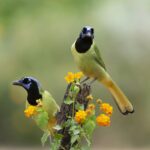
Hawaiʻi is one of the most extraordinary places in the world for birds. Isolated in the central Pacific Ocean for millions of years, the Hawaiian Islands became a natural laboratory of evolution, where birds arriving from distant lands gradually developed into species found nowhere else on Earth.
Brilliant red honeycreepers move through flowering ʻōhiʻa forests. Nēnē walk across volcanic landscapes. Hawaiian hawks circle above native forest, while albatrosses, tropicbirds, shearwaters, and boobies patrol the rugged coastline. During migration, shorebirds that have traveled thousands of miles across the Pacific join the islands’ resident birds.
Yet the birds people encounter in Hawaiʻi today tell two very different stories. High in protected forests and remote wetlands, remarkable native and endemic species survive. In cities, resorts, parks, farms, and other lowland areas, introduced birds such as mynas, doves, cardinals, and Japanese white-eyes are often much more conspicuous.
Understanding the difference makes birdwatching in Hawaiʻi much more rewarding.
🐦 Birds of Hawaii at a Glance
| Bird Group | Examples |
|---|---|
| Endemic forest birds | ʻIʻiwi, ʻApapane, Palila, ʻAkiapōlāʻau, ʻElepaio |
| Endemic waterfowl | Nēnē, Koloa Maoli |
| Native wetland birds | Hawaiian Coot, Hawaiian Stilt, Hawaiian Common Gallinule |
| Native raptors | ʻIo, Pueo |
| Native seabirds | Hawaiian Petrel, Newell’s Shearwater, Laysan Albatross, tropicbirds, boobies |
| Migratory shorebirds | Pacific Golden-Plover, Ruddy Turnstone, Wandering Tattler |
| Common introduced birds | Common Myna, Zebra Dove, Spotted Dove, Japanese White-eye, Northern Cardinal, Red-crested Cardinal, Java Sparrow |
One reason Hawaiian birding can be confusing is that a colorful or abundant bird is not necessarily native. Some of the birds most commonly seen around hotels, neighborhoods, beaches, and city parks were introduced by people.
Many of the genuinely Hawaiian birds require a little more effort to find.
🌺 Native vs. Endemic vs. Introduced Birds
These three terms are especially important when discussing the birds of Hawaiʻi.
Native birds occur naturally in Hawaiʻi without having been introduced by people. This includes resident birds as well as migratory species that naturally travel to the islands.
Endemic birds are native species or subspecies whose natural range is limited to Hawaiʻi. Some are restricted even further to a single island.
Introduced birds were brought to Hawaiʻi directly or indirectly through human activity and later established wild populations.
An endemic Hawaiian bird is therefore native, but not every native Hawaiian bird is endemic.
The Pacific Golden-Plover, for example, naturally migrates to Hawaiʻi but also occurs elsewhere. The ʻIʻiwi, by contrast, evolved in Hawaiʻi and is found nowhere else naturally.
❤️ Remarkable Endemic Birds of Hawaii
Hawaiʻi’s endemic birds are the stars of the islands’ avifauna. Many have become highly specialized for particular foods, habitats, elevations, and islands.
ʻIʻiwi
Few birds symbolize Hawaiʻi’s native forests as beautifully as the ʻIʻiwi (Drepanis coccinea).
Adults are brilliant scarlet-red with contrasting black wings and tail. Their most distinctive feature is an elongated, curved orange or salmon-colored bill adapted for feeding among flowers.
ʻIʻiwi are strongly associated with native flowering forests, particularly areas containing ʻōhiʻa lehua. They travel considerable distances through the forest in search of nectar and also consume insects.
Once much more widespread, ʻIʻiwi are now most reliably encountered in higher-elevation native forests, especially on Hawaiʻi Island and Maui.
ʻApapane
The ʻApapane (Himatione sanguinea) is another crimson Hawaiian honeycreeper, but it can be distinguished from the ʻIʻiwi by its shorter, dark bill and contrasting pale undertail area.
ʻApapane are among the more abundant surviving Hawaiian honeycreepers and are closely associated with flowering ʻōhiʻa trees.
When ʻōhiʻa lehua is in bloom, these lively birds may move rapidly from tree to tree, feeding on nectar and calling frequently.
Because both species are red and black, beginning birdwatchers sometimes confuse ʻApapane with ʻIʻiwi. Look carefully at the bill: long, dramatically curved, and orange on an ʻIʻiwi; shorter and dark on an ʻApapane.
Nēnē

The Nēnē (Branta sandvicensis), or Hawaiian Goose, is Hawaiʻi’s official state bird.
This endemic goose has a black face and crown, buff-colored cheeks, a strongly furrowed neck, and a barred gray-brown body. Its feet are less extensively webbed than those of many aquatic geese, an adaptation that helps it move across Hawaiʻi’s rugged volcanic terrain.
Nēnē came extraordinarily close to extinction during the twentieth century. Captive breeding, habitat protection, predator control, and reintroduction programs helped the population recover significantly.
The species was federally downlisted from endangered to threatened in 2019, although it continues to require active protection.
Today Nēnē can be encountered on several Hawaiian islands, including Hawaiʻi, Maui, Kauaʻi, Molokaʻi, and Oʻahu.
Palila
The Palila (Loxioides bailleui) is one of Hawaiʻi’s most distinctive surviving honeycreepers.
Adults have a yellow head, gray back, pale underside, and a thick finch-like bill. Unlike nectar-feeding honeycreepers such as the ʻIʻiwi, Palila are closely associated with the dry, high-elevation māmane forests of Hawaiʻi Island.
Māmane seeds form an important part of their diet.
The Palila’s highly restricted habitat makes it one of Hawaiʻi’s most vulnerable birds. Birders hoping to see one generally need to explore suitable high-elevation habitat on the slopes of Mauna Kea while carefully respecting protected areas and access rules.
ʻAkiapōlāʻau
Few Hawaiian birds demonstrate evolutionary specialization as dramatically as the ʻAkiapōlāʻau (Hemignathus munroi).
This endangered honeycreeper occurs only on Hawaiʻi Island and possesses an extraordinary two-part bill. The shorter lower mandible is used to probe and peck into bark, while the long, curved upper mandible helps extract insects hidden within wood.
Its feeding strategy fills an ecological role somewhat similar to that occupied by woodpeckers elsewhere.
ʻAkiapōlāʻau primarily inhabit mature native forests containing koa and ʻōhiʻa and can be difficult to find.
ʻIo — Hawaiian Hawk
The ʻIo (Buteo solitarius), commonly called the Hawaiian Hawk, is Hawaiʻi’s only surviving native hawk.
It occurs naturally only on Hawaiʻi Island.
Plumage varies considerably. Some individuals are dark brown, while others are much paler underneath. Birders may see ʻIo soaring above forests, pastures, agricultural land, and other open areas.
Its diet can include birds, insects, small mammals, and other available prey.
The silhouette of an ʻIo circling above a Hawaiian forest is a reminder that Hawaiʻi’s endemic birdlife includes predators as well as nectar-feeding songbirds.
Pueo
The Pueo is Hawaiʻi’s endemic form of the Short-eared Owl (Asio flammeus sandwichensis).
Unlike many owls, Pueo may be active during daylight, particularly around dawn and dusk. They hunt over grasslands, shrublands, agricultural fields, and open country.
Pueo have great cultural importance in Hawaiʻi and appear in Native Hawaiian traditions as ʻaumakua, or ancestral guardian spirits, for some families.
Although they can be encountered on several islands, populations and sightings vary considerably.
Koloa Maoli — Hawaiian Duck
The Koloa Maoli (Anas wyvilliana), or Hawaiian Duck, is an endemic dabbling duck associated with freshwater wetlands, streams, ponds, flooded fields, and other aquatic habitats.
It resembles a small female Mallard, with mottled brown plumage.
One major conservation challenge is hybridization with introduced feral Mallards. Protecting genetically distinct Koloa populations and suitable wetland habitat remains important to the species’ future.
🌳 Hawaiian Honeycreepers and the Story of Island Evolution
Hawaiian honeycreepers are one of the world’s classic examples of adaptive radiation.
Their ancestors reached the remote Hawaiian Islands millions of years ago. Over immense periods of isolation, populations adapted to different foods and ecological niches.
The results were extraordinary.
Some species developed long curved bills for reaching nectar inside flowers. Others evolved short bills for catching insects, powerful bills for cracking seeds, or specialized bills for probing beneath bark.
The ʻIʻiwi, ʻApapane, Palila, ʻAkiapōlāʻau, ʻĀkepa, ʻAnianiau, ʻĀkohekohe, and other surviving birds represent only part of what was once a much richer radiation of Hawaiian forest birds.
Many Hawaiian honeycreeper species disappeared after humans reached the islands, and losses accelerated after the introduction of additional predators, habitat changes, mosquitoes, and avian diseases.
The surviving species are therefore not simply beautiful birds. They are remnants of one of Earth’s most remarkable evolutionary stories.
💧 Native Wetland Birds
Hawaiʻi’s wetlands provide habitat for another important group of native birds.
Hawaiian Coot
The Hawaiian Coot, or ʻAlae Keʻokeʻo (Fulica alai), is an endemic waterbird with a dark body and conspicuous white facial shield and bill.
It occurs around freshwater and brackish wetlands, ponds, reservoirs, and marshes.
Hawaiian Stilt
The Hawaiian Stilt, known as Aeʻo, is a distinctive Hawaiian form of the Black-necked Stilt.
Its extremely long pink legs, slender bill, white underside, and black upperparts make it relatively easy to recognize.
Aeʻo forage in shallow wetlands for aquatic invertebrates and other small prey.
Hawaiian Common Gallinule
The Hawaiian Common Gallinule, or ʻAlae ʻUla, is an endemic Hawaiian subspecies of the Common Gallinule.
Adults have dark plumage, a red frontal shield, and a red bill tipped with yellow. They inhabit marshes and densely vegetated freshwater wetlands.
Wetland protection is essential for all three birds because much of Hawaiʻi’s original lowland wetland habitat has been altered or lost.
🌊 Seabirds of Hawaii

Hawaiʻi’s birdlife extends far beyond the forests.
The isolated archipelago is surrounded by thousands of miles of Pacific Ocean, making its islands and offshore islets enormously important to seabirds.
Depending on location and season, birdwatchers may encounter:
- Laysan Albatross
- Black-footed Albatross
- Hawaiian Petrel
- Newell’s Shearwater
- Wedge-tailed Shearwater
- Red-footed Booby
- Brown Booby
- Great Frigatebird
- White-tailed Tropicbird
- Red-tailed Tropicbird
- Brown Noddy
- White Tern
Many seabirds spend most of their lives over the open ocean and return to land primarily to nest.
Cliffs, offshore islands, protected headlands, and predator-controlled nesting colonies can therefore provide spectacular viewing opportunities.
Because many seabirds nest on or near the ground, visitors should remain on designated trails and obey barriers around colonies.
🏖️ Migratory Birds That Travel to Hawaii
Not every naturally occurring Hawaiian bird lives on the islands year-round.
Each year, remarkable migratory shorebirds cross vast stretches of the Pacific to spend part of their annual cycle in Hawaiʻi.
Pacific Golden-Plover
The Pacific Golden-Plover, known in Hawaiʻi as Kōlea, is one of the most familiar migrants.
These long-distance travelers breed in the Arctic and migrate across the Pacific to wintering grounds that include the Hawaiian Islands.
Kōlea can appear in surprisingly ordinary locations, including lawns, parks, golf courses, fields, beaches, and open ground.
Ruddy Turnstone
Ruddy Turnstones, known as ʻAkekeke, frequent rocky shorelines, beaches, mudflats, and other coastal habitats.
Their habit of flipping stones, shells, and debris while searching for food gives them their English name.
Wandering Tattler
The Wandering Tattler, or ʻŪlili, is another regular visitor to Hawaiian shores.
It commonly feeds along rocky coastlines and can often be recognized by its gray appearance, relatively long legs, and characteristic bobbing movements.
These migrants add yet another dimension to Hawaiian birdwatching: some birds seen on a Hawaiian beach may have traveled thousands of miles to get there.
🏙️ Common Introduced Birds in Hawaii

Visitors are often surprised to discover that many of the birds they notice first are not native Hawaiian species.
Common introduced birds include:
- Common Myna
- Zebra Dove
- Spotted Dove
- Japanese White-eye
- Northern Cardinal
- Red-crested Cardinal
- Java Sparrow
- House Sparrow
- Red-billed Leiothrix
- Saffron Finch
- Cattle Egret
Introduced species are particularly conspicuous in urban areas, hotel grounds, gardens, agricultural areas, and lower-elevation habitats.
The bright red crest of a Northern Cardinal or the spectacular head pattern of a Red-crested Cardinal may look perfectly at home in a tropical landscape, but neither species evolved in Hawaiʻi.
The contrast between lowland introduced communities and high-elevation native forests is one of the most striking features of Hawaiian birdlife today.
🏝️ Birds by Hawaiian Island
Each island offers a different birding experience.
Hawaiʻi Island — The Big Island
Hawaiʻi Island provides some of the best opportunities to experience endemic Hawaiian forest birds.
Possible species include:
- ʻIʻiwi
- ʻApapane
- Hawaiʻi ʻAmakihi
- Hawaiʻi ʻElepaio
- ʻŌmaʻo
- ʻIo
- Palila
- ʻAkiapōlāʻau
- Hawaiʻi ʻĀkepa
- Hawaiʻi Creeper
- Nēnē
Hawaiʻi Volcanoes National Park offers some of the most accessible native-forest birdwatching, while the Hakalau Forest National Wildlife Refuge protects exceptional habitat for rare species.
Hakalau is not open to self-guided visitation, however. Birders interested in entering permitted areas must arrange access through authorized guides and follow current refuge rules.
Maui
Maui combines volcanic alpine landscapes, native forests, wetlands, and coastline.
Notable birds include:
- ʻIʻiwi
- ʻApapane
- Hawaiʻi ʻAmakihi
- Maui ʻAlauahio
- Kiwikiu
- ʻĀkohekohe
- Nēnē
- Hawaiian Petrel
- Hawaiian Coot
- Hawaiian Stilt
Haleakalā National Park is particularly important for native forest birds, while Keālia Pond National Wildlife Refuge offers excellent wetland birding.
Kauaʻi
As the oldest of the main Hawaiian Islands, Kauaʻi has an extraordinary but highly threatened endemic bird community.
Birds associated with the island include:
- ʻAnianiau
- Kauaʻi ʻAmakihi
- ʻApapane
- ʻIʻiwi
- ʻAkekeʻe
- Puaiohi
- Nēnē
Kōkeʻe State Park and the Alakaʻi region contain some of the island’s most important remaining native forest habitat.
Along the north shore, Kīlauea Point National Wildlife Refuge provides outstanding opportunities to see seabirds including albatrosses, boobies, tropicbirds, frigatebirds, and shearwaters.
Oʻahu
Oʻahu’s large human population and long history of ecological change mean introduced birds are especially conspicuous.
Nevertheless, the island retains important native species, including the Oʻahu ʻElepaio, Oʻahu ʻAmakihi, Pueo, native waterbirds, seabirds, and migratory shorebirds.
Kaʻena Point Natural Area Reserve is one of Oʻahu’s most rewarding birding destinations, particularly for Laysan Albatrosses and Wedge-tailed Shearwaters.
Molokaʻi and Lānaʻi
Molokaʻi and Lānaʻi generally receive less attention from visiting birders, but both can still offer opportunities to observe seabirds, shorebirds, Pueo, Nēnē in appropriate areas, and introduced lowland species.
The composition of native birds varies considerably among islands, one of the reasons Hawaiian birding rewards careful attention to geography.
🔭 Best Places to See Birds in Hawaii
Hawaiʻi Volcanoes National Park — Hawaiʻi Island
This enormous protected landscape is one of the best places for accessible native forest birding on the Big Island.
Kīpukapuaulu, sometimes called Bird Park, can produce ʻApapane, ʻŌmaʻo, ʻElepaio, and other native forest species. Other high-elevation areas of the park support ʻIʻiwi and Hawaiʻi ʻAmakihi.
Early morning is generally an excellent time to listen for the forest coming alive.
Hakalau Forest National Wildlife Refuge — Hawaiʻi Island
Hakalau protects exceptional montane forest and habitat for some of Hawaiʻi’s rarest birds, including several endangered honeycreepers.
Self-guided public access is currently closed. Visitors interested in birding Hakalau should check current U.S. Fish and Wildlife Service information and use an authorized guide when required.
Haleakalā National Park — Maui
Haleakalā offers opportunities to see ʻIʻiwi, ʻApapane, Hawaiʻi ʻAmakihi, Nēnē, and other native birds.
Hosmer Grove is one of the more accessible forest birding areas, while additional species occur deeper in suitable native habitat.
Keālia Pond National Wildlife Refuge — Maui
For wetlands rather than forest birds, Keālia Pond is an excellent destination.
Hawaiian Stilts and Hawaiian Coots can be seen here, and migratory shorebirds and waterfowl add variety during the appropriate seasons.
Kōkeʻe State Park & Alakaʻi Region — Kauaʻi
Kōkeʻe and the Alakaʻi Plateau contain some of the most important remaining high-elevation habitat for Kauaʻi’s endemic forest birds.
Birding here can be challenging because some species are now extremely scarce, but the region remains enormously significant to Hawaiian bird conservation.
Kīlauea Point National Wildlife Refuge — Kauaʻi
Few locations offer such convenient views of Hawaiian seabirds.
Possible sightings include Laysan Albatrosses, Red-footed Boobies, Brown Boobies, Great Frigatebirds, tropicbirds, Wedge-tailed Shearwaters, Pacific Golden-Plovers, and Nēnē.
Access rules and reservation requirements can change, so check current refuge information before visiting.
Kaʻena Point Natural Area Reserve — Oʻahu
At the remote western tip of Oʻahu, Kaʻena Point protects coastal habitat and important seabird nesting areas.
Laysan Albatrosses and Wedge-tailed Shearwaters breed here, while boobies, frigatebirds, tropicbirds, migratory shorebirds, and Pueo may also be encountered.
🌤️ Best Time for Birdwatching in Hawaii
Birdwatching is possible in Hawaiʻi throughout the year.
For forest birds, early morning is often best. Temperatures are cooler, bird activity can be higher, and vocalizations make locating birds easier.
Fall through spring can be especially rewarding for migratory shorebirds and waterfowl. Seabird viewing varies according to the species and its nesting schedule.
Rather than choosing a single “best month,” plan around the type of birds you most want to see.
For many visitors, a combination of high-elevation forest birding and coastal or wetland birding provides the greatest variety.
🔍 Tips for Finding Native Hawaiian Birds
Seeing native birds in Hawaiʻi often requires a different strategy from simply watching birds around a hotel or neighborhood.
Go higher. Many surviving Hawaiian forest birds are concentrated in cooler, higher-elevation native forests.
Look for ʻōhiʻa. Flowering ʻōhiʻa lehua is an important nectar source for birds such as ʻIʻiwi and ʻApapane.
Start early. Dawn and the first few hours of morning are often excellent for forest activity.
Listen first. Dense vegetation can make Hawaiian forest birds difficult to see. Learning their calls can dramatically improve your chances.
Bring binoculars. Many birds remain high in the canopy or far across protected habitat.
Visit several habitats. Forests, wetlands, rocky coasts, grasslands, and seabird colonies support very different communities.
Pay attention to elevation. An urban park at sea level and a native forest several thousand feet above it may contain almost completely different birds.
⚠️ Why Are So Many Hawaiian Birds Endangered?
Hawaiian birds evolved in extreme isolation, without many of the predators and diseases common on continents.
That isolation created remarkable species—but also left them vulnerable when new threats arrived.
Major threats include:
Avian Malaria
Non-native mosquitoes transmit avian malaria, a disease to which many native Hawaiian forest birds have little resistance.
Historically, cooler high-elevation forests provided some refuge because mosquitoes were less common there. Warmer temperatures have increased concern that mosquitoes and disease can expand farther upslope.
Conservation programs are now using landscape-scale mosquito suppression as one tool to protect highly vulnerable forest birds.
Introduced Predators
Rats, cats, mongooses, and other introduced mammals prey on native birds, eggs, and nestlings.
Species that evolved on islands without mammalian predators may be particularly vulnerable.
Habitat Loss
Agriculture, development, invasive plants, grazing animals, and other landscape changes have greatly reduced or altered native Hawaiian habitat.
Invasive Species
Introduced plants and animals can change forest structure, compete with native wildlife, damage vegetation, or create conditions favorable to additional threats.
Disease and Forest Decline
The health of native birds is closely tied to the health of native forests.
Threats such as Rapid ʻŌhiʻa Death are especially concerning because ʻōhiʻa forests provide food, nesting habitat, and shelter for numerous Hawaiian species.
🌱 Protecting Hawaii’s Birds
Conservation programs throughout Hawaiʻi are working to prevent additional extinctions.
Efforts include:
- Protecting and restoring native forest
- Controlling invasive predators
- Restoring wetlands
- Creating predator-resistant nesting areas
- Captive breeding of critically endangered species
- Reintroducing birds into protected habitat
- Controlling mosquitoes that transmit avian malaria
- Protecting native plants
- Monitoring rare populations
- Preventing the spread of forest diseases
Visitors can help as well.
Stay on established trails, respect closures, keep a generous distance from nests and wildlife, never feed wild birds, follow refuge regulations, and clean footwear and equipment when requested to prevent moving invasive organisms and plant pathogens between forests.
Responsible birdwatching matters enormously in places where some species survive in very small populations.
💡 Birdwatching Tip
If you visit Hawaiʻi and mostly see mynas, doves, cardinals, and Japanese white-eyes, don’t assume you’ve seen the islands’ characteristic native birdlife.
Change elevation and habitat.
A trip from a coastal resort to a protected high-elevation forest can feel like traveling into an entirely different bird world.
❓ Frequently Asked Questions
What is Hawaii’s state bird?
The Nēnē, or Hawaiian Goose, is the official state bird of Hawaiʻi. It is an endemic species found naturally nowhere else.
What is the most famous Hawaiian bird?
The Nēnē may be the best-known because it is the state bird, while the brilliant scarlet ʻIʻiwi is one of the strongest symbols of Hawaiʻi’s unique native forest birds.
Are all birds in Hawaii native?
No. Many of Hawaiʻi’s most common lowland birds were introduced by people. Common Mynas, Zebra Doves, Japanese White-eyes, Northern Cardinals, and several other familiar species are not native to Hawaiʻi.
What does endemic mean for a Hawaiian bird?
An endemic Hawaiian bird is naturally restricted to the Hawaiian Islands or, in some cases, to a single Hawaiian island.
Are there hummingbirds in Hawaii?
Hawaiʻi has no native hummingbird species, and hummingbirds are not part of the islands’ established wild bird community.
Some Hawaiian honeycreepers occupy nectar-feeding ecological roles that may remind visitors of hummingbirds, but the two groups are not closely related.
Can you see ʻIʻiwi in Hawaii?
Yes, although they are no longer easy to find everywhere they once occurred. High-elevation native forests on Hawaiʻi Island and Maui provide some of the better opportunities.
Which Hawaiian island is best for birdwatching?
There is no single best island.
Hawaiʻi Island is outstanding for endemic forest birds.
Kauaʻi combines rare forest birds with exceptional seabird viewing.
Maui offers both Haleakalā forest birds and productive wetlands.
Oʻahu provides accessible coastal birding, nesting seabirds, migratory shorebirds, and a mixture of native and introduced species.
A birder interested in seeing the widest variety should consider visiting more than one island.
Why are native Hawaiian birds usually found at higher elevations?
Habitat loss and introduced diseases have pushed many surviving forest birds into higher-elevation native forests. Cooler temperatures historically limited mosquitoes that transmit avian malaria, making these upland forests important refuges.
Are there owls in Hawaii?
Yes. The native Pueo is an endemic Hawaiian subspecies of the Short-eared Owl. Barn Owls were introduced and also occur on the islands.

Are there hawks in Hawaii?
Yes. The ʻIo, or Hawaiian Hawk, is endemic to Hawaiʻi Island and is the islands’ only surviving native hawk.
❤️ A Bird World Found Nowhere Else
Hawaiʻi’s birds reveal what can happen when evolution unfolds in isolation for millions of years.
From the curved bill of an ʻIʻiwi to the extraordinary feeding apparatus of an ʻAkiapōlāʻau, the islands produced birds unlike those found anywhere else. Wetlands became home to unique waterbirds, volcanic landscapes shaped the Nēnē, and remote cliffs and islands became refuges for seabirds crossing enormous stretches of the Pacific.
Many of these birds now face an uncertain future.
That makes seeing an ʻIʻiwi among flowering ʻōhiʻa, a Nēnē walking over black lava, or an albatross gliding past a Hawaiian headland more than a memorable birdwatching experience.
It is a glimpse of a living natural heritage that exists nowhere else on Earth.
🔗 Related Articles
📚 Sources
- Hawaiʻi Department of Land and Natural Resources — Native Birds of Hawaiʻi
- Hawaiʻi Department of Land and Natural Resources — Hawaiʻi’s Birds
- Hawaiʻi Department of Land and Natural Resources — Mosquito Control for Native Forest Birds
- Hawaiʻi Department of Land and Natural Resources — Forest Bird Conservation
- National Park Service — Native Hawaiian Forest Birds of Hawaiʻi Volcanoes National Park
- National Park Service — Native Hawaiian Forest Birds of Haleakalā
- U.S. Fish & Wildlife Service — Nēnē
- U.S. Fish & Wildlife Service — ʻAkiapōlāʻau
- U.S. Fish & Wildlife Service — Hakalau Forest National Wildlife Refuge
- U.S. Fish & Wildlife Service — Kīlauea Point National Wildlife Refuge
- U.S. Fish & Wildlife Service — Keālia Pond National Wildlife Refuge