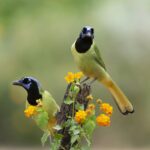
Granite cliffs and thundering waterfalls may dominate the postcards, but Yosemite National Park is just as remarkable for what moves through its forests, meadows, rivers, and mountain skies.
Yosemite supports an extraordinary variety of birdlife because the park climbs from relatively low-elevation foothills to alpine country above 13,000 feet. Along the way, oak woodland gives way to towering conifer forests, wet meadows, rushing mountain streams, granite cliffs, and high-elevation pine country. Each habitat attracts a different community of birds.
More than 260 bird species have been documented in Yosemite, while more than 165 species regularly use the park as residents, migrants, winter visitors, or breeding birds. That means a birder can watch an American Dipper disappear beneath a rushing river in the morning, hear a Mountain Quail calling from dense brush later in the day, and scan Yosemite’s immense cliffs for a Peregrine Falcon before sunset.
Some birds are common and conspicuous. Others are among the most elusive birds in the Sierra Nevada.
Here are some of the most distinctive birds to look for in Yosemite National Park—and the habitats where you have the best chance of finding them.
🦉 1. Great Gray Owl
Few Yosemite birds inspire as much excitement as the Great Gray Owl (Strix nebulosa).
Despite its enormous appearance, much of the owl’s size comes from its thick plumage. Its huge circular facial disks, piercing yellow eyes, gray-and-brown feathers, and nearly silent flight make it one of the most impressive birds in the park.
Yosemite’s Great Gray Owls are especially significant. Research has found that the Sierra Nevada population is genetically distinct from Great Gray Owls elsewhere in North America. Yosemite contains an exceptionally important portion of California’s remaining population.
Where to Look
Great Gray Owls are associated with middle-elevation forests adjoining montane meadows. Meadows provide hunting areas for rodents, while nearby forests offer nesting and roosting habitat.
Look along quiet meadow edges rather than busy developed areas. Early morning and evening are particularly promising times to watch for an owl perched on a forest-edge snag or gliding low over a meadow.
During winter, some owls move to lower elevations where snow cover does not make prey as difficult to reach.
What to Watch For
Look for:
- A very large gray owl
- Huge round facial disks
- Yellow eyes
- A small white “bow tie” beneath the face
- Slow, buoyant flight over open ground
Never approach or surround an owl for photographs. Yosemite’s Great Gray Owls are rare, and allowing them to hunt and rest without disturbance is far more important than getting closer.
🦅 2. Peregrine Falcon
Yosemite’s enormous granite walls provide nearly perfect Peregrine Falcon habitat.
The Peregrine Falcon (Falco peregrinus) is famous for its spectacular hunting dives. During a high-speed stoop, a peregrine can exceed 200 miles per hour, making it the fastest animal known.
The species also has an important history in Yosemite.
Peregrines disappeared from the park for decades during the widespread population collapse associated with DDT. They were rediscovered breeding on El Capitan in 1978, and careful conservation work helped the population recover.
Today, Yosemite remains an important breeding area for the species.
Where to Look
Yosemite Valley is one of the best places to watch the sky for peregrines.
Scan:
- El Capitan
- Other major cliff faces
- Granite ledges
- Open sky above Yosemite Valley
- Areas around Glacier Point and other large rock formations
A spotting scope can be especially helpful because the birds may be hundreds of feet above you.
During nesting season, respect all temporary climbing closures and protected nesting areas.
What to Watch For
Peregrines have:
- Long, pointed wings
- A streamlined falcon shape
- Dark markings around the face
- Fast, direct flight
Sometimes your first clue will simply be a falcon streaking across the face of a granite wall.
🌊 3. American Dipper
Not every extraordinary Yosemite bird lives in the trees.
The American Dipper (Cinclus mexicanus) is North America’s only truly aquatic songbird.
A dipper may stand on a river rock, repeatedly bobbing its body before suddenly plunging into rushing water. It can swim, dive, and even walk along submerged rocks while searching for aquatic insects and other small prey.
The gray plumage may seem understated, but few birds have more entertaining behavior.
Where to Look
Follow Yosemite’s clear, fast-moving rivers and streams.
One particularly promising habitat is the Merced River, where American Dippers have long been observed.
Look around:
- Rapids
- Riffles
- Cascades
- Streamside boulders
- Rocks projecting above swift water
Rather than constantly scanning the trees, keep your binoculars pointed toward rocks in and beside the river.
What to Watch For
The repeated dipping motion gives the bird its name.
Watch for a chunky gray bird about the size of a small thrush standing on a rock, pumping its body up and down and then vanishing beneath the water.
🌲 4. White-headed Woodpecker
Few North American woodpeckers are as instantly recognizable as the White-headed Woodpecker (Leuconotopicus albolarvatus).
The bird is almost entirely black except for its striking white head and patches of white in the wings. Males also have a small red patch toward the back of the crown.
Unlike many woodpeckers that focus heavily on drilling for insects, White-headed Woodpeckers consume large quantities of pine seeds.
Where to Look
Search mature mountain pine forests containing large ponderosa or sugar pines.
Suitable forest habitat occurs around Yosemite’s middle elevations, including areas associated with Crane Flat and similar mature conifer forests. White-headed Woodpeckers have also been documented during Yosemite bird-monitoring work in this part of the park.
Watch the trunks and especially the cones of large pines.
What to Watch For
The combination is unmistakable:
black body + white head + white wing patches.
White-headed Woodpeckers can be quieter than some other woodpeckers, so patient visual searching may work better than waiting to hear loud hammering.
🔥 5. Black-backed Woodpecker
Fire may temporarily transform a Sierra Nevada forest, but burned woodland quickly becomes habitat for an entirely different community of wildlife.
One of the most interesting beneficiaries is the Black-backed Woodpecker (Picoides arcticus).
This bird specializes in forests containing dead and fire-damaged trees, where populations of wood-boring beetles can flourish after a fire.
Its nearly black upperparts provide remarkable camouflage against charred tree trunks.
Where to Look
Search appropriate recently burned conifer forests where access is permitted and conditions are safe.
Black-backed Woodpeckers have been recorded in Yosemite, including around meadow-monitoring areas such as Hodgdon Meadow.
Because burn conditions and road access change, never enter closed fire areas simply to look for birds.
What to Watch For
Look for:
- Mostly black back and wings
- White underparts
- White facial stripe
- Yellow crown patch on adult males
Examine dead trunks carefully. A motionless Black-backed Woodpecker can practically disappear against burned bark.

🌈 6. Western Tanager
Spring and summer add one of Yosemite’s most colorful birds to the forest canopy.
Male Western Tanagers (Piranga ludoviciana) combine a fiery orange-red head with a brilliant yellow body and contrasting black wings. Females and young birds are more subdued but retain yellowish or greenish tones.
Despite that spectacular coloration, Western Tanagers can be surprisingly difficult to see when they remain high among conifer branches.
Where to Look
Search open conifer forests and forest edges, particularly from spring through summer.
They occur across a wide range of elevations and are associated with pine, fir, and other western conifer forests.
Scan the canopy rather than concentrating solely on eye-level vegetation.
What to Watch—and Listen—For
The Western Tanager’s song can resemble an American Robin’s but often sounds shorter and rougher.
Hearing one may be much easier than seeing it.
Once you locate a singing bird, carefully examine the upper branches nearby.
🏔️ 7. Clark’s Nutcracker
Climb into Yosemite’s higher country and another charismatic member of the crow family begins to appear.
The Clark’s Nutcracker (Nucifraga columbiana) is a gray, black, and white bird strongly associated with mountain conifer forests. It has an extraordinary relationship with pines, collecting and caching enormous numbers of seeds for later use.
Seeds that are forgotten can germinate, making nutcrackers important participants in the regeneration and distribution of some western pine forests.
Where to Look
Tuolumne Meadows and the surrounding high country provide excellent habitat to watch for Clark’s Nutcrackers.
Also search:
- High-elevation trailheads
- Open subalpine forests
- Scenic overlooks
- Pine-covered slopes
- Areas near treeline
They sometimes appear around campgrounds and picnic areas, but wild birds should never be fed.
What to Watch For
A Clark’s Nutcracker is roughly jay-sized and largely pale gray, with black wings and contrasting white areas visible during flight.
Its loud, harsh, grating calls often reveal its presence long before you notice the bird.
🌿 8. Mountain Quail
Seeing a Mountain Quail (Oreortyx pictus) can require considerably more patience.
These striking ground birds have gray-and-chestnut plumage and an exceptionally long, narrow head plume that seems to rise straight above the head.
The problem is that Mountain Quail often live in exactly the kind of dense vegetation that makes seeing them difficult.
Where to Look
Concentrate on:
- Dense brush
- Chaparral
- Shrubby forest openings
- Streamside vegetation
- Mountain woodland edges
- Regenerating or naturally disturbed areas
During summer, Mountain Quail can move well into Yosemite’s higher-elevation woodlands.
What to Watch For
Listen first.
A calling Mountain Quail hidden inside a wall of shrubs may be only a short distance away and still remain completely invisible.
If one crosses a trail or road opening, however, the tall head plume makes identification relatively easy.
💙 9. Steller’s Jay
Not every special Yosemite bird is difficult to find.
The Steller’s Jay (Cyanocitta stelleri) is among the park’s most familiar feathered residents and one of the great bird personalities of western forests.
Its blackish head, pointed crest, and brilliant blue body make it immediately recognizable.
The blue color itself is fascinating: the feathers do not contain blue pigment. Microscopic feather structures interact with light to produce the blue appearance.
Where to Look
Almost anywhere with conifers.
Steller’s Jays commonly appear around:
- Yosemite Valley
- Forest trails
- Campgrounds
- Picnic areas
- Mountain overlooks
- Coniferous woodland
They are often much easier to find than the park’s rarer birds.
Enjoy Them Without Feeding Them
Their intelligence quickly teaches Steller’s Jays where people eat.
Even when a jay appears to be begging, don’t provide food. Feeding wildlife can change natural behavior and encourage birds to spend too much time around developed areas.
Watching a Steller’s Jay hunt, forage, cache food, or interact with other birds provides a much more interesting glimpse into its natural life.
🦉 10. Northern Pygmy Owl
At the opposite end of the owl size spectrum from the Great Gray Owl is the tiny Northern Pygmy Owl (Glaucidium californicum).
Its small size can be deceiving. This is an active predator capable of hunting birds and mammals surprisingly large relative to its own body.
Unlike many owls, Northern Pygmy Owls frequently hunt during daylight.
Where to Look
Search conifer and mixed forests, especially places with:
- Forest openings
- Meadows
- Woodland edges
- Dead trees containing cavities
- Good populations of small birds
Sometimes the easiest way to discover a pygmy owl is to watch the behavior of other birds.
Chickadees, nuthatches, and other small birds may gather around an owl and mob it with excited alarm calls.
If a normally quiet patch of forest suddenly erupts with agitated songbirds, investigate carefully.
🌲 Best Birding Areas in Yosemite
You don’t necessarily need to chase individual species. Visiting several different habitats is often a better strategy.
Yosemite Valley
Yosemite Valley combines forest, open meadow, cliffs, and the Merced River within a relatively small area.
Watch for:
- Peregrine Falcon
- American Dipper
- Steller’s Jay
- Acorn Woodpecker
- American Robin
- Various warblers and other songbirds
Spend time watching the river as well as the cliffs and trees.
Tuolumne Meadows
High-elevation Tuolumne Meadows offers a completely different birding experience.
Depending on season and habitat, possibilities include:
- Clark’s Nutcracker
- Mountain Chickadee
- Western Tanager
- Woodpeckers
- Flycatchers
- Thrushes
- Finches
- Meadow-associated songbirds
The surrounding subalpine forests dramatically increase the variety of habitat available.
Crane Flat and Nearby Forests
The Crane Flat region combines meadow habitat with mature conifer forest.
Yosemite bird-monitoring projects have documented an impressive assortment of species in this general area, including woodpeckers, hummingbirds, songbirds, and other forest species.
Hodgdon Meadow
The meadow and surrounding forest can be rewarding for birds associated with both open areas and conifers. Yosemite bird researchers have documented species including White-headed and Black-backed Woodpeckers in the broader monitoring area.
Wawona
The combination of Wawona Meadow, forest, and the South Fork Merced River creates excellent habitat diversity.
Search meadow edges early in the morning, then explore forest and riparian habitat as the day progresses.

📅 Best Time of Year for Birding in Yosemite
There really isn’t a bad birding season in Yosemite—the cast simply changes.
Spring
Spring is one of the most exciting times.
Migrants arrive, resident birds begin nesting, and territorial songs make many otherwise inconspicuous species easier to locate.
Summer
Summer provides excellent birding in the high country once snow has melted and seasonal roads are open.
This is an especially good period for exploring Tuolumne Meadows and other high-elevation habitats.
Fall
Migration brings movement through forests and meadows as birds feed heavily before continuing south or moving to lower elevations.
Fall can also be a wonderful time to bird Yosemite with fewer peak-season crowds.
Winter
Winter birding is quieter but fascinating.
American Dippers remain active in icy rivers, mixed flocks of chickadees and nuthatches move through the trees, and some high-elevation birds shift downslope.
🔭 Tips for Finding More Yosemite Birds
A few simple habits can greatly improve your chances of seeing birds.
Go early. Bird activity is often strongest during the first few hours after sunrise.
Listen before walking. Birdsong can reveal species you would never notice visually.
Watch habitat edges. Places where meadow meets forest or forest meets water often concentrate bird activity.
Scan at different heights. One bird may be hopping on the ground while another is feeding 100 feet above it.
Spend time beside water. Rivers, streams, wet meadows, and riparian vegetation attract many species.
Bring binoculars. An 8×42 or 10×42 pair works well for most Yosemite birding.
Move slowly. Covering fewer miles can actually produce more birds.
🌿 Birding Ethics in Yosemite
Finding a rare bird is exciting, but protecting it comes first.
The National Park Service asks birdwatchers to tread lightly and quietly and specifically discourages the use of broadcast recordings to provoke birds into responding.
Never approach nests, flush birds repeatedly for photographs, or pursue an owl that is trying to move away.
Stay on established trails where required and obey all wildlife closures.
And never feed birds—even the very persuasive Steller’s Jays patrolling picnic tables.
A wild bird behaving naturally is always more rewarding to watch than one responding to human interference.

❓ Frequently Asked Questions
How many bird species live in Yosemite National Park?
More than 260 species have been documented in Yosemite when residents, migrants, wintering birds, transients, and rare visitors are included. More than 165 species regularly use the park as migrating, wintering, or breeding birds.
What is the rarest bird to look for in Yosemite?
There isn’t one simple answer, but the Great Gray Owl is among Yosemite’s most coveted sightings. California’s Sierra Nevada population is exceptionally small and genetically distinct.
Where is the best place for birdwatching in Yosemite?
Yosemite Valley is an excellent starting point because cliffs, rivers, woodland, and meadow habitats occur close together. Tuolumne Meadows is outstanding for high-elevation birds, while Crane Flat, Hodgdon Meadow, and Wawona offer productive meadow-and-forest combinations.
Can you see owls in Yosemite during the daytime?
Yes. Great Gray Owls can sometimes hunt during daylight, and Northern Pygmy Owls are notably active during the day. Seeing either remains a matter of patience and luck.
Are there Peregrine Falcons in Yosemite?
Yes. Peregrine Falcons breed in Yosemite and have an especially important conservation history in the park. The immense granite cliffs of Yosemite Valley provide nesting habitat.
What bird swims underwater in Yosemite?
The American Dipper. This remarkable gray songbird dives into fast-moving streams and rivers while searching for aquatic insects and other prey.
What is the big blue bird commonly seen in Yosemite?
It is likely a Steller’s Jay. These dark-headed, blue-bodied jays are among Yosemite’s most conspicuous resident birds.
❤️ A Park Worth Exploring One Bird at a Time
Yosemite’s birds reveal a side of the national park that can easily be overlooked.
A Peregrine Falcon streaking past El Capitan connects you to one of America’s great wildlife recovery stories. An American Dipper vanishing beneath the Merced River demonstrates just how specialized a songbird can become. A Clark’s Nutcracker carrying pine seeds through the high country illustrates the intricate relationships between birds and forests.
And somewhere along a quiet meadow edge, one of California’s rare Great Gray Owls may be waiting silently in the shadows.
You don’t need to find every species to have a memorable day of birding in Yosemite.
Slow down, listen to the forest, watch the water, scan the cliffs, and look a little more carefully into the trees.
Yosemite’s famous landscape becomes an entirely different park once you start noticing the feathers moving through it.

🔗 Related Articles
- Great Grey Owl
- Northern Pygmy Owl
- Steller’s Jays
- Pine Grosbeak
- Bird Species Guide
- Bird Identification Guide
📚 Sources
- National Park Service — Birds of Yosemite National Park
- National Park Service — Birdwatching in Yosemite National Park
- National Park Service — Great Gray Owl
- National Park Service — Special Status Bird Species in Yosemite
- National Park Service — The American Dipper
- National Park Service — Monitoring Birds in the Park: A Bird in the Hand
- Yosemite Conservancy — Meadow Visitors: Yosemite’s MAPS Stations
- Yosemite Conservancy — Songbird Science
- Cornell Lab of Ornithology — Great Gray Owl
- Cornell Lab of Ornithology — American Dipper
- Cornell Lab of Ornithology — White-headed Woodpecker
- Cornell Lab of Ornithology — Black-backed Woodpecker
- Cornell Lab of Ornithology — Clark’s Nutcracker
- Cornell Lab of Ornithology — Western Tanager
- Cornell Lab of Ornithology — Mountain Quail