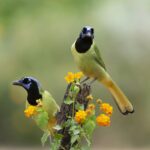
Few birds look as though nature used quite as many colors as the Gouldian Finch. With a brilliant purple breast, golden-yellow belly, green back, turquoise collar, and a head that may be black, red, or yellow, this small Australian songbird is often described as a living rainbow.
Native to the tropical savannas of northern Australia, the Gouldian Finch is far more than a beautiful bird. Its unusual color variations, social behavior, reliance on seasonal grass seeds, and specialized nesting habits make it one of Australia’s most fascinating finches.
The species has also experienced a serious historical decline. Although it is currently assessed globally as Least Concern, it remains listed as Endangered under Australia’s Environment Protection and Biodiversity Conservation Act, making its conservation an important part of protecting northern Australia’s savanna ecosystems.
🌈 Gouldian Finch at a Glance
| Feature | Details |
|---|---|
| Common Name | Gouldian Finch |
| Other Names | Rainbow Finch, Gould’s Finch, Lady Gouldian Finch |
| Scientific Name | Chloebia gouldiae |
| Older Scientific Name | Erythrura gouldiae |
| Family | Estrildidae |
| Order | Passeriformes |
| Native Range | Northern Australia |
| Length | About 12–15 cm (4.7–6 in) |
| Weight | Around 14–15 g (0.5 oz) |
| Diet | Primarily grass seeds |
| Habitat | Tropical savanna woodland and grassland |
| Nest | Tree hollows and occasionally other cavities |
| Clutch Size | Usually 4–8 eggs |
| Global Conservation Status | Least Concern |
| Australian Conservation Status | Endangered |
Size and breeding figures vary slightly among references, but adults are generally around 12–15 centimeters long and weigh only about 14–15 grams.
🔬 Scientific Classification
| Classification | Gouldian Finch |
|---|---|
| Kingdom | Animalia |
| Phylum | Chordata |
| Class | Aves |
| Order | Passeriformes |
| Family | Estrildidae |
| Genus | Chloebia |
| Species | Chloebia gouldiae |
There is an important taxonomic detail worth noting. BirdLife International currently uses Chloebia gouldiae, while many Australian government documents and other references continue to use the older name Erythrura gouldiae. Both names therefore appear frequently in literature about the species.
🎨 A Bird Painted in Almost Every Color
The Gouldian Finch’s extraordinary plumage is what first attracts most people’s attention.
Adult males typically display the most intense colors. A male may have a vivid purple breast, bright yellow abdomen, green upperparts, and turquoise-blue coloring around the neck. Females possess many of the same colors, but their plumage is generally softer and less intensely saturated.
Juveniles look dramatically different. Young Gouldian Finches are mostly gray-green or olive before developing the brilliant adult plumage that makes the species famous.
Perhaps the most remarkable feature is the head.
Wild Gouldian Finches naturally occur in three head-color forms:
- Black-headed
- Red-headed
- Yellow-headed
These are not separate species or subspecies. They are naturally occurring genetic color morphs within the same species.
Black-headed birds are the most common. Australian Geographic reports that roughly 70 percent are black-headed, around 30 percent are red-headed, and fewer than 1 percent have yellow heads.
That rare yellow-headed bird can therefore be an especially exciting sight.
🧠 Head Color May Mean More Than Appearance
The different head colors are not simply decorative.
Research has found fascinating behavioral differences among Gouldian Finch color morphs. Experimental studies have shown that red-headed birds tend to behave more aggressively than black-headed individuals, while head color may also influence social interactions and mate choice.
This makes the Gouldian Finch an especially valuable species for scientists studying the relationship between genetics, coloration, personality, and social behavior.
Its plumage is not merely beautiful—it can carry biological information.
📍 Where Do Gouldian Finches Live?
Gouldian Finches are native exclusively to northern Australia.
Historically, their range extended from the Cape York Peninsula in Queensland through northern portions of the Northern Territory and west into the Kimberley region of Western Australia.
Today, their distribution is considerably more restricted, with important populations remaining in parts of the Northern Territory and the Kimberley.
They inhabit warm tropical landscapes rather than dense rainforest.
Typical Gouldian Finch habitat includes:
- Open tropical savanna
- Eucalyptus woodland
- Grassy plains
- Areas with abundant native grasses
- Landscapes containing mature hollow-bearing trees
- Locations with reliable access to drinking water
This combination is critical because Gouldian Finches need grass seeds for food, water for drinking, and tree cavities for nesting.

🌾 What Do Gouldian Finches Eat?
Gouldian Finches are primarily granivores, meaning seeds form the foundation of their diet.
They forage for seeds from native grasses, moving between food sources as different grasses ripen throughout the year.
Native sorghum is particularly important during parts of the seasonal cycle. In the dry season, the birds may forage on fallen grass seeds, while changing rainfall patterns determine which seed-producing plants are available at other times.
This seasonal dependence helps explain why alterations to fire patterns or grazing can have such serious consequences. A landscape may still look like grassland to people while producing far fewer seeds at exactly the time the birds need them most.
Some sources also report that insects may supplement the diet during the breeding season, although seeds remain the species’ principal food.
💧 A Strong Connection to Water
Water is an especially important feature of Gouldian Finch habitat.
Northern Australia’s tropical climate creates dramatic wet and dry seasons. As the landscape dries, permanent and semi-permanent water sources become increasingly valuable.
Flocks may congregate near waterholes to drink, sometimes creating spectacular opportunities for birdwatchers to see several brightly colored birds together.
The dependence on both water and seasonally available seeds means Gouldian Finches cannot simply occupy any patch of woodland. They need a landscape containing the right resources at the right times of year.
🐦 Social Life and Flocking Behavior
Gouldian Finches are highly social birds.
Outside the breeding season they may gather into substantial flocks, sometimes mixing with other seed-eating finches. Groups move through grasslands and woodland in search of food and water.
Their social nature provides advantages. More eyes can help detect predators, while flocking allows birds to quickly exploit temporary concentrations of ripening seed.
Gouldian Finches communicate with relatively soft calls, chirps, trills, and other quiet vocalizations rather than the powerful songs associated with many larger songbirds.
💕 Courtship: Showing Off Those Colors
A male Gouldian Finch has good reason to possess spectacular plumage.
During courtship, he puts it on display.
Courtship behavior can include head bobbing, feather fluffing, body movements, beak wiping, and postures that emphasize the bright breast and head coloration.
The male may stand upright, puff out his chest, and perform animated movements in front of a potential mate.
Color also plays an important role in mate choice. Research indicates that Gouldian Finches often show preferences related to head-color morph, adding another intriguing layer to their unusual color polymorphism.
🪺 An Unusual Finch That Nests in Hollows
Many small finches construct nests among grasses, shrubs, or branches.
Gouldian Finches do something different.
They are cavity nesters, relying heavily on hollows in mature trees—especially eucalyptus trees. Several breeding pairs may even use cavities within the same tree or nesting area.
This dependence on hollows makes old trees particularly important. A young woodland may provide grasses but still lack suitable nesting sites for many years.
Pairs build nests from grasses and other plant material within these protected cavities.
🥚 Eggs and Chicks
A typical Gouldian Finch clutch contains about four to eight eggs.
Both parents participate in incubation and care of the chicks. Incubation lasts roughly two weeks, and the parents continue feeding the young after hatching.
The chicks possess one of the strangest features in the bird world.
Around the corners of their mouths are unusual pale blue or pearly nodules known as papillae.
These structures are sometimes described as glowing, but they do not actually produce light. Instead, they reflect available light, which may help adults locate the mouths of hungry chicks inside a dark nesting cavity.
It is an extraordinary adaptation to life inside a tree hollow.
🌧️ Breeding With Australia’s Seasons
Gouldian Finch reproduction is closely tied to northern Australia’s seasonal environment.
Rainfall triggers new plant growth and eventually produces abundant grass seed. Breeding activity is timed so that adults have sufficient food available while raising young.
This creates a delicate relationship between rainfall, vegetation, fire, and reproduction.
When normal seasonal cycles are disrupted, the consequences can ripple through the entire breeding population.
🔥 Why Did Gouldian Finch Numbers Decline?
Gouldian Finches were once much more widespread across northern Australia.
Their decline has been linked to several interacting pressures, including:
- Changes in natural fire regimes
- Intense or poorly timed fires
- Livestock grazing
- Habitat clearing and modification
- Loss of suitable grass-seed resources
- Reduced availability of nesting hollows
- Predation
- Historical trapping for the cage-bird trade
Australian government recovery efforts have focused particularly on habitat management and maintaining the landscape conditions necessary for feeding and breeding.
Fire is especially complicated.
Fire itself is a natural and essential part of northern Australian savannas. The problem is not simply that fires occur, but how often, how intensely, and at what time of year they burn.
Very extensive or intense late-season fires can alter grass communities and damage hollow-bearing trees, reducing both food and nesting opportunities.
🌿 Conservation Status: Why Two Different Ratings?
The Gouldian Finch presents an interesting conservation situation.
BirdLife International, the authority that conducts bird assessments for the IUCN Red List, currently evaluates the species globally as Least Concern.
Australia, however, continues to list the Gouldian Finch as Endangered under the EPBC Act.
These designations are not necessarily contradictory. Global and national conservation assessments operate at different geographic scales and may use different criteria, datasets, and review schedules.
The Australian designation reflects the dramatic decline the species experienced within its native country and the continuing importance of habitat protection and management.
🌳 Protecting Gouldian Finch Habitat
Conserving the Gouldian Finch means conserving an entire ecosystem.
Healthy populations require landscapes containing:
- Mature hollow-bearing trees
- Diverse native grasses
- Productive wet-season feeding areas
- Reliable dry-season food
- Accessible water
- Appropriate fire patterns
- Limited habitat degradation
Protecting these resources benefits many other animals living within northern Australia’s tropical savannas.
Conservation is therefore not simply about saving one colorful bird. It is about preserving the ecological processes that allow an entire landscape to function.
👩🎨 Why Is It Called the Gouldian Finch?
The species is associated with nineteenth-century British ornithologist John Gould, who formally described the bird in 1844.
He named it in honor of his wife, Elizabeth Gould, an accomplished artist who created and prepared illustrations for many of the ornithological works produced by the Goulds.
This history also explains the traditional name Lady Gouldian Finch.
While John Gould’s name became famous in ornithology, Elizabeth’s artistic contributions were substantial, making the bird’s name an enduring connection to both natural history and wildlife illustration.
🌈 Gouldian Finch vs. Other Finches
Despite being commonly called a finch, the Gouldian Finch is not closely related to familiar North American birds such as the American Goldfinch or House Finch.
The Gouldian belongs to the family Estrildidae, a group often known as estrildid finches or waxbills.
The American Goldfinch and many other familiar Northern Hemisphere finches belong to the separate family Fringillidae.
Their similar seed-eating lifestyles and compact bodies are therefore somewhat misleading. The name “finch” is used for several groups of small seed-eating songbirds that are not all each other’s closest relatives.

✨ Fascinating Gouldian Finch Facts
- Gouldian Finches naturally occur with black, red, or yellow heads.
- Yellow-headed birds are exceptionally rare in wild populations.
- Males are usually more vividly colored than females.
- Juveniles are mostly muted green and gray rather than rainbow-colored.
- They are native only to Australia.
- Their primary diet consists of grass seeds.
- Unlike many finches, they normally nest inside tree cavities.
- Both parents participate in raising the chicks.
- Their chicks have unusual light-reflecting structures around their mouths.
- Gouldian Finches can gather in large social flocks outside the breeding season.
- Head color is associated with measurable differences in behavior.
- The species is globally assessed as Least Concern but remains nationally listed as Endangered in Australia.
🔭 Seeing Gouldian Finches in the Wild
For birdwatchers, encountering wild Gouldian Finches can be an unforgettable experience.
Northern Australia offers the best opportunities, particularly portions of the Northern Territory and the Kimberley where populations remain.
Because the birds regularly need water, waterholes surrounded by suitable savanna habitat can be productive locations. Early mornings may provide particularly good viewing opportunities as birds travel between roosting, drinking, and feeding areas.
Observers should maintain a respectful distance, especially near waterholes and nesting areas. In harsh dry-season conditions, birds already expend considerable energy reaching essential resources and should not be disturbed unnecessarily.
❓ Frequently Asked Questions
Why are Gouldian Finches so colorful?
Their coloration results from pigments and structural properties of their feathers. Plumage is important in social signaling and courtship, and the species’ genetically controlled head-color morphs are also associated with differences in behavior.
Are Gouldian Finches rare?
They suffered a major historical decline and remain patchily distributed in northern Australia. Australia lists the species as Endangered, although BirdLife International currently assesses its global status as Least Concern.
Where are Gouldian Finches found?
They are native to northern Australia, with important remaining populations in the Northern Territory and Kimberley region of Western Australia.
What do Gouldian Finches eat?
They primarily eat seeds from native grasses. Their diet changes seasonally depending on which grasses are producing seed.
Are there really different colored Gouldian Finches in the wild?
Yes. Black-, red-, and yellow-headed Gouldian Finches occur naturally. Black is the most common head color, while yellow is extremely rare.
Are male and female Gouldian Finches different?
Both sexes can be beautifully colored, but males generally display richer, more saturated plumage. Females tend to have softer coloration.
Do Gouldian Finches migrate?
They are better described as locally nomadic rather than classic long-distance migrants. Flocks may move through the landscape as water and seed availability change.
Where do Gouldian Finches build their nests?
They usually nest inside tree hollows, particularly cavities in eucalyptus trees.
How many eggs do Gouldian Finches lay?
A typical clutch contains around four to eight eggs.
Is the Gouldian Finch endangered?
In Australia, yes—the species is listed as Endangered under the EPBC Act. At the global level, BirdLife International currently assesses it as Least Concern.
🌏 A Living Rainbow Worth Protecting
The Gouldian Finch may be famous for its beauty, but its story reaches far beyond colorful feathers.
Its life is tied to the rhythms of Australia’s tropical savannas: seasonal rainfall, ripening grasses, old eucalyptus trees, fire, and water. Remove too many pieces from that system and even one of the world’s most spectacular birds can disappear from landscapes where it was once common.
Protecting the Gouldian Finch therefore means protecting something much larger—the intricate ecological community of northern Australia.
And perhaps that is what makes this tiny bird especially remarkable. At barely more than a dozen centimeters long, the Gouldian Finch manages to embody an entire landscape in its colors: green woodland, golden grass, blue sky, blazing red, and the deep purple of an Australian twilight.
It truly is one of the jewels of Australian avifauna.
🔗 Related Articles
- Evening Grosbeak
- Mountain Bluebird: A Bright Symbol of Open Skies in the West
- African Grey Parrot: Intelligence, Habitat, Behavior & Conservation
- Birds With Red Chests: Identification Guide
📚 Sources
- Australian Government Department of Climate Change, Energy, the Environment and Water — National Recovery Plan for the Gouldian Finch
- BirdLife International — Gouldian Finch Species Factsheet
- Australian Geographic — Gouldian Finch Fact File
- San Diego Zoo Wildlife Alliance — Gouldian Finch
- Proceedings of the Royal Society B — Red Dominates Black: Agonistic Signalling Among Head Morphs in the Colour-Polymorphic Gouldian Finch
- Proceedings of the Royal Society B — A Non-Coding Region Near Follistatin Controls Head Colour Polymorphism in the Gouldian Finch