Kauaʻi is home to some of the most extraordinary birds in the Hawaiian Islands. From tiny honeycreepers living in misty mountain forests to albatrosses gliding above dramatic sea cliffs, the island supports birdlife shaped by millions of years of isolation.
Some birds found on Kauaʻi occur throughout Hawaiʻi. Others are endemic to Kauaʻi, meaning they naturally occur nowhere else on Earth. The island is also an important refuge for native waterbirds, nesting seabirds, migratory shorebirds, and a large assortment of introduced species.
For birdwatchers, this creates an unusual combination. A morning in the mountains might bring the flash of a native honeycreeper among flowering ʻōhiʻa trees, while an afternoon on the coast could include frigatebirds, boobies, tropicbirds, or a Laysan albatross soaring over the Pacific.
Unfortunately, Kauaʻi is also a place where the conservation crisis facing Hawaiian birds is especially visible. Several of its endemic forest species have disappeared, while others survive in extraordinarily small populations.
Here is a closer look at the birds of Kauai, the species that make the island special, and some of the best places to go birdwatching.
🐦 Why Is Kauai So Special for Birds?
The Hawaiian Islands are among the most isolated island groups on Earth. Birds that reached the islands naturally became separated from their ancestral populations for thousands or millions of years.
Over time, some evolved into entirely new species.
Kauaʻi is the oldest of the main Hawaiian Islands, and its long isolation helped produce a remarkable assortment of endemic birds. Its habitats range from coastal cliffs and beaches to wetlands, valleys, rainforests, and the cool, extremely wet forests of the Alakaʻi Plateau.
Each environment supports a different bird community.
Unfortunately, isolation also made Hawaii’s native birds particularly vulnerable to threats that arrived with people, including introduced predators, habitat destruction and mosquito-borne diseases.
Today, some of the best remaining habitat for Kauaʻi’s forest birds occurs in the high-elevation forests of the island’s interior.
🌺 Endemic Birds of Kauai
Several living bird species are found naturally only on Kauaʻi.
These are among the island’s most remarkable birds.
| Bird | Scientific Name | What Makes It Special |
|---|---|---|
| Kauaʻi ʻAmakihi | Chlorodrepanis stejnegeri | Yellow-green honeycreeper found only on Kauaʻi |
| ʻAnianiau | Magumma parva | Tiny yellow honeycreeper endemic to Kauaʻi |
| Kauaʻi ʻElepaio | Chasiempis sclateri | Small native flycatcher found only on the island |
| ʻAkekeʻe | Loxops caeruleirostris | Rare honeycreeper of high-elevation native forest |
| ʻAkikiki | Oreomystis bairdi | Critically rare Kauaʻi honeycreeper now nearly extinct in the wild |
| Puaiohi | Myadestes palmeri | Rare native thrush of remote Alakaʻi ravines |
Spotting one of the commoner endemic species can be a highlight of a Kauaʻi birding trip. The rarest species, however, should never be treated as birds a visitor can expect to see. Some survive in extremely small populations in remote and difficult terrain.
Kauaʻi ʻAmakihi
The Kauaʻi ʻamakihi is a yellow-green Hawaiian honeycreeper found only on Kauaʻi.
Its slightly curved bill helps it forage for nectar and insects among native vegetation. Although it remains easier to encounter than some of Kauaʻi’s critically endangered forest birds, it has also experienced pressures from disease and changing habitat.
Look for ʻamakihi in higher-elevation native forests, particularly around Kōkeʻe and the Alakaʻi region.
ʻAnianiau
The bright yellow ʻanianiau is the smallest living Hawaiian honeycreeper.
Males are especially vivid yellow, while females tend to be somewhat duller. The species feeds on nectar as well as insects and other small arthropods and is closely associated with native forest.
It occurs nowhere outside Kauaʻi.
Kauaʻi ʻElepaio
The Kauaʻi ʻelepaio is part of a uniquely Hawaiian group of monarch flycatchers.
Brownish above and lighter below, the bird does not have the spectacular colors associated with many Hawaiian honeycreepers. Its personality can make up for its subdued plumage, however, as ʻelepaio are active forest birds that forage among branches for insects.
Kauaʻi has its own distinct ʻelepaio species.
ʻAkekeʻe
The ʻakekeʻe is another honeycreeper restricted to Kauaʻi.
Its unusual crossed bill tips are an adaptation for opening buds and searching for insects. Once much more widespread, the species is now concentrated primarily in high-elevation native forest.
Declining numbers have made the ʻakekeʻe an important focus of conservation programs.
ʻAkikiki
The ʻakikiki, sometimes called the Kauaʻi creeper, is one of the rarest birds on Earth.
Unlike brightly colored honeycreepers, the ʻakikiki is mostly gray to olive above and whitish below. It searches trunks, branches, bark, lichens, and moss for insects and spiders.
The species once occurred much more widely across Kauaʻi.
Today its situation is dire. Recent conservation reports describe only a handful of individuals remaining in the wild, while captive breeding provides an important safeguard against complete extinction.
A visitor should therefore never expect an ʻakikiki sighting. Protecting the species and its habitat is far more important than attempting to locate one.
Puaiohi
The puaiohi, or small Kauaʻi thrush, survives in remote wet forests and steep ravines of the Alakaʻi region.
Its gray-brown appearance may seem understated compared with a brilliant honeycreeper, but the species is enormously important from a conservation perspective.
Puaiohi depend heavily on intact native forest, where they feed on fruit and invertebrates. Their restricted distribution makes them especially vulnerable to habitat degradation, introduced predators and other environmental changes.
❤️ ʻIʻiwi and ʻApapane
Not every spectacular native forest bird on Kauaʻi is endemic specifically to the island.
Two especially important examples are the ʻiʻiwi and ʻapapane, both members of Hawaii’s famous honeycreeper radiation.
ʻIʻiwi
The ʻiʻiwi is instantly recognizable when seen well.
Adults are predominantly brilliant scarlet with black wings and tail, while a long, curved salmon-colored bill gives the bird an unmistakable profile.
The ʻiʻiwi is a Hawaiian honeycreeper—not a parrot.
Its curved bill is adapted for feeding from flowers, although ʻiʻiwi also eat insects. The species was once widespread across the Hawaiian Islands but has disappeared or declined dramatically in many areas.
Kauaʻi still supports ʻiʻiwi, particularly in higher-elevation native forest, although the species faces continuing pressure from avian malaria.
ʻApapane
Another splash of red in Kauaʻi’s forest canopy may belong to the ʻapapane.
This Hawaiian honeycreeper is crimson with contrasting darker wings and tail. It is strongly associated with flowering ʻōhiʻa trees and can travel considerable distances in search of nectar.
Of Hawaii’s native forest birds, ʻapapane remain relatively widespread, making them one of the more realistic native honeycreepers for birdwatchers to encounter.
🪿 Nēnē: Hawaii’s State Bird
The nēnē, or Hawaiian goose, is Hawaii’s state bird and one of the archipelago’s great conservation success stories.
Nēnē are related to Canada geese but have evolved distinctive adaptations to life in Hawaii. They have buff-colored cheeks, dark heads and striking furrowed feathers along the neck.
Once reduced to an extremely small population, the species has benefited from decades of captive breeding, reintroduction and habitat protection.
Kauaʻi now supports an important population.
Visitors may encounter nēnē around wildlife refuges, parks and other open areas. Never feed them, even if an individual approaches people looking for food.

💧 Native Waterbirds of Kauai
Kauaʻi’s wetlands support another fascinating group of native birds.
Hawaiian Duck
The koloa maoli, or Hawaiian duck, is an endemic Hawaiian duck with mottled brown plumage.
Kauaʻi is particularly important for the species because the island supports valuable wetland habitat. Hybridization with introduced mallards has complicated conservation of Hawaiian ducks elsewhere in the islands.
Hawaiian Stilt
Few wetland birds are more distinctive than the aeʻo, or Hawaiian stilt.
Its remarkably long pink legs contrast with a black-and-white body and long, thin bill. The bird wades through shallow wetlands searching for aquatic invertebrates and other small prey.
Hawaiian Coot
The ʻalae keʻokeʻo, or Hawaiian coot, is a dark waterbird with a prominent pale frontal shield.
It occurs in freshwater wetlands, ponds and marshy areas where it feeds, rests and nests among aquatic vegetation.
Hawaiian Gallinule
The ʻalae ʻula, or Hawaiian gallinule, is another native wetland bird.
Its dark body, bright red frontal shield and yellow-tipped bill make adults distinctive when seen clearly.
Hanalei and other protected wetlands on Kauaʻi provide essential habitat for these birds.
🌊 Seabirds of Kauai
Kauaʻi’s towering cliffs and position in the central Pacific make it an exceptional island for seabirds.
One of the best places to experience them is Kīlauea Point National Wildlife Refuge on the island’s north shore.
Laysan Albatross
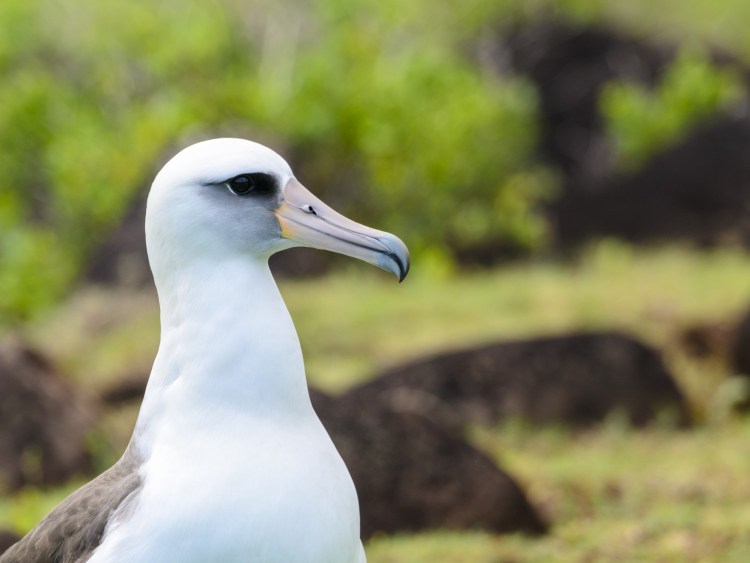
The Laysan albatross, known in Hawaiian as mōlī, is among the most memorable birds a visitor may see on Kauaʻi.
Albatrosses spend much of their lives over the open ocean, using their long wings to glide tremendous distances with remarkably little effort.
They return to land to breed.
Seeing an albatross soaring past the cliffs of Kauaʻi offers an entirely different birdwatching experience from searching for honeycreepers in the island’s forests.
Red-Footed Booby
The red-footed booby is another signature bird of Kīlauea Point.
Adults have brightly colored feet and are superb aerial hunters, flying over tropical waters in search of fish and squid.
Large numbers nest in the refuge.
Great Frigatebird
The great frigatebird, or ʻiwa, can often be recognized by its enormous wings, deeply forked tail and effortless soaring flight.
Frigatebirds are masters of the air and can remain aloft for long periods while searching for food over the ocean.
Tropicbirds
Elegant white-tailed and red-tailed tropicbirds may also be encountered around Hawaii.
Their predominantly white plumage and extremely long central tail feathers make adult tropicbirds among the most graceful seabirds in the Pacific.
🏖️ Migratory Shorebirds
Kauaʻi also receives visitors from thousands of miles away.
One of the most familiar is the Pacific golden-plover, known in Hawaii as the kōlea.
These remarkable shorebirds breed in Alaska and migrate across the Pacific to spend the nonbreeding season on tropical islands, including Hawaii.
Visitors may find them in surprisingly varied places, from wetlands and beaches to lawns and other open areas.
Other migrants can include ruddy turnstones, wandering tattlers, sanderlings, northern pintails and additional waterbirds and shorebirds.
Migration means Kauaʻi’s bird community changes during the year, giving repeat visitors something new to look for.
🐓 What About Kauai’s Chickens?
One bird is almost impossible to miss.
Kauaʻi is famous for its free-roaming chickens.
Red junglefowl were originally brought to the Hawaiian Islands by Polynesian voyagers, while later settlers introduced domestic chicken breeds. Modern feral chickens on Kauaʻi reflect that complicated history.
Today, roosters and hens can be seen virtually everywhere—from roadsides and beaches to parking lots, neighborhoods and parks.
They may be the island’s most conspicuous birds, but they shouldn’t be confused with the extraordinary native species that evolved in Hawaii long before most introduced birds arrived.
🌎 Introduced Birds You May See

Kauaʻi is now home to numerous non-native bird species.
Some are considerably easier to encounter than native forest birds.
Common introduced birds may include:
- Red-crested cardinal
- Northern cardinal
- Common myna
- Zebra dove
- Spotted dove
- Warbling white-eye, also widely called Japanese white-eye or mejiro
- White-rumped shama
- House finch
- Scaly-breasted munia
- Feral chickens
Some introduced species have become familiar parts of Hawaii’s modern landscape, but introduced animals can also affect native ecosystems through competition, predation or habitat changes.
For bird identification, it is therefore useful to know whether the bird you’re watching is endemic, indigenous, migratory or introduced.
🔍 Endemic vs. Native vs. Introduced
These terms can be confusing when discussing Hawaiian birds.
Endemic means the species naturally occurs nowhere else in the world.
A Kauaʻi endemic, such as the ʻanianiau, occurs naturally only on Kauaʻi.
A Hawaiian endemic, such as the nēnē, is restricted to the Hawaiian Islands but isn’t necessarily restricted to a single island.
Indigenous species reached Hawaii naturally but also occur elsewhere.
Introduced species were brought to the islands directly or indirectly by people.
Kauaʻi contains birds from all four categories, which is part of what makes identifying them so interesting.
📍 Best Birdwatching Spots on Kauai
Different parts of Kauaʻi offer very different birding experiences.
1. Kīlauea Point National Wildlife Refuge

Best for: Seabirds, nēnē and spectacular coastal birdwatching
Kīlauea Point is one of Hawaii’s premier places for viewing seabirds from land.
Potential sightings include:
- Laysan albatross
- Red-footed booby
- Great frigatebird
- Brown booby
- Tropicbirds
- Nēnē
The refuge occupies dramatic ocean cliffs surrounding the historic Daniel K. Inouye Kīlauea Point Lighthouse.
Entry procedures can change, and reservations may be required, so check the refuge’s official visitor information before going.

2. Kōkeʻe State Park
Best for: Native forest birds
High above the western side of Kauaʻi, Kōkeʻe State Park protects native forest habitat and provides access to some of the island’s best-known forest birding areas.
Possible native birds include:
- ʻApapane
- Kauaʻi ʻamakihi
- ʻAnianiau
- Kauaʻi ʻelepaio
- ʻIʻiwi
Some much rarer species inhabit the broader region but should not be expected during an ordinary visit.
Kōkeʻe’s elevation also means conditions can differ dramatically from the sunny coast. Rain, clouds, cool temperatures and mud are common.
3. Pihea Trail and Alakaʻi Swamp Trail
Best for: Serious forest birding and native rainforest
The Pihea Trail and Alakaʻi Swamp Trail lead into one of Kauaʻi’s most important remaining native forest landscapes.
This is prime habitat for Hawaiian forest birds, but it is not casual roadside birding.
Trails can be extremely wet, slippery and muddy. Fog and rain may arrive quickly, and portions of the Alakaʻi are remote.
For birders prepared for the conditions, however, walking quietly through the native forest can be one of the most memorable wildlife experiences on Kauaʻi.
4. Hanalei National Wildlife Refuge Viewpoint
Best for: Native waterbirds
The wetlands of Hanalei Valley are particularly important for native Hawaiian waterbirds.
Possible species include:
- Hawaiian duck
- Hawaiian stilt
- Hawaiian coot
- Hawaiian gallinule
- Nēnē
- Black-crowned night heron
- Migratory shorebirds and waterfowl
The refuge itself is primarily managed as protected wildlife habitat and is not generally open for visitors to wander through.
Instead, birdwatchers can use the Hanalei National Wildlife Refuge Viewpoint, which offers an excellent way to observe the valley while minimizing disturbance to sensitive wildlife.
5. Kawaiʻele State Waterbird Sanctuary
Best for: Wetland birds
On western Kauaʻi, Kawaiʻele provides protected wetland habitat for native waterbirds.
Hawaiian stilts, Hawaiian coots, Hawaiian gallinules, black-crowned night herons and visiting nēnē are among the birds associated with the sanctuary.
It offers a completely different birding environment from the high forests of Kōkeʻe.
🌤️ When Is the Best Time for Birdwatching on Kauai?
Birdwatching is possible on Kauaʻi throughout the year, but what you see changes with season, location and weather.
For forest birds, early morning is often an excellent time. Birds tend to be active, conditions may be calmer, and clouds have sometimes not yet obscured the higher elevations.
Coastal seabird activity varies by species and breeding season.
Winter also brings migratory birds from northern breeding grounds, including Pacific golden-plovers and other shorebirds.
Rather than choosing a single “best” month, consider what type of bird you most want to see.
🦟 Why Are Kauai’s Forest Birds Disappearing?
The decline of Kauaʻi’s native forest birds is one of the most urgent bird conservation stories in the United States.
There is no single cause.
Major threats include:
- Avian malaria
- Introduced mosquitoes
- Habitat loss and degradation
- Rats
- Feral cats
- Invasive plants
- Competition from introduced species
- Climate change
- Severe storms and other natural disturbances
Avian malaria is particularly serious.
Hawaiian honeycreepers evolved without the disease and many species have little natural resistance to it. Mosquitoes transmit the parasite between birds.
Historically, cool high-elevation forests provided some protection because temperatures were less favorable for mosquitoes. As environmental conditions have changed, mosquitoes and malaria have increasingly reached areas that once served as refuges for native birds.
Conservationists are now working on habitat restoration, predator control, mosquito management, monitoring and captive breeding in an effort to prevent additional extinctions.
🕯️ Birds Kauai Has Already Lost
Understanding Kauaʻi’s living birds also means remembering those that have disappeared.
The most famous is probably the Kauaʻi ʻōʻō.
Once found only on Kauaʻi, the species suffered from habitat loss, introduced predators, disease and other pressures. The last widely accepted recordings of a Kauaʻi ʻōʻō were made in the 1980s.
The species is now considered extinct.
Several other unique Kauaʻi forest birds have disappeared as well.
Their loss makes protecting the island’s surviving endemic species even more important.
👀 How to Birdwatch Responsibly on Kauai
Many Hawaiian birds are endangered, and some survive only because enormous conservation efforts protect their remaining habitat.
A few simple practices can make birdwatching safer for them:
- Watch birds from a respectful distance.
- Use binoculars or a telephoto lens instead of approaching wildlife.
- Never feed wild birds.
- Stay on established trails.
- Never approach nests or young birds.
- Keep noise to a minimum around sensitive habitat.
- Do not use recordings to repeatedly lure rare birds closer.
- Follow refuge, park and trail rules.
- Never enter closed conservation areas.
- Clean hiking footwear and equipment when requested to reduce the spread of invasive organisms.
A rare bird doesn’t need to come closer for an encounter to be special.
💡 Tips for Finding Birds on Kauai
Kauaʻi birding becomes easier when you concentrate on habitat rather than simply searching for individual species.
In the mountains, look for flowering native trees and listen for calls before trying to locate movement among the leaves.
At wetlands, scan muddy edges, shallow water and patches of vegetation.
At Kīlauea Point, look both at the cliffs and high over the ocean. A distant soaring bird may turn out to be the highlight of the day.
A pair of 8x or 10x binoculars is helpful for most situations.
And be patient.
Hawaii’s rarest forest birds are not zoo exhibits. Even experienced birders may spend hours in excellent habitat without seeing a particular species.

❓ Frequently Asked Questions
What birds are unique to Kauai?
Living birds found naturally only on Kauaʻi include the Kauaʻi ʻamakihi, ʻanianiau, Kauaʻi ʻelepaio, ʻakekeʻe, ʻakikiki and puaiohi.
What is the most famous bird on Kauai?
There isn’t a single answer. The nēnē is Hawaii’s state bird and is commonly associated with the island, while the Laysan albatross is a favorite at Kīlauea Point. Among conservationists, extremely rare forest birds such as the ʻakikiki have become symbols of the urgent effort to prevent further Hawaiian bird extinctions.
Are there parrots on Kauai?
Introduced parrots and parakeets occur in Hawaii, but the brilliant red ʻiʻiwi is not a parrot. It is a Hawaiian honeycreeper.
Are there albatrosses on Kauai?
Yes. Laysan albatrosses breed on Kauaʻi, and Kīlauea Point National Wildlife Refuge is one of the best-known public locations for watching seabirds on the island.
Where is the best place to see native forest birds on Kauai?
Kōkeʻe State Park and trails leading toward the Alakaʻi region offer some of the best accessible opportunities. The Pihea and Alakaʻi Swamp trails are particularly well known for native forest birding, although conditions can be muddy and difficult.
Can you visit Hanalei National Wildlife Refuge?
The refuge’s sensitive wetland habitat is largely closed to general public access. The Hanalei National Wildlife Refuge Viewpoint provides visitors with a designated place to observe the refuge and learn about its native waterbirds.
Can I see an ʻakikiki on Kauai?
An ʻakikiki sighting should not be expected. The species is nearly extinct in the wild, and the few remaining birds inhabit remote protected forest. Conservation of the species takes priority over recreational sightings.
What are the most common birds tourists see on Kauai?
Visitors commonly notice feral chickens, common mynas, zebra doves, red-crested cardinals, white-rumped shamas and warbling white-eyes. Native birds become more likely when visiting appropriate wetland, coastal or high-elevation forest habitat.
🌿 A Remarkable Island for Birds
Kauaʻi’s birds tell two stories at once.
One is a story of evolution.
Isolation allowed birds arriving on the Hawaiian Islands to diversify into species found nowhere else on Earth. Honeycreepers developed specialized bills, forest birds occupied ecological niches unique to the islands, and seabirds established colonies along remote Pacific cliffs.
The second story is about survival.
Introduced predators, habitat changes, mosquitoes and disease have pushed many Hawaiian birds toward extinction. Some have already disappeared. Others survive only because biologists and conservation organizations are working intensely to protect them.
That makes birdwatching on Kauaʻi about more than adding species to a checklist.
Whether you’re watching an ʻapapane feeding among ʻōhiʻa blossoms, a Hawaiian stilt walking across a wetland, a nēnē beside a grassy clearing or an albatross sailing above the ocean, you’re seeing the survivors of one of the world’s most remarkable—and most vulnerable—bird communities.
Treat them well, give them space, and Kauaʻi may reward you with bird encounters you’ll remember long after leaving the island.
🔗 Related Articles
📚 Sources
- Hawaiʻi Division of Forestry and Wildlife — Native Birds of Hawaiʻi
- Hawaiʻi Division of Forestry and Wildlife — Learn About Kauaʻi
- Kauaʻi Forest Bird Recovery Project
- U.S. Fish & Wildlife Service — Kīlauea Point National Wildlife Refuge
- U.S. Fish & Wildlife Service — Hanalei National Wildlife Refuge
- Hawaiʻi State Parks — Kōkeʻe State Park
- Hawaiʻi State Parks — Alakaʻi Swamp Trail
- Hawaiʻi Birding Trails — Kauaʻi Bog to Beach Trail
- Hawaiʻi DLNR — Mosquito Control Efforts in the Alakaʻi Wilderness